
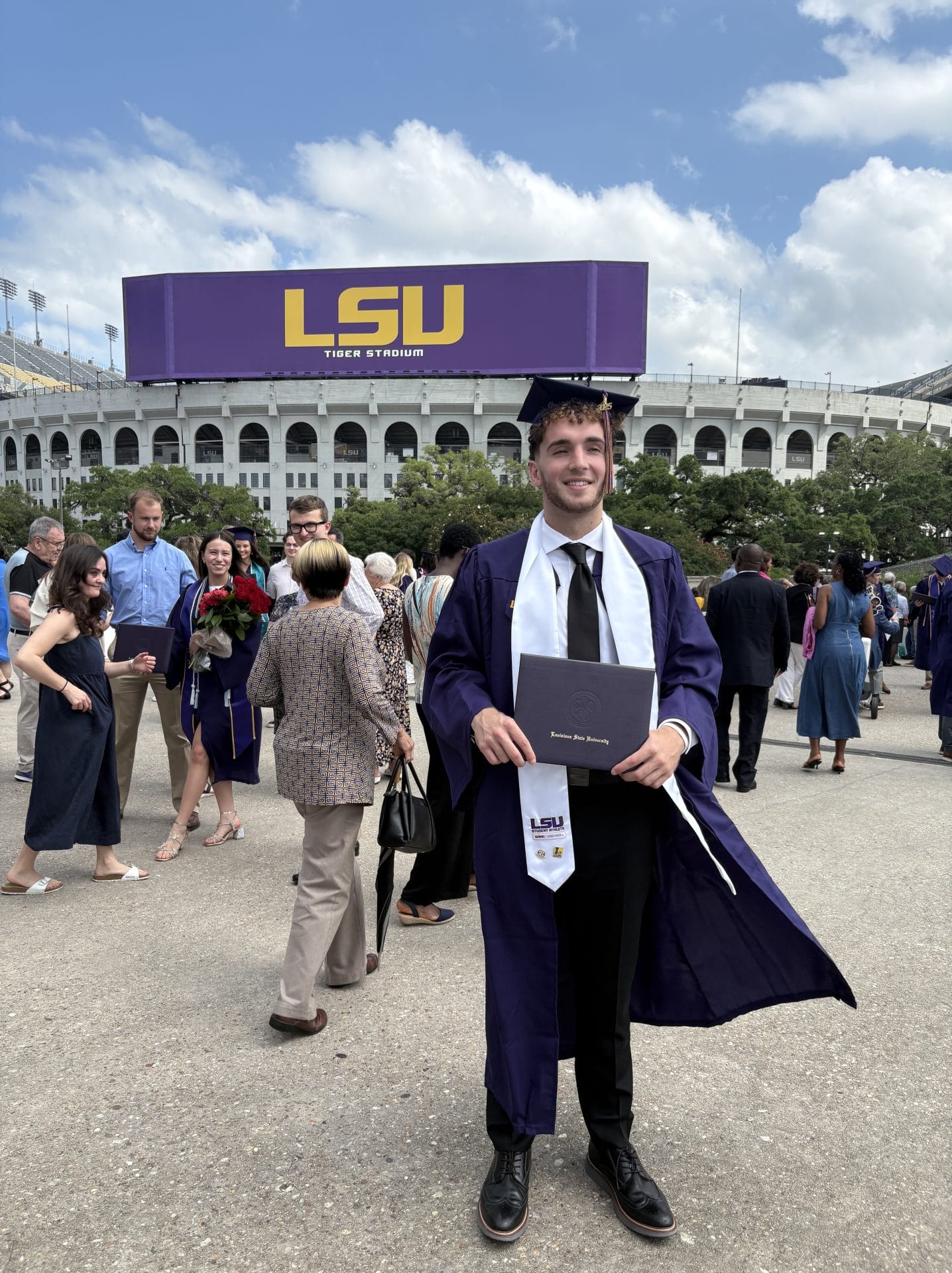
Adam Benhayoune grew up in San Antonio, Texas, where basketball quickly became more than just a game. In high school at Sandra Day O’Connor, he was a 4 year varsity starter, Prom King, voted Most Athletic, and a member of the National Honor Society. But what really defined him was his long-standing commitment to serving others. Starting in middle school, he volunteered in classrooms for students with special needs and worked with the Special Olympics—something he continued through college and beyond.
In 2021, Adam earned a walk-on spot with the LSU men’s basketball team. Competing in the SEC without a scholarship meant putting in the same effort with none of the spotlight. Over four years, he became known as a quiet leader who showed up early, stayed late, and pushed teammates to be their best. He earned SEC Honor Roll recognition each year and participated in many outreach events through LSU Athletics.
Adam graduated in 2025 with a degree in Management and a specialization in Human Resources. Now, he’s focused on coaching at the college level. He believes in building players from the inside out—helping them grow in discipline, character, and confidence. He still volunteers with inclusive sports programs and stays rooted in the values that shaped him early on. For Adam, leadership means being dependable, consistent, and present. That’s how he shows up, whether on the court, in the locker room, or in the community.
What is your typical day, and how do you make it productive?
Most days start with movement. I’ll get up early and stretch—sometimes it’s light cardio, sometimes it’s shooting form shots in my backyard. That clears my head. I set three priorities each morning: one related to coaching development, one to learning something new, and one that’s relational- or service-focused.
How do you bring ideas to life?
I write everything down, even if it feels small. I like visualizing things—play designs, practice drills, player development plans. I’ll test things during volunteer coaching or run them past coaches I know.
What’s one trend that excites you?
NIL deals are changing college sports. For me, it’s exciting because it forces athletes to think about who they are outside of the game. Branding, responsibility, decision-making—it’s a crash course in real life. It also challenges coaches to connect with athletes beyond a pay check.
What is one habit that helps you be productive?
I reflect every night. Just 10 minutes. What worked, what didn’t, what I could do better tomorrow. It helps me stay grounded and honest with myself.
What advice would you give your younger self?
Don’t worry about being noticed. Focus on being dependable. The right people will notice when the time is right.
Tell us something you believe almost nobody agrees with you on?
I think the bench is the best classroom in sports. You learn to watch, to listen, and to lead quietly. It teaches you patience and humility.
What is the one thing you repeatedly do and recommend everyone else do?
Volunteer. Especially with people outside your usual environment. It teaches perspective, patience, and gratitude.
When you feel overwhelmed or unfocused, what do you do?
I shoot the basketball. No distractions—just the ball, the rim, and my thoughts. That rhythm brings me back to center.
What is one strategy that has helped you grow your business or advance in your career?
Leading without a title. As a walk-on, I had no authority. But I earned trust through effort—being consistent, staying ready, encouraging others. It taught me that respect is built through consistency, not control.
What is one failure in your career, how did you overcome it, and what lessons did you take away from it?
One failure in my career came my senior year of high school when we lost to Westlake right before reaching the state tournament. We were leading most of the game, and it was excruciating knowing that would be my last high school game. I overcame it by using the loss as motivation, committing myself to improve and prepare for every opportunity I’d get in college. The biggest lesson I took away was the importance of finishing strong, staying locked in until the very end, and using setbacks as fuel for growth.
What is one business idea you’re willing to give away to our readers?
Nowadays, everyone is given a business at birth. Who you are, what you do, and how you present it on social media, done strategically enough, can be a business that booms. No matter what profession you decide, using social media to display your work, your skills, your humor, or whatever traits your work requires excellence in, can be a permanent everlasting business.
What is one piece of software that helps you be productive? How do you use it?
I use Excel to store drills, keep stats, and record progress. I use CapCut to edit all of my videos
Do you have a favorite book or podcast you’ve gotten a ton of value from and why?
One book on life that I really valued is The Seven Habits of Highly Effective People by Stephen R. Covey. Reading it taught me the power of being intentional with my actions and focusing on what I can control. It showed me the importance of setting clear priorities, building strong relationships, and continually working on self-improvement. The biggest takeaway for me was that lasting success starts with discipline and personal responsibility.
What’s a movie or series you recently enjoyed and why?
The Playbook on Netflix. Each episode is a different coach sharing their rules for life. The Doc Rivers and Dawn Staley episodes really stood out to me.
Key learnings
- Consistency is often more powerful than charisma in leadership.
- Daily reflection improves clarity, growth, and performance.
- Serving others provides purpose beyond personal goals.
- The bench can be just as valuable for learning as the spotlight.
- Leading without a title builds trust and long-term respect.