
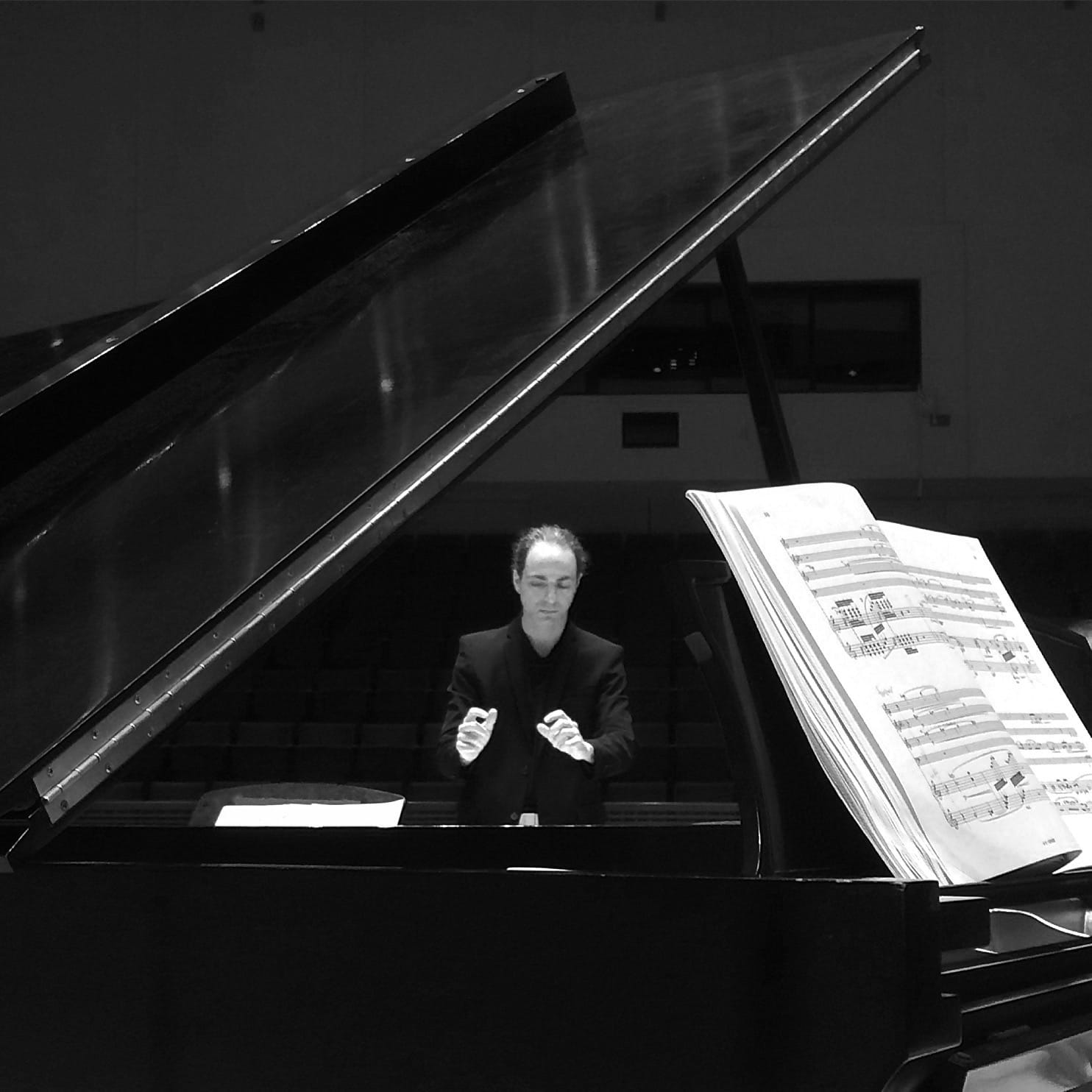
Peyman Farzinpour is a conductor, composer, multimedia producer, and arts entrepreneur whose career has been shaped by curiosity and creative risk. His work moves easily between classical tradition and new ideas, often blending music with multimedia, visual art, and performance.
Farzinpour’s journey began with a strong academic and artistic foundation. He attended the Windward School before pursuing studies at Johns Hopkins University and the Peabody Conservatory of Music, where he balanced English Literature with guitar and composition. He later earned a master’s degree in music composition and conducting from UC Davis, followed by a doctorate in orchestral conducting from the Civica Scuola di Musica Claudio Abbado in Milan, Italy.
His professional career started with the Los Angeles Philharmonic and expanded at the Los Angeles County Museum of Art, where he served as Director of New Music. There, he created innovative concert programs that earned national recognition for adventurous contemporary music programming.
Over the years, Farzinpour has led orchestras and ensembles across the United States, Canada, and Europe. He has served as Music Director and Conductor of Erato Philharmonia, the Rivers Symphony Orchestra, and the Waltham Philharmonic Orchestra, and as Conductor-in-Residence with Opera Cabal in New York City. He is currently the Executive and Artistic Director of ENSEMBLE / PARALLAX and Sinfonietta Notturna, as well as Director of Farzinpour Creative Music & Multimedia Ventures.
As a composer and educator, he has shared his work and knowledge at major institutions, including Berklee College of Music and UMass Dartmouth. His music has been performed internationally, and his career continues to reflect a deep belief in collaboration, exploration, and bringing bold ideas to life.
What is your typical day, and how do you make it productive?
My days are structured but flexible. I usually start early with quiet time before emails. That’s when I study scores, sketch compositional ideas, or outline projects for ENSEMBLE / PARALLAX. Mornings are for deep thinking. Afternoons are for people. Rehearsals, meetings, teaching, or production planning. Evenings are often performances or creative reviews. I try to group similar tasks together. Context switching kills focus. Productivity, for me, comes from protecting blocks of time and knowing what kind of thinking each block requires.
How do you bring ideas to life?
I start small. Almost every large project I’ve done began as a one-page concept. When I was at LACMA, I would sketch concerts on paper before anyone else was involved. One question guided me: What experience do I want the audience to have? With ENSEMBLE / PARALLAX, that approach stayed the same. Each piece is paired with a multimedia work. I prototype early, test ideas in rehearsal, and adjust fast. Ideas become real when they meet deadlines and collaborators.
What’s one trend that excites you?
I’m excited by the slow breakdown of silos between disciplines. Musicians are learning visual language. Visual artists are thinking structurally like composers. This isn’t about technology. It’s about literacy across art forms. I see this clearly when working with choreographers or video artists who understand musical time.
What is one habit that helps you be productive?
Daily score reading. Even when I’m not preparing a concert. Reading scores keeps my mind sharp and connected to craft. It’s like athletes doing drills.
What advice would you give your younger self?
Don’t wait for permission. Many opportunities I eventually built myself because I waited too long early on. Institutions catch up later.
Tell us something you believe almost nobody agrees with you on?
I don’t believe innovation requires breaking tradition. Some of the most radical ideas I’ve had came from studying classical forms very closely.
What is the one thing you repeatedly do and recommend everyone else do?
Write things down by hand. I plan seasons, projects, and even rehearsals with pen and paper first. It slows thinking in a useful way.
When you feel overwhelmed or unfocused, what do you do?
I change environments. A long walk. A museum. Sometimes just moving rehearsal to a different room helps reset my brain. Motion creates clarity.
What is one strategy that has helped you grow your business or advance in your career?
I’ve consistently built platforms instead of chasing gigs. ENSEMBLE / PARALLAX exists because I wanted a place to test ideas that didn’t fit elsewhere. That strategy later opened doors internationally.
What is one failure in your career, how did you overcome it, and what lessons did you take away from it?
Early on, I programmed a season that was too ambitious. Too many projects. Too little support. It stretched people thin. I learned that vision without pacing leads to burnout. Since then, I design seasons like narratives, not checklists.
What is one business idea you’re willing to give away to our readers?
Create small experimental projects with clear boundaries. One concert. One theme. One collaborator. Treat it like a lab. Scale later.
What is one piece of software that helps you be productive? How do you use it?
Notion. I use it to track projects, rehearsal notes, multimedia assets, and long-term ideas. It becomes a second brain across music, teaching, and production.
Do you have a favorite book or podcast you’ve gotten a ton of value from and why?
The Timeless Way of Building by Christopher Alexander. It changed how I think about structure, whether in architecture, music, or organizations.
What’s a movie or series you recently enjoyed and why?
The Bear. The way it shows leadership under pressure feels very familiar to running an ensemble or rehearsal room.
Key learnings
- Building platforms can create more long-term opportunities than chasing individual roles.
- Deep craft study can fuel innovation rather than limit it.
- Clear structure and pacing are essential for sustaining creative teams.
- Cross-disciplinary literacy strengthens leadership and collaboration.
- Small, well-defined experiments often lead to the most durable ideas.