
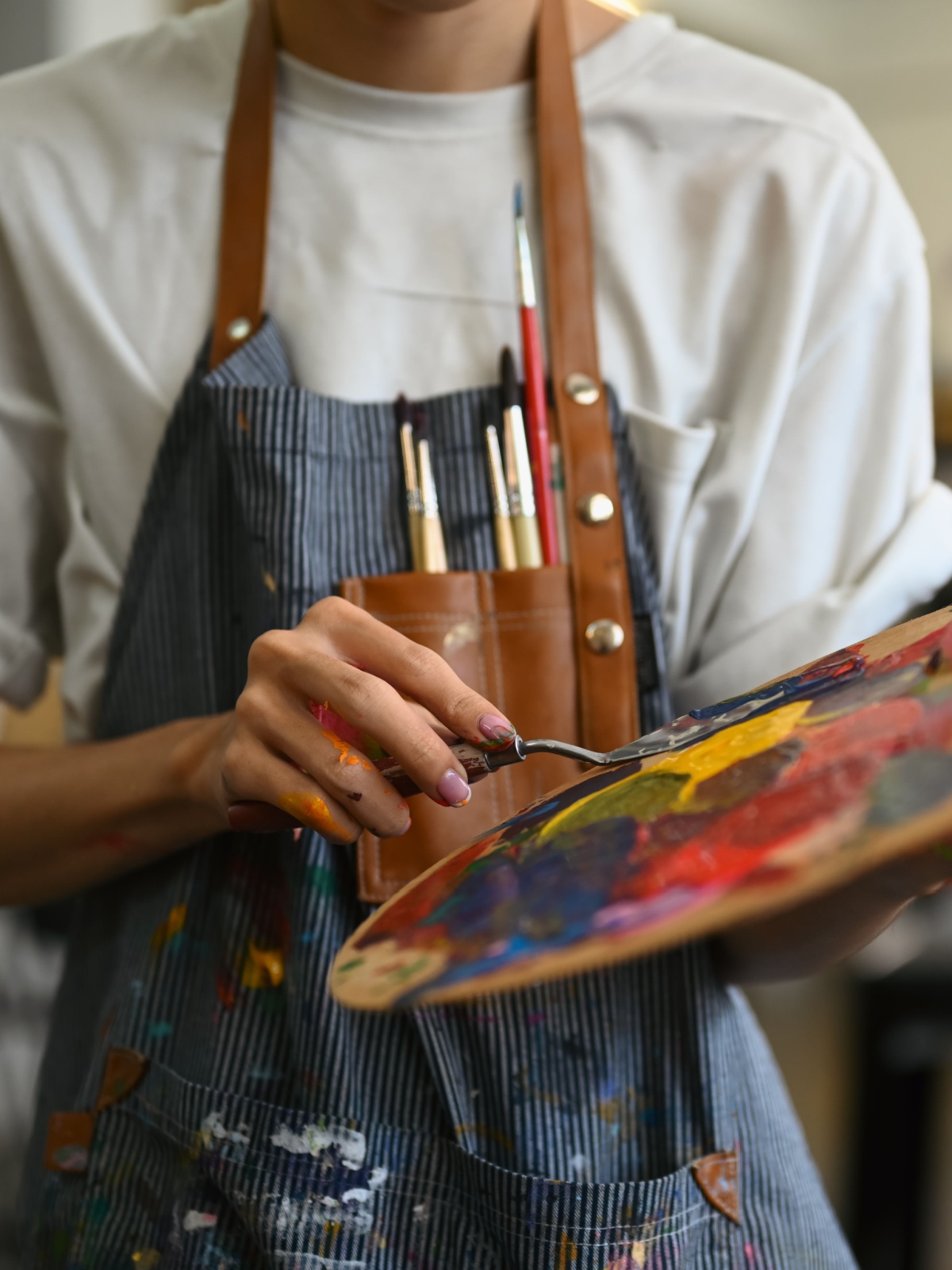
James Buchler is a visual arts educator with nearly two decades of experience teaching elementary students and building vibrant, inclusive art programs. Known for his creativity, leadership, and commitment to student growth, James Buchler has played a key role in elevating arts education within East Allen County Schools, inspiring students through hands-on learning and cross-curricular engagement.
Throughout his career, James Buchler has designed and taught engaging art lessons aligned with curriculum standards, while encouraging experimentation across a wide range of media. His instruction has included ceramics, weaving, sculpture, painting, mixed media, and art history, often integrating cultural studies and interdisciplinary connections.
Mr. Buchler played a leadership role in numerous school and district initiatives. He organized and supported events such as the FAME Art Show, Fine Arts Day, special musical program exhibitions, student art contests, carnivals, and art clubs. His efforts helped increase the visibility of student artwork and reinforced the importance of arts education within the broader school community.
He has also coordinated the Art to Remember fundraiser for many years, leading successful fundraising efforts that support school programs while celebrating student creativity. In addition, he has volunteered as a tutor, museum and science center volunteer, and participant in educational outreach initiatives.
What is your typical day, and how do you make it productive?
As an elementary art teacher, my typical day is a mix of planning, creating, guiding, and a little controlled chaos—and productivity comes from embracing all of that intentionally.
A typical day
• Before class, I prepare materials, set up examples, and sketch a loose plan for the lesson. I also think about one clear goal for the day (e.g., “Students experiment with texture” not “Finish everything.”)
During class:
1. I start with a short demo or visual inspiration.
2. Students work independently or in groups while I circulate—asking questions, giving quick feedback, and helping them problem-solve more than fixing things for them.
3. I build in moments to pause and reflect, like a quick share-out or mini critique.
• Between classes/after-school: I reset materials, document student work (photos or notes), answer emails, and adjust upcoming lessons based on what worked or didn’t. Many days end with grading or planning the next unit.
How I make it productive:
• Clear structure, flexible outcomes: I plan tightly, but allow students freedom in how they interpret the assignment.
• Routines: Consistent setup, cleanup, and critique routines save time and reduce chaos.
• Mini-deadlines: Breaking projects into stages keeps students moving and prevents overwhelm.
• Student ownership: I encourage choice in materials and themes. Engagement boosts productivity more than strict control.
• Reflection: I end lessons with quick reflections (verbal or written) to reinforce learning and guide my next steps.
• Self-care and boundaries: I don’t try to perfect every lesson. Energy and creativity matter more than over-polishing.
In short, a productive day isn’t about everything being neat or finished. It’s about students thinking, experimenting, and growing as artists.
How do you bring ideas to life?
I bring ideas to life by helping kids turn their imagination into something they can see and touch.
In my classroom, ideas start with curiosity and play—looking closely, asking “what if?”, and trying things without worrying about being perfect. I use stories, music, pictures, and real-world connections to spark inspiration, then guide students step by step as they explore materials like paint, clay, paper, and found objects.
Most importantly, I encourage experimentation. Mistakes aren’t failures—they’re discoveries. By giving students the freedom to explore and the tools to express themselves, their ideas grow into unique artwork that reflects who they are.
In short: imagination, guidance, and hands-on creativity bring ideas to life.
What’s one trend that excites you?
One trend that really excites me in the elementary art room is process art—where the focus is on exploring, experimenting, and how kids create.
It’s awesome to see students mix materials, try neat ideas, make “mistakes,” and discover their own style. It builds creativity, confidence, and problem-solving—and every child’s work ends up truly unique. Plus, it takes a lot of pressure off of little artists (and teachers!) and makes the art room feel joyful and playful.
What is one habit that helps you be productive?
One habit that really helps me stay productive as an elementary art teacher is setting up the next day before I leave.
Even just 10 to 15 minutes at the end of the day to:
• Lay out supplies,
• Prep samples,
• Jot a quick “first 5 minutes” plan makes a huge difference.
When students walk in, I’m calm, materials are ready, and the class starts smoothly—which saves way more time than it costs.
Bonus: It lowers stress, keeps transitions tight, and gives you mental space to actually enjoy teaching instead of scrambling.
If I could tap my younger-me on the shoulder on day one of teaching art, I’d say this:
• You don’t have to be the most talented artist in the room. Your job isn’t to impress students—it’s to unlock them. Process beats perfection. Curiosity beats polish. Let them see you experiment, mess up, and rethink.
• Teach observation, not just techniques. Anyone can learn how to shade or mix colors. What changes lives is learning how to notice: light, emotion, intention, culture, and story. Slow looking is a superpower
• Classroom management is also an art form.
Routines, clear expectations, and kindness will give students more creative freedom—not less. Chaos doesn’t equal creativity.
• Protect your own creative practice. Even if it’s small. Even if it’s messy. If you stop making art, teaching it gets heavier and duller. Your students feel your creative energy more than your lesson plans.
• Not every student will love art—and that’s okay. For some, your class will be the only place where they’re allowed to think differently. For others, it’s just another credit. Both are valid. You still matter to them.
• Teach art history like it’s human history. Art isn’t a timeline of past geniuses—it’s about people responding to power, joy, trauma, identity, and hope. Make it relevant, messy, and alive.
• You will change students in ways you’ll never see. The quiet student who never talks. The “struggling” student who stays after to clean brushes. The one who remembers you 10 years later. Trust that.
• Don’t burn yourself out trying to be the “cool art teacher.” Be a real one. Students respect consistency and authenticity way more than gimmicks.
And lastly, what you’re really teaching isn’t art—it’s permission. Permission to experiment. To feel. To fail. To see themselves as creative humans
Tell us something you believe that almost nobody agrees with you on.
I believe that true success is not just about achieving personal goals, but about making a positive impact on others. Many people equate success with wealth, status, or personal achievements, but I see it differently. I think that our greatest accomplishments come from helping others achieve their potential and making meaningful contributions to our communities. This belief drives me to focus on mentorship, philanthropy, and initiatives that create a lasting positive impact beyond my immediate circle.
What is the one thing you repeatedly do and recommend everyone else do?
One thing I repeatedly do—and always recommend to other art teachers—is to model being an artist yourself, out loud and in front of students.
Not just showing finished work, but:
• Sketching while they sketch.
• Messing up and saying, “Yep… that didn’t work. Watch how I fix it.”
• Narrating your thinking: “I’m choosing this color because…” or “I don’t love this yet, so I’m going to try…”
Why it matters:
• It demystifies talent. Students see that art is decisions plus practice, not magic.
• It normalizes mistakes and risk-taking (huge for reluctant artists).
• It teaches process, not just product.
• It builds trust—students see you as a fellow artist, not just a grader.
Bonus side effects:
• Classroom anxiety drops.
• Critiques get better because students have language for choices.
• Kids try more adventurous ideas.
If I had to put it in one sentence: Teach like an artist, not just about art.
When you feel overwhelmed or unfocused, what do you do?
Speaking as an art teacher (and honestly, as a human), when I feel overwhelmed or unfocused, I usually do a few of these—sometimes in combination:
• I simplify the moment. I stop trying to do everything and pick one small, concrete task: sharpen pencils, prep one demo, clean a table. Physical, low-stakes actions help my brain settle.
• I make something messy and low-pressure. Five minutes of doodling, tearing paper, scribbling with a marker, or doing a quick value scale. No “final product,” no judging—just movement.
• I change the environment. Different chair or corner of the room, open a window, turn the lights down, put on instrumental music. A small sensory reset goes a long way.
• I pause and name it. Just mentally saying, “I’m overwhelmed, not failing” helps me stop spiraling. Teaching is a lot of invisible labor, especially in the arts.
• I lean into structure. Ironically, creativity flows better for me with boundaries—timers, checklists, or a very limited prompt (one tool, 2 minutes, no erasing).
• I let students work independently for a bit. Circulating quietly instead of directing gives me space to breathe and observe rather than perform.
• I forgive the day. Some days aren’t masterpiece days—they’re “keep the room safe and curiosity alive” days. That still counts.
What is one strategy that has helped you grow your business or advance in your career?
One strategy that has really helped me grow as an elementary art teacher is continually seeking out professional learning and collaboration. Early on, I made a point to attend art education workshops, district professional development sessions, and connect with other art teachers—both in person and online. Through those experiences, I picked up new lesson ideas, classroom management strategies specific to the art room, and ways to better align my curriculum with standards. I also started sharing my own lessons and student work, which built my confidence and helped me develop a stronger professional voice.
This strategy helped me grow because it kept my teaching fresh and responsive, improved student engagement, and allowed me to build a network of colleagues who offered support and encouragement. Over time, that growth led to greater leadership opportunities, such as mentoring newer teachers and contributing to curriculum planning.
What is one failure in your career, how did you overcome it, and what lessons did you take away from it?
One challenge I faced early in my teaching career was when I designed a new project for my students that I thought would be exciting and accessible—an experimental mixed-media piece. I assumed everyone would understand the concept, but I quickly realized that many students were confused. The project was not as successful as I had hoped, and some students lost some confidence in their abilities.
To overcome this, I reflected on what went wrong and asked for student feedback. I realized I needed to scaffold the project more carefully, providing clearer step-by-step instructions and examples while still encouraging creativity. I also started incorporating mini-lessons on the techniques before launching larger projects.
The biggest lesson I took away from that experience was the importance of balancing challenges with support. I learned that as an art teacher, my role isn’t just to inspire creativity, but also to guide students through uncertainty and help them build confidence along the way. That experience ultimately made me a more patient, attentive, and effective teacher.
What is one business idea you’re willing to give away to our readers?
Here’s a simple, creative, and low-barrier business idea for an elementary art teacher:
“Art Kits Subscription for Kids.” The concept involves curating and selling monthly art kits that include all the materials and instructions for a fun, age-appropriate art project. Each kit could focus on a different medium or theme—like clay modeling, watercolor, collage, or seasonal crafts.
Why it works:
• Parents are always looking for creative activities for their kids at home.
• Kids love getting “surprise” packages with everything ready to go.
• You can scale from a small local mailing to an online subscription service.
Extra tips to stand out:
• Include a QR code linking to a short, playful video where you demonstrate the project.
• Offer a “teacher’s touch” by including tips on art techniques or fun art facts.
• Encourage kids to share their finished projects on social media (with parental permission) for a community feel.
This idea leverages your expertise, creativity, and love for teaching art while creating a small, flexible business that can grow online or locally.
What is one piece of software that helps you be productive? How do you use it?
One piece of software that helps you be productive in the art room is Procreate (for iPad).
How I use it:
• Sketching and ideation: Quickly draw thumbnails, brainstorm concepts, and experiment with compositions before moving on to paper or paint.
• Color exploration: Test out color schemes using layers and blending modes without wasting physical materials.
• Layer management: Work with multiple layers so students can separate line work, color, and texture—great for teaching digital art techniques.
• Export and share: Save artwork as high resolution files to print, display on classroom screens, or upload to a class gallery.
Procreate helps streamline planning, encourages experimentation, and supports both traditional and digital workflows in the art room.
What is the best $100 you recently spent? What and why?
The best recent $100 I spent as an art teacher was on a set of high quality, soft graphite and charcoal drawing pencils plus a pack of assorted blending tools (tortillons, stumps, chamois cloths).What exactly I bought:
• A set of graphite pencils graded from 6H to 8B.
• A set of charcoal pencils and sticks.
• Several blending tools (tortillons, blending stumps, chamois).
• A small sharpener and eraser kit tailored for detailed work.
Why this was the best spend:
1. Immediate impact on student skills
These tools transformed how my students approach:
• value (light/dark)
• texture
• edge control
• expressive mark making
Suddenly they weren’t just “scribbling”—they were thinking about line quality and tonal range.
2. Accessible for all skill levels
Graphite and charcoal are forgiving:
• Beginners can experiment.
• Advanced students can refine technical control.
No intimidating barriers—just creative exploration.
3. Promoted observation and patience
Using soft and hard pencils encourages students to slow down and see, not just draw. That’s a fundamental shift in thinking that carries across all mediums.
4. Instant classroom visibility
Within a week of adding these tools to our cupboards:
• Student confidence visibly increased.
• Observational drawing work improved.
• Classroom discussions shifted to artistic choices, not just how to use materials.
Do you have a favorite book or podcast you’ve gotten a ton of value from and why?
For an elementary art teacher, there are some fantastic resources that can inspire both teaching methods and creativity. Here are a couple of my top recommendations:
• Art Book: The Art Teacher’s Survival Guide for Elementary and Middle Schools by Helen D. Hume
This book is a goldmine of practical ideas for lesson planning, classroom management, and project inspiration. It’s especially great for elementary teachers because it balances creative activities with strategies to keep young students engaged and organized. The examples are easy to adapt for different age levels, and it encourages thinking about art education in ways that build confidence in both teacher and students.
• Art Podcast: Art Ed Radio
This podcast dives into art education topics, teaching strategies, and interviews with art teachers and artists. It’s perfect for staying updated on trends, discovering new techniques, and hearing real-world experiences from other educators. For elementary school teachers, it’s particularly useful because it often focuses on accessible ideas, classroom-friendly projects, and ways to connect art with other subjects.
What’s a movie or series you recently enjoyed and why?
I really enjoyed Spider-Man: Across the Spider-Verse. From an art teacher’s lens, it’s a MasterClass in visual storytelling—each universe has its own distinct style, color palette, and texture, and you can feel the artist’s hands in every frame. It’s a great example of how breaking traditional animation “rules” can actually deepen emotion and narrative.
Key learnings
- Create an art room environment where every student succeeds. Create a setting where students can take their art projects to the next level. Help students turn their imagination into something they can see and touch.
- Let all your students’ voices be heard. You learn from conversations and new points of view in the art room.
- Students who try out new art techniques, are confident in their artwork and think they can change the world, are the ones who do.