
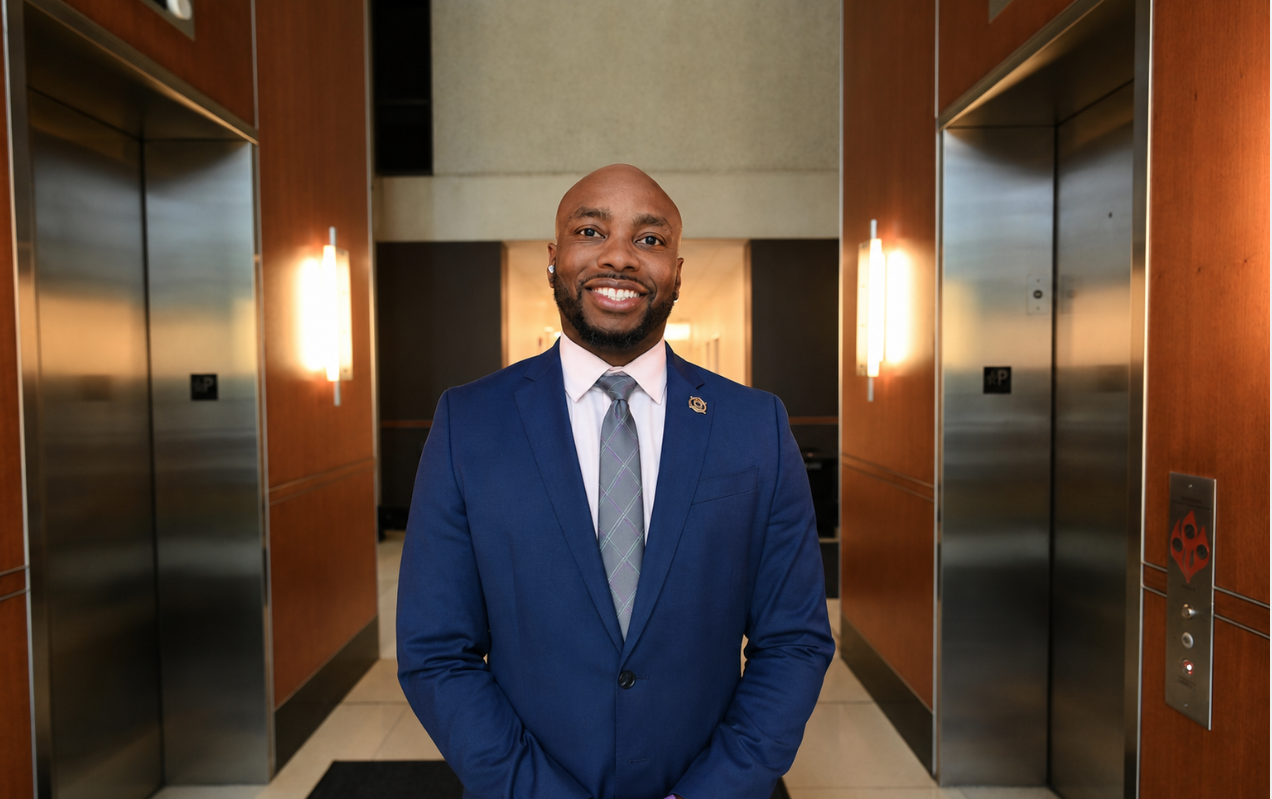
Terrence Scott is an attorney and legal administrator with more than 15 years of experience spanning appellate advocacy, juvenile justice, court administration, and private practice. Throughout his career, Terrence Scott has demonstrated a commitment to public service, legal excellence, and improving outcomes within Ohio’s justice system.
Mr. Scott began his legal career with the Office of the Ohio Public Defender, where he represented indigent defendants in appellate and post-conviction proceedings before state and federal courts. He authored and argued more than 250 appellate briefs and motions, successfully litigating precedential cases before the Ohio Supreme Court while mentoring attorneys and providing statewide legal education.
Mr. Scott later served in leadership and administrative roles with the Franklin County Court of Common Pleas, where he directed juvenile court oversight and reporting initiatives, strengthened compliance frameworks, and led technology modernization efforts. As a juvenile magistrate, he presided over complex abuse, neglect, dependency, custody, and delinquency cases, issuing findings that balanced legal requirements with the best interests of children and families. He also served as faculty for judicial education programs through the Ohio Supreme Court and professional associations.
In March 2026, he founded Pierrot Law & Consulting. He provides legal representation in bankruptcy, criminal defense, domestic relations, and contract matters, combining practical advocacy with client-centered counsel.
What is your typical day, and how do you make it productive?
I typically start my day early, around 5:00 am, with a ride either on my stationary or on my bike in my neighborhood park. If it is an indoor ride, my partner-in-crime—a year-old Rhodesian Ridgeback named The Adonis Sultan Ozymandias (Ozzy)—loves to bring me toys and play tug-of-war while I ride. If it is an outdoor ride at the park, Ozzy is up to chase me for 20 miles, no sweat. After the ride, I make a home-brewed Americano and review my case tickler, calendar, check emails and voicemails.
Once the ride and coffee is out of the way, my morning and mind is wide open and when I love to work the most. I try to place my most challenging tasks and clients’ cases in my morning window. Grind hard until noon. Noon, I like to draw the blinds and meditate for 30 to 40 minutes. Mindfulness and a light lunch fuels my afternoon. I then spend the early afternoon on the remainder of hearings and scheduling with new clients. I try and wrap up the remainder of my business day by 5:00 pm. Pick up my son from afterschool activities, prepare dinner, and do an evening walk with the dog, which usually helps with good digestion.
How do you bring ideas to life?
I bring ideas to life by grounding them in the community I’m trying to serve, then moving quickly from talk to action.
Listen first. I start by understanding what people in the community actually need, not what I assume they need. The best ideas come from real conversations with the people affected, not from a planning meeting.
Start small and visible. I look for a concrete first action that creates momentum—a single event, a pilot program, a small win people can see and rally around. Early proof builds the trust and energy needed for something bigger.
Build the coalition. Volunteer work lives or dies on relationships. I identify who shares the goal—neighbors, local organizations, faith groups, businesses—and bring them in early so it’s a shared effort with shared ownership, not my project that others help with.
Make it easy to participate. People want to help but have limited time, so I create clear, low-barrier roles where anyone can plug in and contribute meaningfully. Sustainable involvement comes from making the ask specific and doable.
Show impact and keep people invested. I track and celebrate what we accomplish—who we reached, what changed—because volunteers stay engaged when they see their effort mattered, and that visibility attracts the next wave of support.
The heart of it: an idea only comes to life in this space when the community owns it alongside you. My job is to spark it, organize the effort, and then build the structure that lets it outlast any single person.
What’s one trend that excites you?
When the automobile arrived, it didn’t just give people a faster horse—it dissolved an entire ecosystem almost overnight. Think about everything built around the horse: breeders, stables, blacksmiths, farriers, harness makers, feed suppliers, the people who cleaned manure off city streets. In 1900, horses were everywhere; within roughly two decades, that whole web of trades had collapsed or transformed. The people who thrived weren’t the ones who built a better saddle—they were the ones who saw that the job being done was “moving people and goods,” not “caring for horses,” and repositioned around the new tool.
AI is doing the same thing to knowledge work. A lot of roles today are organized around tasks—drafting, summarizing, researching, first-pass analysis—the way the old economy was organized around the horse. AI doesn’t just make those tasks faster; it threatens to dissolve the assumption that a human needs to do them at all. The blacksmiths of this shift are the people who define themselves by the task. The people who thrive will be the ones who define themselves by the outcome the task served—judgment, trust, accountability, knowing which problem is worth solving—and who treat AI as the engine rather than the threat.
What is one habit that helps you be productive?
One habit that makes me productive is single-tasking—doing one thing at a time, all the way through, before I move to the next.
It sounds almost too simple, but it runs against the instinct most of us have to juggle. The temptation is to feel productive by keeping a lot of plates spinning—answering a message while drafting a document while half-listening to something in the background. But every time you switch tracks, your brain pays a tax to reload the context, and that tax is invisible but constant. You end up busy all day and somehow finish nothing cleanly.
So, I deliberately close the loop on one thing before opening the next. When I’m writing, I’m only writing—messages and notifications are off. When I’m in a conversation, I’m in it fully. The work goes faster and, more importantly, it comes out better, because the hardest tasks need uninterrupted attention to do well. A complex piece of analysis done in 20 unbroken minutes beats the same task stretched across two hours of constant interruption.
The deeper payoff is quality. Some work can survive being done in fragments; the work that actually matters usually can’t. Single-tasking is how I make sure my best effort goes to the things that deserve it.
What advice would you give your younger self?
Honestly, there’s nothing I’d go back and do differently. We’ve gotten into this habit, culturally, of treating mistakes like they’re failures to be avoided at all costs—like the goal is to make the right call every single time. I don’t buy that. There’s an old line in research that if you’re not making mistakes, you’re not actually out on the edge of anything new. The same is true in life and in a career. I am who I am because of the good decisions and the bad ones. Both of them taught me something, and together they’re what built whatever judgment and wisdom I bring to the table now. I wouldn’t trade the wrong turns away even if I could, because I wouldn’t be the same person without them.
Tell us something you believe that almost nobody agrees with you on.
Something I believe that puts me at odds with most people: we are doing real harm to kids by trying to protect them from every possible mistake, disappointment, or hard feeling. The research is starting to catch up with what some of us have been saying for a while—that children who are bubble-wrapped grow into adults who can’t handle setbacks, can’t take risks, and don’t trust their own judgment, because they never got to practice any of it.
The instinct to shield kids is loving. I understand it. But love isn’t the same thing as protection from discomfort. A child who is never allowed to fail a test, lose a game, work through a conflict on the playground, or sit with the consequences of a bad choice is a child who never gets to build the muscle that adulthood actually requires. We’re raising a generation that’s been told their feelings are emergencies and that someone else is supposed to fix the hard parts for them. Then we’re surprised when they hit 18, 25, 30, and they’re fragile.
I’ve seen this from a few angles. I’ve watched it as a magistrate, where the kids who’d been held accountable somewhere along the way usually came out the other side, and the ones who’d been rescued from every consequence kept coming back. I’ve seen it as a mock trial coach for over a decade—the students who grow the most are the ones whose parents let them lose, let them stumble through a cross-examination, let them feel the sting of an unfavorable ruling, and then trusted them to figure out how to come back stronger. And honestly, I’ve seen it in myself. The decisions I’m proudest of, and the judgment I bring now, were built on the ones that didn’t go well at the time. Kids don’t need to be protected from struggle. They need to be loved through it.
What is the one thing you repeatedly do and recommend everyone else do?
Get outside and walk and walk with someone. Talk to them and allow yourself to be talked to. It is why I started a wellness walking group called Club 497.
When you feel overwhelmed or unfocused, what do you do?
In business, I try and work closest to the dollar. In other words, when you have many things that need addressed, what item will pay out the fastest and work from there. In my personal life, I walk and meditate.
What is one strategy that has helped you grow your business or advance in your career?
When I started out, the glamorous assignments were rarely the ones available to me. What was available were the cases nobody wanted to touch, the committees that needed a body, the programs that needed someone willing to build them from nothing. I took those on. Over time, I noticed something—the work other people avoided was often the work that taught me the most and put me in rooms I couldn’t have walked into otherwise. The hard appeal that nobody wanted to brief became the case that built my reputation. The administrative role nobody wanted to fill became the seat at the table where decisions actually got made. The volunteer program that didn’t exist yet became something I could point to as mine.
The strategy underneath it is simple: visibility and value come from solving problems other people are stepping around. If you’re willing to do the work that nobody’s fighting over, you build a track record fast, and you become the person leadership thinks of when something difficult lands on their desk. That reputation compounds. One hard thing done well leads to the next opportunity, and the next, and eventually you look up and realize you’ve built a career on the work everyone else passed on.
What is one failure in your career, how did you overcome it, and what lessons did you take away from it?
One of the early setbacks in my career came right out of undergrad. I’d graduated in May of 2001 with a real plan in place—I had an opportunity with the U.S. Department of Health as a criminal investigator, with the path forward being a transition into federal law enforcement and the agency eventually funding my law school education. It was a clear track, and I was ready to walk it.
Then September 11th happened. Almost overnight, the government’s priorities shifted, budgets moved, and the opportunity I’d been counting on disappeared. I was a recent graduate watching the plan I’d built my future around evaporate through no fault of my own.
I had a choice to make. I could wait for things to settle and hope the path reopened, or I could pivot and find another way to where I wanted to go. I chose to pivot. I enrolled at Capital University Law School in Columbus and paid for it on my own, without the federal program I’d been counting on. It was harder, slower, and a lot more expensive than the route I’d originally mapped out, but I got there.
What I took from that experience has stayed with me ever since. The first lesson is that you can’t tie your future to a single plan, because forces well outside your control can erase it in a day. The second is more important: a setback only becomes a failure if you stop moving. The original plan was gone, but the goal—building a legal career—wasn’t. Once I separated the two, the path forward became clear. I’ve carried that distinction into every difficult moment since. The plan is negotiable; the direction isn’t.
What is one business idea you’re willing to give away to our readers?
A “legal literacy” subscription for small business owners. Most small businesses can’t afford a lawyer on retainer but desperately need one. A flat monthly subscription—say, $99 to $199—that includes contract templates, a monthly office-hours call, document review up to a set page count, and discounted hourly rates beyond that. It’s the Netflix model applied to small business legal needs.
A turnkey CASA-style volunteer program for elder advocacy. CASA exists for kids in foster care. Nothing comparable exists for elderly adults stuck in guardianship proceedings, even though the population is exploding. A nonprofit or hybrid social enterprise that trains and deploys volunteer advocates for older adults in court would fill a glaring gap, and there’s grant funding available for exactly this kind of program.
What is one piece of software that helps you be productive? How do you use it?
AI tools to build templates.
What is the best $100 you recently spent? What and why?
Claude Pro.
Do you have a favorite book or podcast you’ve gotten a ton of value from and why?
“StarTalk Radio,” “The Rewatchables,” “The Diary of a CEO,” “Revisionist History.” All three are ran by really smart people and are leaders in their respective fields.
What’s a movie or series you recently enjoyed and why?
“The Expanse”—it projects forward into the near future when humans begin to colonize the inner solar system. It explores the social challenges, the politics, the competition for resources and power. All the while, it strictly adheres to scientific principles and does not take short cuts our of convenience.
Key learnings
- Mistakes are not detours from a successful career—they are the raw material of one.
- Shielding children from struggle does not protect them; it leaves them unprepared.
- Careers advance fastest by taking on the work others avoid.
- AI is reshaping professional work the way the automobile reshaped transportation
- Single-tasking produces better work than multitasking.