
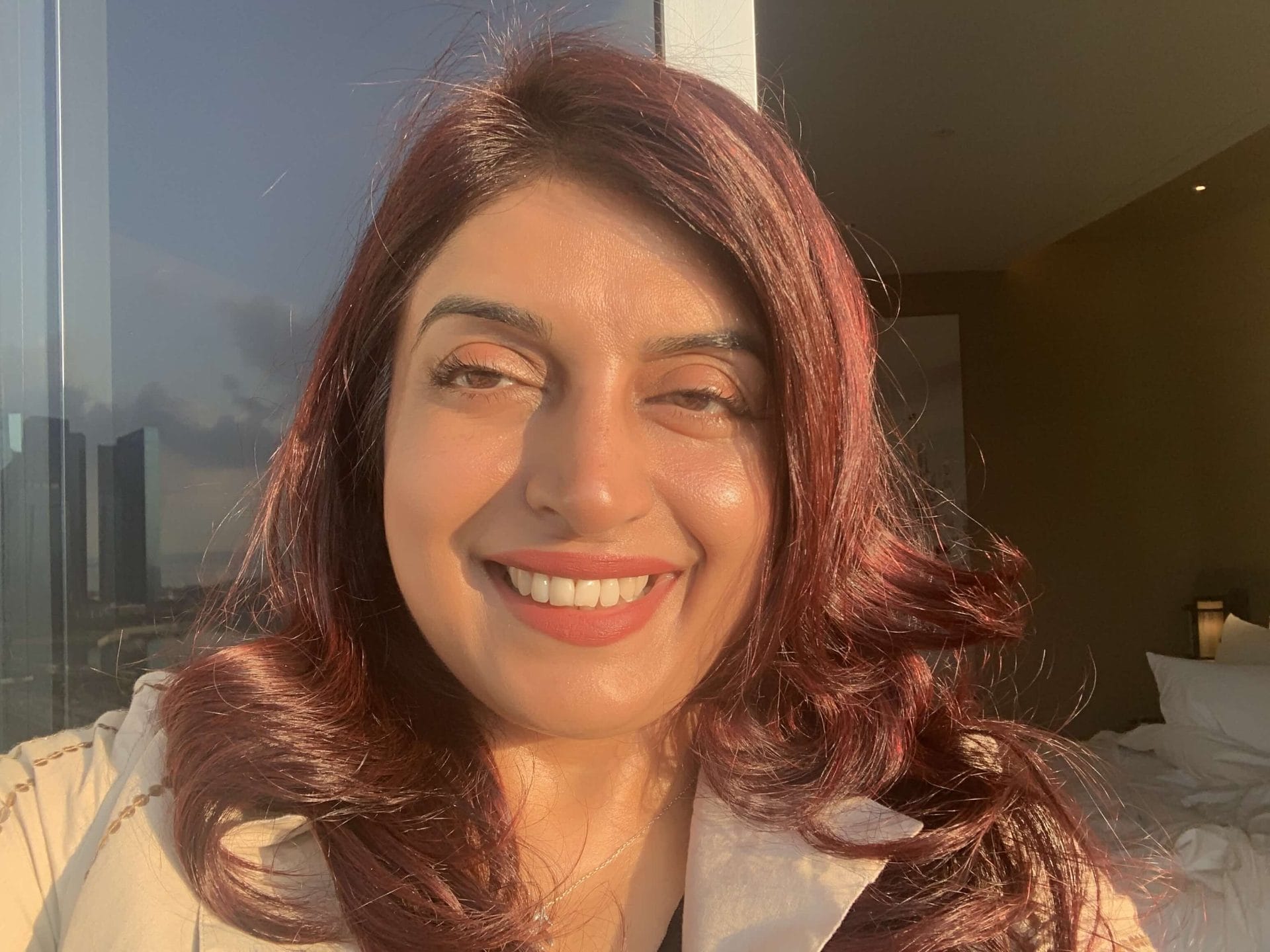
Ruchika Singhal has spent her entire life in transition.
As an army kid who changed seven schools in fourteen years, she learned early what most people spend decades trying to understand, that reinvention is not a crisis. It is a muscle. And every time you are forced to walk into a room full of strangers and rebuild yourself from scratch, that muscle gets stronger.
After completing her MBA from the Wharton School, Ruchika built a career in healthcare holding senior leadership roles across Asia Pacific, working with global organisations including Johnson and Johnson, AstraZeneca, and Medtronic. She led large teams, managed complex markets, and operated at the highest levels of corporate life. And then she did what very few people at that stage of a career choose to do.
She left.
Because something deeper was pulling her forward.
That decision, made without a safety net and with very little support from the people around her, became the foundation of everything she now builds. She founded Elevare Advisory, a Mumbai-based reinvention coaching practice for senior professionals navigating the moments when the life they built no longer fits who they are becoming.
Her work is grounded in a simple but radical idea, that the most disorienting moments of a professional life, job loss, burnout, role transitions, misaligned roles, the quiet sense of being invisible despite working hard, are not signs of failure. They are identity transitions. These identity transitions, navigated with the right framework, become the most powerful turning points of a career.
Through her signature Reinvention Playbook™, Ruchika works with a small number of senior professionals at a time. Her coaching programmes include the 60-Day Career Reinvention Accelerator, Narrative & Confidence Building Program, Emotional Intensive reset and 90 day Blueprint for new role transitions for leaders stepping into their next chapter.
She also works as a Consultant and Coach with Executive Service Corps Chicago, bringing her reinvention framework to organisations navigating change.
Beyond her coaching practice, Ruchika is the author of Happiness Is Right Here: The Reinvention Playbook™, a book about rebuilding identity and finding direction when life no longer fits. She hosts Lead With Ruchika, a podcast on Spotify and Apple Podcasts exploring reinvention, identity, and what it means to start over with purpose. She is also a speaker who gives her talk, “You are Not Stuck. You are Between Identities”, both in India & United States.
She is currently building the Corporate Reinvention Lab™, a programme designed for organisations going through restructuring, helping teams navigate the identity and mindset shifts that leadership speeches alone cannot create.
She believes reinvention is a muscle that you can improve with practise and helps people to see their own reinventions through the framework she has now created.
What is your typical day, and how do you make it productive?
My mornings are non-negotiable. The first couple of hours are kept entirely for my gym workout or tennis lessons, which I alternate, followed by my Buddhist meditation practice and then a cup of coffee sitting quietly, looking out at the sea. That morning ritual gives me all the energy I need for the rest of the day.
After that, I move into creative thinking mode. I keep a couple of hours in the morning for long-term strategy and creative work, because that is when my brain is at its absolute peak. I use that time for thinking about the future of Elevare Advisory, developing new ideas, and doing deep work.
Afternoons are my lowest energy point, so I use that time for admin, follow-ups, and the operational side of running the business. Evenings are reserved for my client sessions because most of my clients are senior professionals who are still working during the day, so late evenings are when they are most available.
I do not work on Sundays. That day is kept for my NGO activities, my family, and going out for lunch or coffee with friends. Having spent my entire career in companies where my calendar was always planned for me by my assistant, I am now very mindful and deliberate about how I structure my time. That intentionality makes all the difference.
How do you bring ideas to life?
When an idea comes to me, I first flesh it out in my mind to understand how far it goes and what it is really about. Then I evaluate it on two things that matter to me the most. One is impact and the other is time & resources. What would be the impact of this idea? How much time and resources would it take to execute?
I also look at where it sits relative to everything else I am already working on. Is this something I need to prioritise now, or does it go into the funnel for later? If it does not measure up on impact and timing, I park it and move on rather than letting it distract me.
The process is structured but also flexible. Not every idea gets executed. But every idea gets evaluated honestly before I decide what to do with it. If I don’t execute it, I park it on the side.
What’s one trend that excites you?
Two things genuinely excite me right now, and I think this is the perfect time to be a founder.
The first is AI. I am a creative person who loves spending time on ideas and clients, and my biggest worry when I started Elevare Advisory was that I would get buried in admin and drudgery. AI has completely changed that. It handles so much of the work I do not enjoy, which means I can spend almost all my time on what I do best: being creative, building relationships, and serving my clients deeply.
The second is the democratisation of knowledge. Information that would have taken months of research a decade ago is now available in minutes. That levels the playing field for founders in a way that simply did not exist before. I genuinely believe this is one of the best times in history to start your own company.
What is one habit that helps you be productive?
Blocking my mornings absolutely and completely. My first two hours of the day are non-negotiable. They are blocked in my calendar permanently for my workout or tennis, my Buddhist meditation, and a quiet cup of coffee looking out at the sea.
That morning routine is non-negotiable and is the fuel that drives the rest of my day. If I skip it, the whole day feels off. If I protect it, I am at full power for the work that matters most. Nothing gets scheduled during that time. Absolutely Nothing.
What advice would you give your younger self?
Do not get obsessed with metrics, performance, and trying to achieve things faster. The most important investment you can make is in relationships and experiences.
Go out and meet people. Have real conversations. Travel. These two things open your mind and your world in a way that nothing else can. Today you can get knowledge and information from anywhere. But the learning that comes from sitting across from another human being and truly understanding how they see the world, or from travelling somewhere completely unfamiliar, that learning cannot be replicated in any other way, even now.
I would tell my younger self to invest far more time in people and travel, and far less time chasing the next metric.
Tell us something you believe almost nobody agrees with you.
When I am at a crossroads, I always follow my own instincts, even when everyone around me is telling me to do something different.
When I decided to leave my corporate career and start Elevare Advisory, I had almost no support. Not from my family, not from my friends. I was doing well. Everyone questioned my decision to leave. They asked me, why was I planning to leave such a great job? They told me to continue and keep going for some more time. I understood why they said it. But my heart and mind were telling me something different. So I followed that.
I have done this over and over in my life. And it has never let me down. I believe that when you are at a crossroads, your own gut, your own instincts, your own sense of what is right for you, will almost always know better than the people around you who love you but are seeing your life from the outside.
What is the one thing you repeatedly do and recommend everyone else do?
Stop thinking that working seventeen or eighteen hours a day means you are doing a great job to succeed.
When you start your own company, there is an enormous pressure to grind constantly. But what I have learned is that your brain is only truly working at a hundred percent for a few specific hours each day. Those are the hours that matter. Know what those hours are for you and use them for your most important, most creative and most strategic work.
The rest of the day? Go for a coffee. Read a book. Take a walk. Do not feel guilty about it. If you have used your peak brain hours fully, you are already doing more than most people who sit at a desk for twelve hours and produce very little. Work smart, not long.
When you feel overwhelmed or unfocused, what do you do?
I give myself a complete break. No halfway measures.
I call some friends and we plan an outing, or I go and visit my family who live about an hour away. Sometimes I go on a short retreat, two or three days somewhere quiet, for meditation, rest, and a complete digital detox.
I have learned not to push through when I feel overwhelmed. My body and mind are telling me something and I listen to it, and the answer is never to work harder. The answer is to step away completely, absorb new energy and a new environment, and come back refreshed. I do not hesitate to do this anymore. It always works.
What is one strategy that has helped you grow your business or advance in your career?
Two things that work together for me are always bring new ideas, and execute them immediately.
I am constantly looking at what can be done differently, what can be improved, what new direction is worth exploring. But I do not just think about ideas. I act on them fast. If something needs to be done, I do it now, not next week.
This combination means the business never stays in status quo, and I find out quickly what works and what does not. If an idea fails, I fail fast and move on to the next one. I do not spend months deciding whether to try something. I try it, see what happens, and adjust.
That bias towards action has helped me more than any other strategy throughout my career and now in my business.
What is one failure in your career, how did you overcome it, and what lessons did you take away from it?
Early in my Asia Pacific role, Japan was a critical market. I flew to Tokyo to work with the local marketing team and align them with our global strategy. I made my presentations, everyone nodded, everyone seemed to agree, and I flew back feeling wonderful about how smoothly it had gone.
A month passed. Nothing happened.
When my boss followed up with the Japanese boss, it became clear they had no intention of implementing any of it. I had completely misread the cultural signals. In Japanese business culture, nodding and appearing agreeable in a meeting does not mean agreement. It means they are being polite.
I went back to Japan. This time I did not make presentations. I became part of the team. I travelled with them, stayed in their budget hotels, met their clients, went with them to karaoke bars in the evenings. I spent months genuinely understanding how they worked, what they valued, and what mattered to them.
Only after that did things begin to shift.
The lesson was humbling and lasting for me. I understood that you cannot lead across cultures by assuming your way of working is universal. Real alignment only comes from genuine understanding and trust and working with the stakeholders closely as a team. I carry that with me in everything I do now.
What is one business idea you’re willing to give away to our readers?
The Corporate Reinvention Lab™.
Organisations going through restructuring spend enormous energy communicating change from the top down. A few speeches from senior leadership, some town halls, an assumption that everyone is aligned. But in my experience on both sides of this, the teams are rarely aligned. They are confused, anxious, and quietly resistant in ways nobody is addressing.
The top leadership feels the team is aligned as they have stopped asking questions out of fear or anxiety and the teams feel the companies don’t care.
What is needed is a structured, experiential lab where teams can actually feel and process what is happening to them. Not be told about it. Go through it. Understand the identity shift that restructuring requires of them. Build a new mindset together rather than being expected to arrive at one on their own.
I have designed this programme for Elevare Advisory, and I believe it could be built and delivered by facilitators and coaches around the world. The need is everywhere and the gap is enormous.
What is one piece of software that helps you be productive? How do you use it?
There is no single one, and I think that is the honest answer for anyone building a business today. I use LinkedIn daily for visibility and connection. I use Claude and ChatGPT for thinking, writing, and research. I use Canva for creative and visual work. I use Squarespace for my website. I use a video editing app for content.
Each one does something different. Together they have made it possible for one person to do what would previously have required an entire team. The combination of these tools is what lets me stay focused on my clients and my creative work while still running a professional, visible business.
What is the best $100 you recently spent?
A minimalist wellness retreat in the southern part of India. Very simple accommodation, basic vegetarian food, soups, fruits, lentils, vegetables, long walks by the river and through the forests, yoga, and absolutely no digital access whatsoever.
It was economical but extraordinarily effective. Completely disconnect from digital screens, from notifications, from business activity, and just being in nature did more for my mind and body than any expensive holiday ever has. I came back completely restored.
I think every founder needs to do this at least once a year. Not a luxury resort.
Do you have a favorite book or podcast from which you’ve received much value?
Book: The Road Less Travelled by M. Scott Peck. It shaped a great deal of how I think about personal growth, discipline, and the choices that define a life. I have gone back to it many times.
Podcast: The Moth and similar storytelling podcasts. Learning the craft of storytelling has transformed how I communicate, with clients, in presentations, and in my coaching work. A well-told story does what no framework or slide deck can. It makes people feel something. And when people feel something, they respond.
What’s a movie or series you recently enjoyed and why?
The Companion on Netflix. It is about a world where you can buy an AI bot as a personal companion, fully customisable to your preferences. It sounds futuristic but it genuinely unsettled me.
Two things struck me.
First, the intimacy people were developing with something that is not human.
Second, what happens when you lose control of the bot? What then?
But what stayed with me most was the loneliness underneath it. People are creating AI companions because human connection has become harder to find or sustain. That is the real story. And it connects directly to the work I do every day, helping people stay anchored in who they are and what truly matters to them in a world that is moving extraordinarily fast.
Key learnings:
- The most productive hours of a day are finite. Founders and professionals who identify their peak brain hours and protect them for their most important work consistently outperform those who measure productivity by hours spent at a desk.
- Cultural intelligence is not optional for anyone working across borders. Real alignment requires genuine immersion and understanding, not just agreement in a conference room. Nodding is not the same as committing.
- Following your own instincts at a crossroads, even when everyone around you disagrees, is one of the most underrated professional skills. The people who know you best are seeing your life from the outside. Only you know what is right from the inside.
- The best investment a professional can make at any stage of their career is in people and travel. Knowledge and information are now universally accessible. The learning that comes from human connection and unfamiliar environments cannot be replicated by any other means.
- I believe in disconnecting completely, through a digital detox, a retreat, time in nature, is not a luxury for high performers. It is a strategy. The quality of thinking that follows genuine rest is categorically different from the thinking that comes from pushing through exhaustion.