
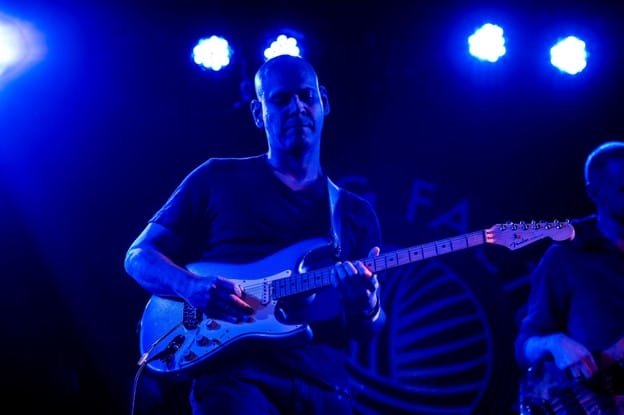
Ramsey Elkholy is a musician/producer, anthropologist, and tech investor based in Los Angeles. He is the founder and creative force behind the indie band Monotronic.
As an anthropologist, he spent years traveling to places most people never see, studying remote societies living, hunting and gathering in the rainforest. His book “Being and Becoming” is a study of one such people, called the Orang Rimba, whom he lived among deep in the forests of Sumatra, Indonesia, for 2 years.
What is your typical day, and how do you make it productive?
My days vary from low to high output. No fixed wake up time, no fixed bed time, and I often go through bursts of productivity followed by days, or even weeks, of low output. This works a lot better for me than having fixed routines. Writing normally happens during the day, while music normally happens at night, unless I’m recording at a studio, in which case it usually happens during the day. My “routines” involve walking the dog and playing guitar for at least an hour a day. No fixed meal times, but I usually eat once a day in the evening (10pm or so), but snack throughout the day.
How do you bring ideas to life?
I try not to force things. In the late 2000’s I invested heavily in Apple and lived off those dividends for about a decade. Then in 2017 I sold about 40% of my shares to buy Bitcoin and Ethereum. Most financial advisors will tell you to have a diversified portfolio. I have always done the opposite, by holding heavy concentrations in assets and companies that I strongly believe in, with an eye toward the long-term.
What’s one trend that excites you?
AI, without question — and I’m involved on both sides of it. As a builder, I’m developing a Visual Scene Player – software that listens to music and performs visuals in response to what it hears in real time. AI is what makes that possible: the engine identifies instruments, sections, and tempo inside a song structure and reacts in the moment. Work that would have taken a team of engineers years to build is now something I can build using AI over the course of 10-15 sessions. What excites me most is the difference between AI that replaces creative work and AI that performs alongside it. The first makes artists unnecessary. The second gives them an instrument that has never existed before. I’m betting on the second.
What is one habit that helps you be productive?
Isolation. Not necessarily going somewhere remote. It can also be achieved by tuning out the world and putting aside enough time to enable a creative flow to happen. Once that happens, I can often do a month’s worth in a week or so. For example, in the month of July I wrote the 2nd edition of Being and Becoming, sold my apartment in NY, invested in Nvidia, and finished up a music video. This should have taken months, but the flow found me, and I was able to get everything done in a few weeks.
What advice would you give your younger self?
Almost never sell or undervalue what is good. Early on I treated everything as tradeable — sell this to fund that, cash out when something rises, move on to the next thing. It feels smart in the moment because you’re always doing something. But looking back, the best decisions I’ve made followed a long-term approach: buy things you believe in, then hold them through the noise. The noise is constant — prices swing, news cycles come and go, people around you cash out and tell you why you should too. Holding through that isn’t passive; it’s a decision you make over and over, and it’s harder than trading.
This applies well beyond investing. For example, keep the friendships that are real, even across distance. Keep the skills, even when they look useless. Even a PhD in Anthropology may seem useless, but it has given me the analytic frameworks to better understand the world – and that is applicable to everything I do. It’s the lens through which I see the world and process information. I can often separate signal from noise much easier than others who may be following trends.
Tell us something you believe almost nobody agrees with you on?
The famous version of a place is usually an outdated version of it. You can see the mechanism up close: fame concentrates crowds, and crowds change the thing they came for. The restaurant that gets discovered stops cooking for its neighbors and starts cooking for tourists. The trek that gets famous builds boardwalks. The market everyone targets fills with competitors. Fame is a lagging indicator — by the time everyone knows something is good, the conditions that made it good are already eroding.
So whatever you’re looking for — a destination, a market, an audience, an investment — assume your instincts are pointing at the famous version, and then dig deeper.
What is the one thing you repeatedly do and recommend everyone else do?
Ask questions — always one more than feels comfortable, even at the expense of looking stupid. Then stop talking and listen.
As an anthropologist, that was the entire method. You don’t walk into a community and announce what you think; you get people talking and stay quiet long enough to allow for real insights to emerge. The first answer is often the rehearsed or politically correct one. The truth often appears after the person has relaxed and you’ve proven you’re actually listening. Most people never get there, because they’re too busy preparing what to say next, or too afraid the next question will make them look like they don’t know something.
That fear is the trap. Looking stupid for a minute is the price of not being stupid for years. I’ve asked musicians questions a music professional “should” already know, and asked business people to explain terms everyone else at the table was nodding along to — and half the time, the nodders didn’t know either. The person willing to ask ends up with the answer. The people protecting their image end up with nothing.
Better to ask the question you’re embarrassed to ask. Then ask the follow-up. Then be quiet, longer than is comfortable, and let the other person fill the silence. You can often learn more this way than by engaging continuously or playing it cool.
When you feel overwhelmed or unfocused, what do you do?
I take a step back until I can see the whole problem set from enough distance that it no longer feels overwhelming. During this time, I might watch a movie, walk the dog, or do anything that enables me to clear my head and come back in again with a fresh perspective and understanding of what is required to get the job done.
What is one strategy that has helped you grow your business or advance in your career?
Same as above: ask a lot of questions!
But also, I think it’s important to treat every team member with respect so they feel invested in the project. Nothing beats teamwork carried out by highly motivated people. Walk into any Apple store, and you will see it firsthand.
What is one failure in your career, how did you overcome it, and what lessons did you take away from it?
I have had so many failures in my life, and the takeaway has always been to try to get a deep understanding of why it happened. Without that understanding, a person is more likely to make the same mistake again, or even worse, take a different approach when the approach wasn’t the reason for the failure. It’s understanding all the factors that came into play that led to the failure. Failure is part of life, and nobody can build a successful career without it. But understanding the “why” is the key to moving past it.
What is one business idea you’re willing to give away to our readers?
Rather than start from scratch with a concept of your own, the easiest way to own your own business is to take over a failing business that offers a product or service that is genuinely useful for society. However, it’s important to know why the business is failing. If you can solve the “why” puzzle, you can remedy the problem (for example, location, marketing, or management might be the issues).
What is one piece of software that helps you be productive? How do you use it?
I use OpenAI’s Fable 5 just about every day. It helps with so many things, kind of like a virtual assistant. Currently, I am building a Visual Music Player (mentioned above). I use Fable for a lot of brainstorming, research, planning, and beta testing. It also works as a virtual secretary, helping me draft letters, business proposals, etc.
What is the best $100 you recently spent? What and why?
In general, I have always believed that the best use of money is for experiences, such as travel. The best $100 I spent was at the Thai massage place up the road. It’s a weekly ritual that always centers me.
Do you have a favorite book or podcast you’ve gotten a ton of value from and why?
I am currently writing a book about my fieldwork in Indonesia, shameless self-plug, I know! I mention it just to say that I have been in my own echo chamber this summer, so I have been out of the loop. With that said, David Byrne’s “How Music Works” was really good, especially his argument that the room co-authors the music. This is especially true in a live music setting, where the audience and musicians form a feedback loop.
What’s a movie or series you recently enjoyed and why?
I recently re-watched “No Country for Old Men” (Coen brothers) and it really took me back to the pre-internet period I grew up in (1980). I think anyone who grew up in the digital revolution will get a really good sense of how America used to be and how much our society has changed in only the last two or three decades.
Key learnings
- Be patient and let the flow come to you.
- Treat everyone on your team with respect, not as employees but as partners, so that they feel they have a genuine vested interest in the project or company.
- Deep experience in unrelated fields — music, anthropology, investment — often leads to very different approaches to business and human relationships more generally. So don’t limit yourself. Follow ALL your interests. You can never know too much!
- Make investments with an eye toward the long-term in a business you understand and truly believe in.