
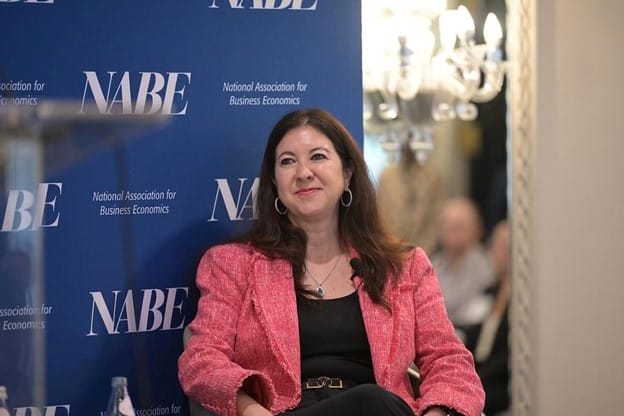
Dr. Adriana Kugler is a labor economist and Professor of Public Policy and Economics at Georgetown University’s McCourt School of Public Policy, where she has taught for more than fifteen years. From 2013 to 2016, she served as the university’s Vice Provost for Faculty, leading initiatives on promotion and tenure standards, faculty development, and support for women in STEM fields.
Kugler made history in September 2023 when she became the first Hispanic person to serve as a Governor of the Federal Reserve Board. Nominated by President Biden and confirmed by the Senate, she served through August 2025 as one of the Board’s seven members and a voting member of the Federal Open Market Committee, speaking widely on inflation, the transmission of monetary policy, employment, and housing markets, and visiting communities across ten of the twelve Federal Reserve districts. The Fed appointment was her second Senate-confirmed role. She previously represented the United States as Executive Director of the World Bank (another Senate-confirmed position) from 2022 to 2023, work that earned her the Treasury Department’s Chase Award, and she also served during the Obama Administration as Chief Economist of the U.S. Department of Labor from 2011 to 2013.
Her scholarship examines how labor markets respond to public policy, with influential studies of payroll taxes, employment protections, occupational licensing, immigration, and unemployment in both advanced and developing economies. Her findings appear in the field’s leading journals, among them the American Economic Review, the Journal of Labor Economics, and the Review of Economics and Statistics, and she holds research appointments at the National Bureau of Economic Research and the Center for Economic Policy Research. She has testified before Congress and delivered keynote addresses at the London School of Economics, Princeton, Harvard, the European Central Bank, and the Economic Club of New York.
Barron’s named her among the 100 Most Influential Women in U.S. Finance in both 2024 and 2025, and she received the 2025 ASHE Academic Achievement Award from the American Society of Hispanic Economists.
What is your typical day, and how do you make it productive?
My days at Georgetown revolve around three things: teaching and students, research, and service. One of the aspects of my academic role I missed the most while I was in public service was time with my students. I love teaching, and I love mentoring students, so I am very happy to be back preparing the next generation of policy-makers. I also missed my research and getting to look deeply into important questions. I try to protect blocks of uninterrupted time for research, because empirical work requires sustained focus, and I keep my door open for students outside of that. What makes a day productive for me is finishing it knowing I moved a project forward, even by a small step. Research progress is cumulative, and I have learned to value steady work over dramatic bursts, although I acknowledge that these dramatic bursts are often needed to take a project to the finish line. I have always been very focused on service, whether it is giving back to my home institution, the Economics profession, or public roles. I have spent five years in public service, and at Georgetown, I have been Vice-Provost for faculty and on many committees, and that certainly continues to be part of my job.
How do you bring ideas to life?
Almost every project I have worked on starts with a policy question that affects real people: how payroll taxes change hiring, how employment protections affect productivity, how licensing rules shape who can work where. From there, the process is about finding the right data and the right setting to answer the question credibly. An idea only comes to life when the evidence can stand on its own, so I spend most of my time testing whether it holds up but also understanding the channels through which these policies work.
What’s one trend that excites you?
The conversation about AI and the future of work. Labor economists have spent decades studying how technology changes employment, wages, and skills, and this is a moment when that body of evidence really matters. I find it exciting that questions my field has long worked on are now at the center of the public debate. And, of course, this last technology wave is different in nature from previous ones in that it affects higher-skilled workers and has the potential of being more broad-based. At the same time, there are also several similarities with the technology boom of the 1990s when I was living in the Bay Area, and this allows us to learn from that comparison.
What is one habit that helps you be productive?
Making time for physical activity. Whether it is walking my dog, going to the gym, or a game of tennis, exercise clears my head and allows me to let off some steam. I find I do my best thinking when I step away from my desk and let ideas simmer, think through them calmly, or talk about an issue to someone with a different perspective.
What advice would you give your younger self?
Hold on to your convictions and do not let anyone talk you out of your persistence. The qualities that can feel like too much when you are young often turn out to be exactly what a career requires.
Tell us something you believe almost nobody agrees with you on?
That labor market regulations are neither as damaging as their critics claim nor as protective as their supporters hope. My research on employment protections and payroll taxes shows the effects depend heavily on design and context. Both sides of that debate tend to dislike this answer, which is how I know the evidence is doing its job.
What is the one thing you repeatedly do and recommend everyone else do?
Mentor. I have mentored high school students, undergraduates, doctoral students, and junior faculty throughout my career, and I have coauthored with many of my graduate students. Every hour spent mentoring pays off many times over, for the person you mentor and for you as well! I love paying it forward, as I have benefitted from many great mentors myself.
When you feel overwhelmed or unfocused, what do you do?
I cook. There is something about working with my hands and following a process from start to finish that resets me. Laughter helps too, ideally with family around the table afterward.
What is one strategy that has helped you grow your business or advance in your career?
Saying yes to roles outside my comfort zone. Taking leaves of absence from academia three times for public service, at the Department of Labor, the World Bank, and the Federal Reserve, meant stepping into unfamiliar institutions each time. Each role made me a better economist and a better teacher. A better economist by ensuring I saw all sides of an issue and relied on evidence to make decisions, but also understood what was feasible in practice. A better teacher because, as a public servant, one is interacting with many non-economists and explaining the economy and decisions in simple terms that can be understood by non-economists. Interestingly, public service also feeds back into my research by allowing me to develop new research questions I would not have thought of without being in these policy roles.
What is one failure in your career, how did you overcome it, and what lessons did you take away from it?
Early in my career, my first job market out of graduate school landed me an academic appointment in Europe. I made the risky decision to take a lower-paying academic job in Europe and let go of other higher-paid, safer non-academic opportunities in the U.S. We packed our bags and moved to Europe for the first time, and many told me I would be isolated as an academic in Barcelona. In response to this unsolicited advice, I became very proactive and traveled often to conferences in Europe and back in the U.S. I also volunteered to organize a seminar series and found out that many American academics were delighted to come give talks in Europe, allowing us to host excellent academics in Barcelona. I was also very welcomed into the community of labor economists in Europe and was invited all over Europe to give seminars. Perhaps more importantly, I arrived in Europe at a time when unemployment and policies to tackle unemployment were the main concerns of European labor economists, while earnings inequality was the main topic of interest for U.S. labor economists. This meant that I became an expert on the drivers of unemployment, and when the Great Recession came around in the U.S., this expertise served me well in my role as Chief Economist at the U.S. Department of Labor.
What is one business idea you’re willing to give away to our readers?
A platform that maps occupational licensing requirements across all fifty states and shows workers exactly what it takes to transfer their credentials when they move. Licensing rules create real barriers to mobility, and the information is scattered and hard to compare. Whoever builds a clean, reliable version of this would help millions of workers.
What is one piece of software that helps you be productive? How do you use it?
Waze. Between campus, speaking engagements, and family, I am often on the move, and it gets me where I need to be on time. It is a small thing, but arriving on time and unstressed sets everything else up.
What is the best $100 you recently spent? What and why?/
The best $100 I have recently spent was on plants to build a herb garden. The herbs not only add aroma to our garden but also provide fresh basil, mint, and rosemary to our cooking. Nothing better than fresh aromatic ingredients to make a great meal.
Do you have a favorite book or podcast you’ve gotten a ton of value from and why?
One Hundred Years of Solitude by Gabriel Garcia Marquez. It is the book I return to again and again not only because I love magical realism as a genre, but because it also reminds me of the political instability and economic hardships that I saw growing up in Colombia and inspired me to study Economics.
What’s a movie or series you recently enjoyed and why?
The Odyssey. Great to see this epic poem I read in my teens brought to the big screen and connected us to today’s reality. The film shows the obsessive chase for trading routes that continues until today, even at the expense of breaking the fragile bonds between peoples. In reality, it doesn’t have to be this way. In fact, greater movements of people, goods and services around the world can have many positive effects.
Key learnings
- Evidence should lead policy debates, not ideology; the effects of labor regulations depend on their design and context.
- Careers benefit from leaving the comfort zone; moving between academia and public service deepens both.
- Mentoring is a repeatable investment that compounds for both the mentor and the people they guide.
- Productivity in research comes from protected, consistent focus rather than bursts of effort.
- Resets matter; stepping away from the desk, whether to cook or exercise, is part of doing good work.