
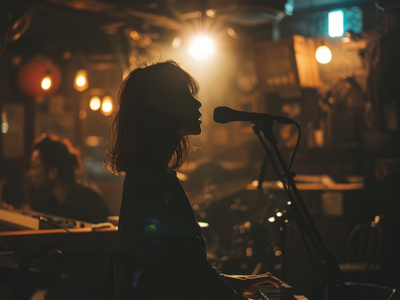
Sundas Naqvi is a Chicago-based jazz and folk vocalist, songwriter, and occasional vocal coach whose work is rooted in storytelling and human connection. She grew up in southern England, where music, books, and the arts were part of everyday life. She began singing in school choirs and community performances before developing a deeper interest in jazz and acoustic folk during her university years.
Sundas studied English Literature and Music Studies at the University of Brighton. That mix shaped the way she approaches music today. She became interested not only in melody, but also in how words, memory, and small details can turn a song into a story.
In her late twenties, Sundas moved to Chicago after meeting her husband. The city soon became home. Its long music history, distinct neighborhoods, and strong local arts scene gave her room to develop her own sound. She began performing in neighborhood jazz lounges, independent coffeehouses, private gatherings, and seasonal festivals.
Her music blends jazz standards with contemporary folk influences. She often explores themes such as resilience, family, belonging, and the ordinary moments people tend to overlook.
Sundas also works with aspiring musicians through occasional vocal coaching and beginner songwriting workshops. She volunteers with youth music programs and helps coach her son’s soccer team, where she sees many of the same lessons found in music: patience, confidence, listening, and teamwork.
Away from the stage, Sundas enjoys street photography, Chicago architecture, literature, local coffee shops, and trips back to England. Her creative life is built around one simple idea: pay attention, listen closely, and make something meaningful from what you notice.
What is your typical day, and how do you make it productive?
My days are rarely identical. I usually start quietly with coffee, reading, and a notebook before checking messages. If I am performing that evening, I protect part of the afternoon for vocal warmups, lyric review, and going through the set list. Other days might include a coaching session, songwriting, errands, or volunteering.
I try not to measure productivity by how many things I finish. I ask whether I gave proper attention to the few things that mattered that day.
How do you bring ideas to life?
I collect fragments first. It might be a sentence I overhear, a building I photograph, or something my son says in the car. I write it down without deciding what it should become.
Later, I return to those notes and look for patterns. A song usually begins when two unrelated ideas suddenly seem connected. I build from there instead of forcing a complete concept from the beginning.
What’s one trend that excites you?
I like seeing more people value smaller, local creative spaces again. Intimate performances in cafés, bookstores, galleries, and neighborhood venues can create a completely different relationship between an artist and an audience.
There is less distance. People listen differently when they are only a few feet away.
What is one habit that helps you be productive?
I keep a paper notebook with me. My phone is useful, but handwriting slows me down enough to notice what I am actually thinking. I use it for lyrics, set ideas, observations, reminders, and even strange phrases that may never become anything.
What advice would you give your younger self?
Stop waiting to feel completely ready. I used to think confidence arrived before you did something difficult. Usually it arrives afterward.
Perform the song. Apply for the opportunity. Ask the question. You can improve while moving.
Tell us something you believe almost nobody agrees with you on?
I think boredom is useful. We are very quick to fill every empty minute with a screen, music, or conversation.
Some of my best ideas arrive when I am walking without headphones or waiting somewhere with nothing to do. A little boredom gives the mind room to wander.
What is the one thing you repeatedly do and recommend everyone else do?
Walk through your own neighborhood without trying to get anywhere quickly. Pay attention to signs, buildings, people, sounds, and small changes. You learn a surprising amount when you stop treating familiar places as background scenery.
When you feel overwhelmed or unfocused, what do you do?
I make things smaller. Instead of thinking about an entire performance or project, I choose one task. Sometimes that is practicing one song or writing four lines.
I also go outside. A short walk around Chicago usually does more for my focus than staring harder at whatever is frustrating me.
What is one strategy that has helped you grow your business or advance in your career?
Showing up consistently has mattered more than chasing one big opportunity. Playing smaller venues helped me meet musicians, event organizers, students, and people who later recommended me for other work. Those relationships developed because I kept showing up prepared and treated every room as worth my full attention.
What is one failure in your career, how did you overcome it, and what lessons did you take away from it?
I accepted a performance where I prepared a set that was far too ambitious. I had chosen songs because they impressed me, not because they suited the room or my voice that evening.
The performance was fine, but it felt disconnected. I learned that preparation is not about proving how much you can do. It is about understanding what the moment actually needs.
What is one business idea you’re willing to give away to our readers?
I would create neighborhood songwriting walks. A small group would spend an hour walking through one Chicago neighborhood, photographing details and writing observations. Then everyone would return to a café or studio and turn those notes into lyrics. It would combine writing, local history, photography, and music in a very natural way.
What is one piece of software that helps you be productive? How do you use it?
I use Google Calendar constantly. Performances, coaching sessions, school activities, soccer practices, and family commitments can overlap quickly. I also schedule blocks for practice and writing. If creative work is not given actual time on the calendar, it is very easy for everything else to take over.
Do you have a favorite book or podcast you’ve gotten a ton of value from and why?
I return to Virginia Woolf’s A Room of One’s Own. What stays with me is the idea that creative work needs space, both physical and mental.
That does not always mean having a perfect studio. Sometimes it simply means protecting an hour where nobody expects anything from you.
What’s a movie or series you recently enjoyed and why?
I recently enjoyed The Bear. Chicago is obviously part of the appeal, but I also like how much of the story is about craft, pressure, family, and people learning to work together.
The attention to small routines feels familiar. Music has similar rituals. The details that nobody in the audience notices are often what make everything else work.
Key learnings
- Consistency and preparation can create more lasting opportunities than waiting for one major breakthrough.
- Keep a record of small observations. Useful ideas often begin as fragments rather than fully formed concepts.
- Make overwhelming projects smaller by focusing on one clear task at a time.
- Spend time away from constant stimulation. Walking, boredom, and quiet observation can strengthen creative thinking.
- Good creative work depends on understanding the audience, setting, and moment rather than trying to impress.