
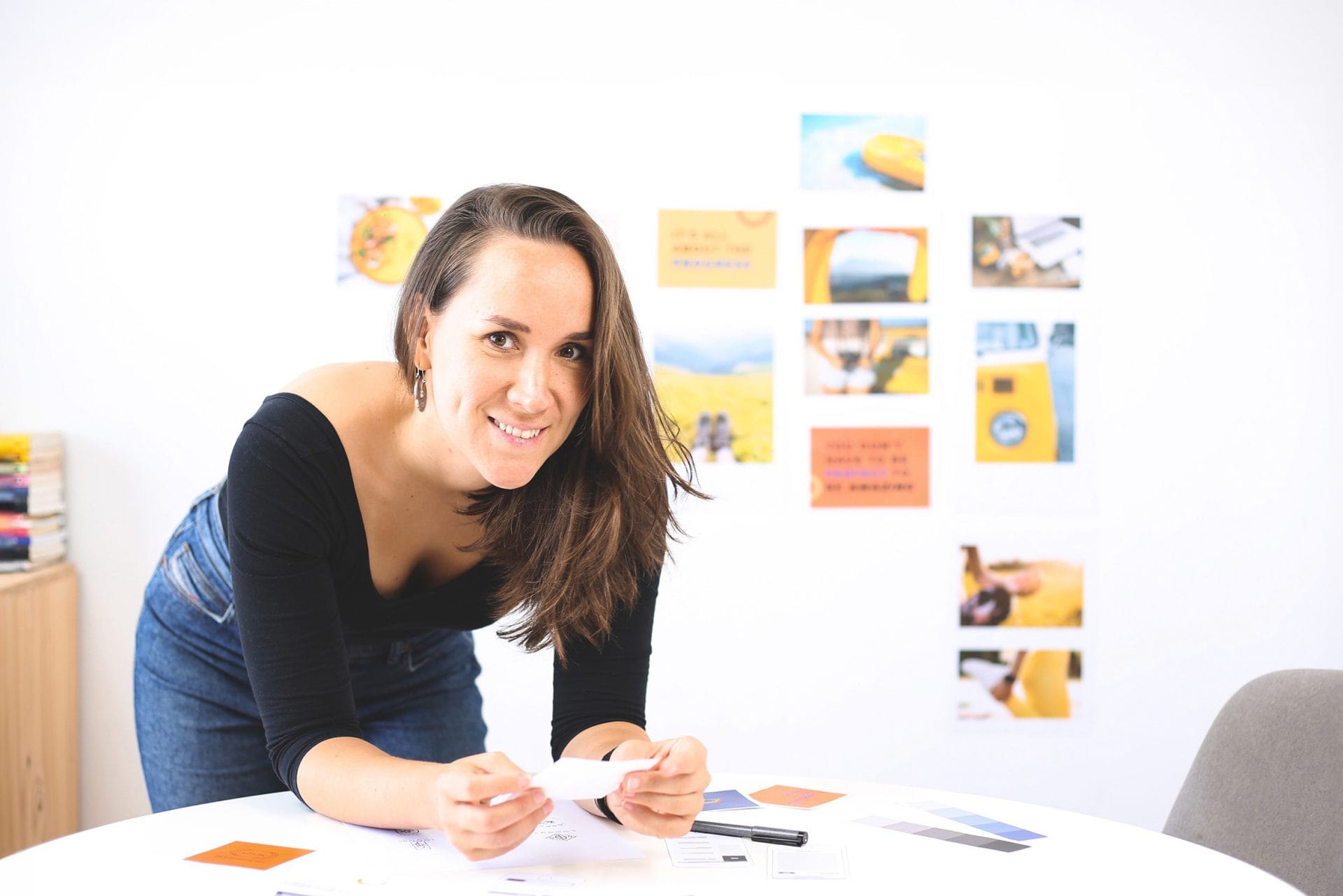
Alexandra Jeglitsch is on a mission to help early-stage entrepreneurs turn their ideas into launch-ready businesses. Since 2012, she has worked as a designer and brand & product manager alongside VC-backed startups and ambitious bootstrapped solopreneurs, guiding them from concept to traction.
With Expedition Solopreneur, she has built a framework that helps founders validate their ideas, craft a Minimum Viable Offer (MVO), and position their brand for launch, before they sink their time, money, and sanity into the wrong thing.
As the founder of LUA LAB (lualab.com), Alexandra specializes in BrandSprints, intensive branding workshops and done-for-you website & design solutions that take startups from scattered ideas to launch-ready clarity in just days, not months.
She’s seen firsthand what works, and what crashes and burns. Her approach is simple: start lean, test fast, and build a business that actually fits your life. Because if it’s not sustainable, it’s not a business.
What is your typical day, and how do you make it productive?
My days run on a mix of structure and flexibility. Three to four days a week, I trick myself into working out first thing in the morning: Pilates, yoga, or something that gets me moving before my brain can come up with excuses. Then, it’s coffee, a solid breakfast, and straight into deep work.
Mornings are for my business: tackling strategic work that moves the needle, whether that’s refining my frameworks, prepping workshops, writing content, or designing something new. Afternoons are for clients and mentoring: whether that’s a 1:1 idea ping-pong session, a BrandQuest workshop, or guiding a cohort of solopreneurs on how to launch their businesses without falling into the all-too-common startup traps.
Twice a week, I flip the script: I start work at 6 AM and wrap up by 1 PM, then spend the rest of the day in nature, exploring, or just catching up with friends. Because if I wanted a 9-to-5 schedule, I wouldn’t have built this life in the first place.
How do you bring ideas to life?
First Idea-Ping-Pongs. For me, nothing sparks innovation like bouncing ideas back and forth with a sparring partner. Usually, then comes is a point, when you’ve explored and exhausted all possible scenarios, ideas and thoughts and no more new things pop up.
So before I get stuck, I step away: wandering through the city, spending a few hours in nature, or just sitting at the waterfront with a notebook. Away from my desk, that’s usually when things start clicking and solidifying.
And then: a lean plan and step-by-step execution.
What’s one trend that excites you?
One trend that excited me, is definitely the democratization of entrepreneurship. You don’t need to be VC-backed, an MBA, or a developer to launch something meaningful anymore. No-code tools, lean startup principles, and solopreneurship are making it easier than ever to turn an idea into a business without waiting for permission or funding.
What is one habit that helps you be productive?
Rest. This might sound counterintuitive, but hustle culture is a scam. For years, I believed productivity meant pushing through exhaustion. Now, I’ve learned that rest is fuel. Taking actual breaks, disconnecting without guilt, and investing in my physical and mental health (shoutout to therapy!) make me 10x more effective.
What advice would you give your younger self?
One advice I would give my younger self is to advocate for yourself. Take up space, have an opinion, and stop waiting for permission. The right people will gravitate toward you. Also? Stop demonizing failure and get comfortable with it being a part of everyday life. F*ckups aren’t a bad thing, embrace them as what they are: data that’ll help you learn, improve and grow. In every aspect in your life. So, play, experiment, and fail forward.
Tell us something you believe almost nobody agrees with you.
Being a generalist is a superpower. Oftentimes, we’re told to specialize and narrow down, but I firmly believe, that connecting the dots across multiple fields often leads to the most innovative solutions. Also? Execution is infinitely more valuable than an idea itself. Everyone can have “great ideas”, but what defines success is who actually acts on them.
What is the one thing you repeatedly do and recommend everyone else do?
Therapy and yoga. One flexes the mind, the other the body. Both make life and business better.
When you feel overwhelmed or unfocused, what do you do?
My go-to remedy for when I feel overwhelmed or unfocused, is going for a walk. Preferably in nature, preferably with a view that stretches for miles—mountains, oceans, flatlands, viewpoints over city skylines… For me, distance (figuratively and literally) creates clarity. It really is like zooming out from a problem and realizing it’s not as big as it felt five minutes ago.
What is one strategy that has helped you grow your business or advance in your career?
One strategy, or more accurately learning that helped me advance my business, was ditching the ‘shoulds’ and embracing authenticity. I wasted years trying to sound “professional” with polished photos, corporate tone, the whole startup playbook, when in reality I was living as a digital nomad out of a tent for over a year and a half. It wasn’t until I finally started leaning into my real voice, my real experiences, and stopped trying to fit into someone else’s blueprint, that I started attracting my kind of people, my kind of clients and my kind of opportunities.
What is one failure in your career, how did you overcome it, and what lessons did you take away from it?
I co-founded a startup that failed because it ran out of cash. A brutal, expensive lesson actually many entrepreneurs and founders learn the hard way. The cycle went like it often does: You have a great idea. You spend ages writing a detailed business plan. You invest time and money in stuff like website, pitch deck, prototype. You pitch investors because you need funding. And then reality hits: Investors want traction to give you money. Clients want a product before they buy. You need money to build the product. You’re stuck in the loop. And at one point, the money’s gone and the momentum simply dies. The lesson I took away from this experience was to always start lean. Validating first. Building only after people are ready to pay. And that’s what I now preach over and over again: bootstrap smart, launch fast, and avoid the frustrating and draining startup death spiral.
What is one business idea you’re willing to give away to our readers?
Stop chasing “original” ideas. Instead, be open to observations, show empathy, listen to what people are complaining about. Find existing pain points and solve them. I, for example, struggle with keeping track of all the micro-decisions I make in a day. From what tools I tested, to why I chose a certain strategy, to that random genius idea I had in the shower but forgot by lunchtime. I’d love to pay for a tool that automatically records, organizes, and connects these scattered thoughts into actionable insights without me having to manually type them out. Maybe it’s an AI-powered decision log that integrates with voice notes, emails, and Slack. Maybe it connects the dots between past decisions and future actions, so I can see patterns and make better choices faster. Maybe it even warns me when I’m about to repeat a past mistake I forgot I made.
What is one piece of software that helps you be productive? How do you use it?
Honestly? The Notes app on my phone. I use it for everything: ideas, meeting notes, random thoughts, to-do lists. Simple, searchable and always in my pocket.
What is the best $100 you recently spent?
A membership in an entrepreneur community. Having a circle of like-minded founders is simply game-changing. When you’re building solo, the right network can totally make the difference between stagnation and momentum.
Do you have a favorite book or podcast from which you’ve received much value?
How I Built This. This podcast reminds me that every successful brand has a messy, uncertain, often even ridiculous backstory. No one has it figured out from day one. That’s a reminder all of us entrepreneurs need sometimes.
What’s a movie or series you recently enjoyed and why?
The Bear. A chaotic, beautifully shot masterclass in leadership, resilience, and turning a passion into a business—even when everything feels like it’s falling apart.
Key learnings:
- Start Lean, Test Fast, Build Smart
Test, experiment and don’t be afraid to fail. Bootstrap smart, pre-sell, and validate demand before you build or chase investors. - Execution over Ideas
Everyone has “million-dollar ideas,” but what separates successful entrepreneurs from the rest is execution and adaptability. - Hustle Culture is a Scam, Rest is a Strategy
Contrary to the grind-until-you-drop mentality, breaks and self-care aren’t indulgences but business strategies. Smart entrepreneurs build sustainable businesses that fit their lives—not the other way around. - Build Your Brand by Owning Your Story
Authenticity attracts your kind of people. Stop following someone else’s blueprint and lean into who you really are.