
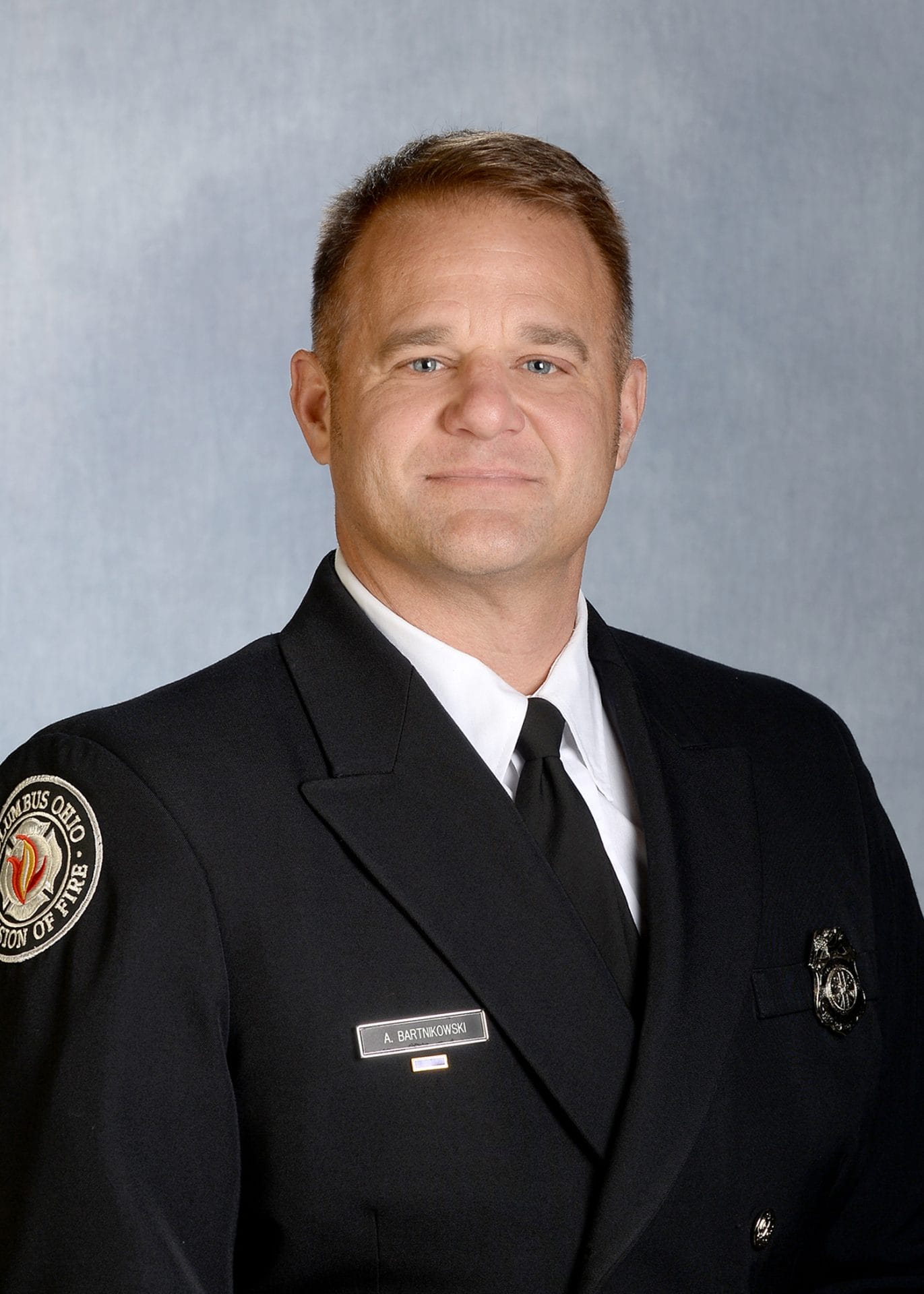
Andrew Bartnikowski brings more than two decades of diverse experience across the public and private sectors, encompassing emergency response, financial planning, program management, and professional training. Since 2012, he has served with the City of Columbus Division of Fire, following earlier tenures with the City of Worthington, OH, and Bluffton Township, SC. Over more than 10,000 emergency calls, Andrew has earned a reputation for rapid assessment, decisive action, and skilled team leadership.
In his capacity as Lead Paramedic, instructor, and mentor, Andrew has been instrumental in shaping the skills of recruits and seasoned personnel. He has led live fire training, coordinated large-scale preparedness drills, and implemented process improvements such as reducing patient care report times by 20%. Beyond field operations, Andrew has contributed as a union steward, a lead negotiator for a $300M labor contract, and a policy advisor on safety and EMS initiatives.
In 2012, Andrew founded the Class 12/10/12 Foundation, a 501(c)(3) nonprofit dedicated to supporting firefighter families affected by injury, line-of-duty death, or suicide. His leadership has helped raise over $150,000 for these causes. Earlier experience in skilled trades and financial services further enhances his operational insight and problem-solving capabilities.
A graduate of The Ohio State University with a BS in Resource Management, Andrew holds multiple advanced certifications, including Paramedic, Fire Instructor, HAZMAT Technician, and Rope Rescue. He is an engaged member of the International Association of Fire Fighters, the Ohio Association of Professional Fire Fighters, and Ohio State University Alumni Association, committed to service, leadership, and lasting impact.
What is your typical day, and how do you make it productive?
My day starts early, often before sunrise, with physical training and time for reflection to prepare mentally. At the firehouse, no two days are the same, which demands adaptability. I balance responding to emergency calls, mentoring newer firefighters, and ensuring equipment and systems are ready for use. To make each day productive, I focus on preparation and mindset. Productivity for me is not just about checking boxes; it is about being fully present in moments that matter, whether saving lives, guiding recruits, or advancing initiatives that improve safety and operational efficiency for our community.
How do you bring ideas to life?
Bringing ideas to life begins with listening. I pay attention to problems people are facing, whether on the fireground, in training, or in organizational challenges, and then brainstorm practical solutions. I collaborate with colleagues to refine those ideas, often testing them in small, real-world scenarios before scaling them. For example, when I identified inefficiencies in patient care reporting, I led testing of new software that ultimately cut reporting time by 20 percent. I believe ideas must be actionable, realistic, and serve people. Execution requires persistence, collaboration, and a willingness to adjust until the vision becomes reality.
What’s one trend that excites you?
I am excited about the integration of technology into emergency response and public safety. From advanced patient care software to drones for situational awareness, technology is becoming a force multiplier for first responders. These tools not only save time but also reduce risks for both firefighters and civilians. For instance, real-time data sharing between field teams and hospitals can significantly improve patient outcomes. It is exciting to think about how these advancements will shape the next decade of firefighting and emergency management. I see this as a chance to blend tradition with innovation in life-saving ways.
What is one habit that helps you be productive?
Consistency is my foundation. No matter how unpredictable the workday becomes, I stick to routines that ground me. Physical training is one, fitness is vital in this career but also clears my mind and keeps me disciplined. Another is reflection, often journaling after shifts to process experiences and extract lessons. These habits help me approach each challenge with clarity and focus. When chaos strikes, I can fall back on the mental and physical discipline I have built over the years. Productivity, to me, is more about being intentional and prepared than simply being busy.
What advice would you give your younger self?
I would tell my younger self to embrace patience and persistence. Early in my career, I wanted immediate results, whether in advancing through ranks, achieving financial goals, or solving big problems overnight. What I have learned is that real progress often comes slowly, through consistent effort, setbacks, and resilience. I would also remind myself to value relationships more deeply. The connections you build with mentors, peers, and community members will not only open doors but also sustain you during hard times. Trust the process, stay humble, and understand that growth is a marathon, not a sprint.
Tell us something you believe that almost nobody agrees with you on?
I believe failure is not only valuable but essential for leadership development. Many people avoid failure at all costs, but I have found that my greatest lessons came from moments where things did not go according to plan. For example, when a training exercise I led did not achieve the intended outcome, I initially felt it was a setback. But it exposed flaws in the system and inspired improvements that made our future drills more effective. Failure, when reflected on honestly, becomes the foundation of stronger leadership. It is not something to fear, but something to embrace.
What is the one thing you repeatedly do and recommend everyone else do?
I make time to mentor others, whether formally or informally. Mentorship does not just benefit the person receiving guidance; it sharpens your own skills, deepens your knowledge, and expands your perspective. I recommend everyone, regardless of career, invest time in helping others grow. Teaching a new firefighter how to stay calm under pressure or guiding a peer through contract negotiations reinforces my own leadership while passing forward knowledge that can save lives. Mentorship creates a legacy far bigger than personal achievements, and it builds stronger, more resilient teams in every field.
When you feel overwhelmed or unfocused, what do you do?
When I feel overwhelmed, I return to the basics: physical movement and deep breathing. A workout, even a short one, clears the mental fog. If I can, I step outside and get perspective by being in nature, even briefly. In the firehouse, I often reset by reviewing procedures or checking equipment, it gives me structure when my mind feels scattered. Reflection also helps; writing things down allows me to sort through chaos and prioritize. Most importantly, I remind myself that being overwhelmed is temporary, and clarity comes from steadying myself before taking the next step.
What is one strategy that has helped you grow your business or advance in your career?
Building trust through consistency has been my most effective strategy. Whether in emergency response, nonprofit leadership, or financial planning, people need to know they can count on you. By showing up prepared, following through on promises, and staying calm under pressure, I have built credibility that opened doors. For example, when I negotiated as part of the union committee, trust from both peers and leadership allowed me to influence outcomes on a 300 million dollar contract. Trust is the currency of leadership, and investing in it pays off across every role and stage of a career.
What is one failure in your career, how did you overcome it, and what lessons did you take away from it?
One failure came early in my career when I underestimated the complexity of a training program I was asked to lead. I assumed preparation alone would guarantee success, but the exercise quickly revealed gaps in communication and coordination. At first, I saw it as a personal failure, but I realized it was a leadership opportunity. I sought feedback, revised the program, and worked collaboratively with others to rebuild it. The lesson was humility, no leader succeeds alone, and adaptability, understanding that failure is not final if you treat it as a chance to grow and improve.
What is one business idea you’re willing to give away to our readers?
I believe there is an untapped opportunity in creating a platform specifically designed for first responder wellness and mental health, combining peer support, professional counseling access, and proactive resilience training. While there are general wellness apps, few address the unique pressures of firefighting, EMS, or law enforcement. A tailored platform could include real-time stress tracking, confidential resources, and community forums where first responders can connect. Given the high rates of burnout and suicide in these professions, such a business could have both profound impact and practical scalability, improving lives while filling a critical gap.
What is one piece of software that helps you be productive? How do you use it?
Google Workspace has been invaluable for productivity. Between union work, nonprofit responsibilities, and daily firehouse needs, I juggle multiple projects. Google Docs and Sheets allow seamless collaboration across committees and with external partners, while Google Drive keeps everything accessible on the go. The calendar function ensures I stay organized between emergency shifts, training sessions, and personal commitments. Its simplicity and integration make it easy to switch between roles without losing focus. In a job where seconds matter, having reliable tools to keep information organized and communication clear is a significant advantage.
Do you have a favorite book or podcast you’ve gotten a ton of value from and why?
One book that has impacted me deeply is Leaders Eat Last by Simon Sinek. It resonates because it emphasizes servant leadership, placing the well-being of others before your own, something that parallels life as a firefighter. The book gave me language to describe principles I had already been practicing: trust, empathy, and accountability. It also challenged me to think about leadership beyond emergency response and into organizational culture. The core idea, that leaders build safety so others can thrive, has influenced my union work, nonprofit efforts, and personal leadership philosophy. It is a resource I recommend often.
What’s a movie or series you recently enjoyed and why?
I recently enjoyed Only the Brave, which tells the true story of the Granite Mountain Hotshots. It is not just a movie about firefighting, it is a story about brotherhood, sacrifice, and resilience. Watching it reminded me of why I chose this profession and the realities first responders face. The film captures both the triumphs and tragedies of the job, making it deeply relatable. It also reinforced the importance of family, both at home and within the firehouse. I appreciated its honesty and respect for the profession, and it left me inspired and reflective.
Key learnings
- Consistency and trust are the foundation of leadership and career growth.
- Failure is an opportunity for reflection and long-term improvement.
- Mentorship benefits both the mentor and the mentee, strengthening teams.
- Technology can transform emergency response when paired with human judgment.
- Service to others creates meaning far beyond personal success.