
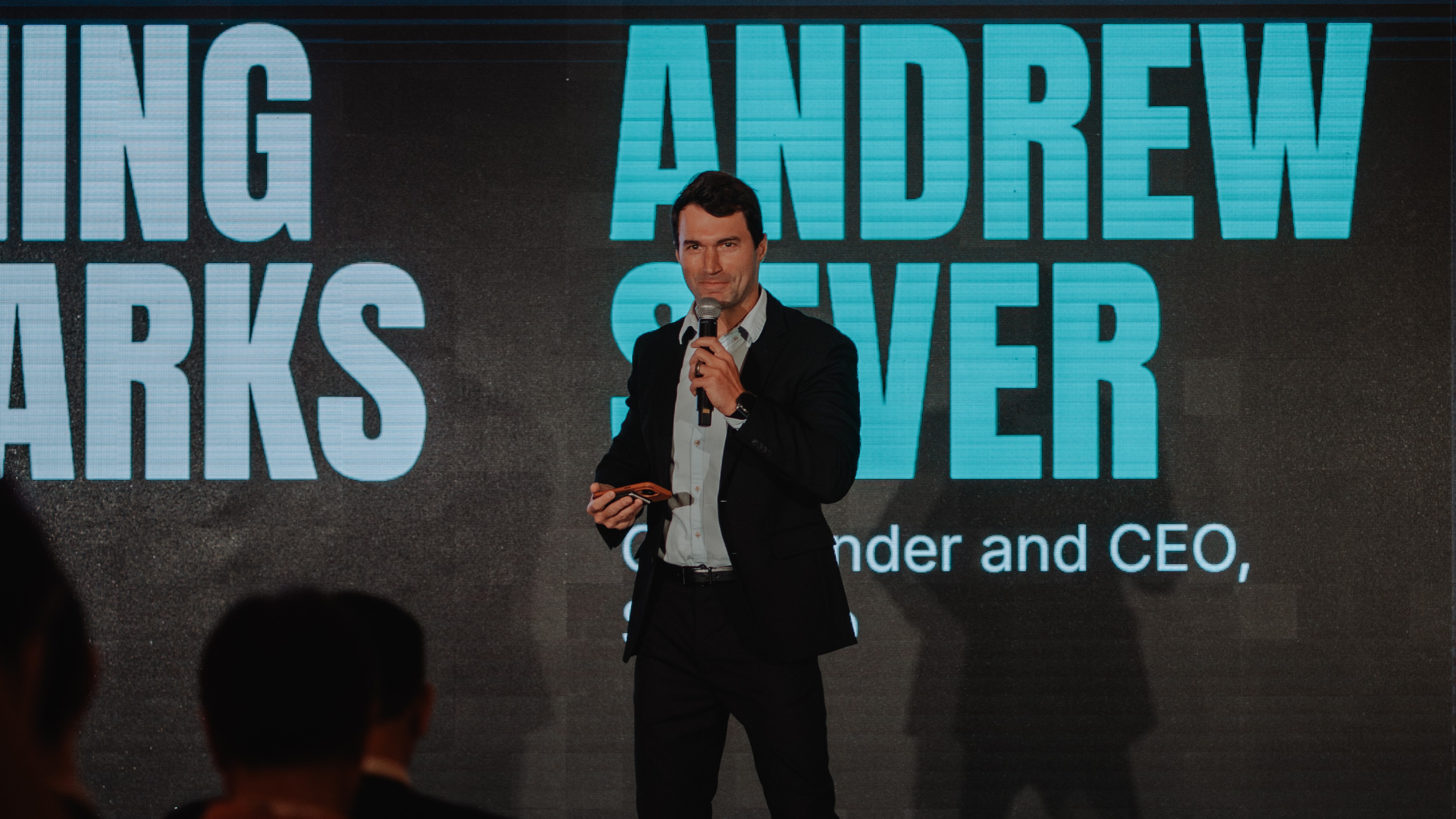
Andrew Sever, Sumsub co-founder and CEO, holds a degree in theoretical physics and formerly worked as a C-suite manager at several leading IT and automotive firms. Sumsub is a leading full-cycle verification platform that enables scalable, fraud-free compliance. Its no-code, adaptive solution covers everything from business and identity verification to ongoing monitoring, and it can quickly adjust to evolving regulations, risks, and market demands.
Sumsub is recognized as a leader in its field by Gartner, Liminal, and others. The platform combines seamless integration with advanced fraud prevention to deliver industry-leading performance. Sumsub currently boasts over 4,000 clients, including Avis, Bitpanda, Wirex, Bybit, Duolingo, Vodafone, Kaizen Gaming, and TransferGo. These clients trust the platform to streamline verification, drive growth, and prevent fraud. Sumsub continuously engages with leading research and public institutions such as the UN, Statista, and Interpol.
Mr. Sever is passionate about nurturing talent and ensuring the Sumsub team is able to effortlessly navigate challenges. He has a proven track record of building and leading exceptional teams and fostering effective, smooth collaboration in a fast-paced industry. His vision with Sumsub is to contribute to a future where digital experiences are secure and seamless for all, regardless of location, age, or tech expertise.
When he’s not working, Mr. Sever enjoys participating in triathlons and reading, particularly books on the subject of neuroscience. A dedicated animal lover (he has a dog called Nessie), he has introduced a pet-friendly culture across all the Sumsub offices with the aim of creating an emotionally healthy and positive work environment. Sumsub has also supported local dog shelters in London, Cyprus, and Serbia.
What is your typical day, and how do you make it productive?
My day starts early with a long walk with my dog, Nessie. It is the quietest part of the day, and it lets me look through messages, send a few thoughts to the team, and get a sense of what needs my focus once I’m back home. After that, the day becomes a sequence of calls, product discussions, and decisions that pile up.
If my schedule leaves a window in the middle of the day, I swim. It clears my head better than anything else. During the week, I cycle on the trainer, usually with work audio playing, so I stay connected while I train. Running happens late at night, often close to midnight, when the city is empty and thinking comes easier.
There is nothing dramatic in this routine. It is a simple structure that keeps me steady, helps me carry context across a long day, and gives me enough clarity to make good decisions.
How do you bring ideas to life?
Nothing at Sumsub is born in isolation. Ideas evolve through constant dialogue with my brothers, who co-founded the company with me, with our C-level team, and with people who challenge us. I rely on them heavily; we argue, test, refine, and eventually align.
The process is rarely linear. Someone brings a spark: a market signal, a client frustration, or an emerging risk, and then we dissect it from every angle. And each of us sees a different layer. Jacob follows crypto and industry shifts that signal where the market is moving. Peter brings regional and product clarity — UK, non-document flows, UX logic. Vyacheslav tracks big-tech trends and pressure points. My role is to connect these layers until they start forming a system. That’s when an idea becomes real, when it stops belonging to one person and starts belonging to the company.
What’s one trend that excites you?
What excites me is that we live in a world where you cannot rely on anything blindly anymore. We have to think, question, and check. This shift forces us to think critically and keeps the mind awake.
There is also the “democratisation of fraud”, as we call it internally. Anyone can access tools that used to be available only to a few. The whole landscape becomes more unpredictable and multilayered. It is not clear where things are going next, and for me that is the interesting part. I lose interest the moment everything becomes obvious. The work becomes exciting when the problem has many dimensions and you have to untangle them one by one.
What is one habit that helps you be productive?
I rely on something I call catching hyperfocus. When I enter that state, I can stay with one thing for hours. I can watch a long interview, work through a complex topic, or unpack a problem without noticing the passage of time. It is rare, but when it happens, it is highly effective.
To trigger it, I use a small psychological trick. I shift the internal deadline forward. If something is due on Friday, I tell myself it is due on Wednesday. It sounds simple, but it works. It creates just enough pressure to switch my brain into a sharper, more obsessive mode. Once I am there, the work moves fast and clean.
What advice would you give your younger self?
So I’d tell my younger self: keep doing what you do. Keep believing that it’s not about your ego or recognition. Stay curious long enough for that curiosity to become part of you.
You see there are two kinds of people: some build to be noticed, others build because they can’t stop thinking about how to make something work. We’ve always been the second kind.
We never built Sumsub to prove a point or to get attention. We built it because we wanted to understand why fraud keeps winning, why good users get blocked, and why the system isn’t fair. That curiosity slowly turned into an obsession.
There were plenty of moments when it wasn’t clear whether any of it would work. But we kept going, not out of ambition, but because we couldn’t leave the puzzle unsolved. Over time, the company stopped being just a business and became part of who we are. Every product decision, every client win or mistake – it all feels personal. That’s what keeps us moving forward.
Tell us something you believe that almost nobody agrees with you on.
I believe that most interactions are forms of manipulation and that they are not a moral problem but a natural part of how people communicate. We influence each other constantly. We push, we persuade, and we frame things in ways that make sense to us. Calling it manipulation does not make it evil. It just makes it honest. The most vigorous pushback usually comes from people who want communication to be sterile and perfectly defined.
And there is a second part to this: communication only works well when there is some sense of play. The moment everything becomes overly serious, people lose curiosity and stop seeing nuance. Communication is never neutral, and that is precisely why a bit of playfulness makes it functional. It keeps the negotiation human rather than mechanical.
What is the one thing you repeatedly do and recommend everyone else do?
I recommend taking your physical training seriously. Not for discipline or fitness, but because biology makes it very clear that the body and the mind are one system. There is no clean split between hardware and software. Your gut influences your brain, mitochondria communicate, and chemistry shapes how you think. Once you understand even the basics of genetics or cell biology, you see that movement is not optional. If you stop moving, you damage the system.
I think of it this way: you are the most complex and expensive organism you will ever manage. Treating yourself like a high-value system changes how you train, rest, and make decisions. And it only works when there is a mental anchor: a goal, a sense of direction, or the people around you. Without that, the whole structure weakens.
When you feel overwhelmed or unfocused, what do you do?
I’ve dealt with dyslexia and some version of attention variance my whole life. For years, I saw it as a flaw: I couldn’t sit still, couldn’t write linearly, and lost track in long meetings. It felt scattered. Then I discovered motion. Walking while thinking. Cycling during calls. Swimming before a big decision. Movement helps me metabolize complexity. It doesn’t calm me, but it clarifies me. Focus, for me, is about finding the right kind of motion.
I also change my sensory environment when I need a different type of focus. I use a reMarkable tablet for thinking and writing because it strips away every distraction. And I use adjustable white-noise headphones that let me build a sound environment — ocean, forest, even a cat’s purring. It sounds unusual, but it helps me cut the overload and stay inside one task.
What is one strategy that has helped you grow your business or advance in your career?
I pay close attention to people. Not just to what they’re good at, but to how their strengths fit together. That’s been the core of everything we’ve built. A company only scales when the right people collide at the right moment, not earlier, not later. My job is to recognise that timing and make those connections work.
The second part is pattern recognition. I’ve learnt to notice small shifts before they become obvious: a market that’s waking up, a region where regulation is about to tighten, a product line that needs to evolve. We made some of our best moves — APAC, reusable identity, deep compliance — because something in the environment felt unfinished or about to turn. I trusted that signal and then tested it fast.
Strategy, for me, is staying close enough to people, markets, and clients to sense when the ground is changing and having a team strong enough to move with it.
What is one failure in your career, how did you overcome it, and what lessons did you take away from it?
The real challenge for me was English. I was already running an international company, speaking to global teams and investors, yet I still could not express myself the way I needed. I had spent years learning through a method that does not work for a dyslexic mind, trying to memorise rules that never turned into real speech.
Eventually I dropped the whole system and rebuilt it from zero, using full phrases and real conversations instead of grammar theory. That was the first time the language started to make sense.
I still practise every day. I use real work discussions with my tutors to sharpen how I think and speak. For me it is an ongoing project, not a solved skill, and that is the part I like — to improve as long as you stay awake to your own weak spots.
What is one business idea you’re willing to give away to our readers?
I would rebuild the platform athletes use to work with their coaches. The entire market runs on outdated tools: data flows in from wearables and sensors, but nothing intelligent happens with it. It is all fragmented, slow and twenty years behind.
The idea is simple. Create a modern orchestration layer that unifies training data, understands patterns, and gives athletes real behavioural insight. Not another tracker, but a system that actually interprets how the body works and guides training accordingly.
It is not a small niche. Done properly, it is a few hundred million in value. If I had a parallel team, I would build it tomorrow.
What is one piece of software that helps you be productive? How do you use it?
Group chats in Telegram. They keep the company visible to me in real time. We have dozens of chats across products, regions and teams, and I read the key ones throughout the day. It gives a level of transparency and speed that Slack simply cannot provide in the same way, especially during fast growth. Telegram helped us stay connected when we were small and chaotic, and it still works for me now that the company is larger and more structured.
What is the best $100 you recently spent? What and why?
A new open-water swimming buoy. My previous one flipped during a six-kilometre swim and I lost all my gels and water, which was extremely inconvenient. The new buoy has a built-in bladder system and pockets for nutrition, so everything stays stable even in rough water. It sounds like a small upgrade, but for long distances it changes the whole experience.
Do you have a favorite book or podcast you’ve gotten a ton of value from and why?
The first is Siddhartha by Hermann Hesse. I read it when I was young, and it showed me something simple but important: one life can contain many dimensions. You can be wealthy, or ascetic, or searching, or calm, and none of these states are permanent. You move between them, and the meaning comes from the movement itself, not the role you happen to occupy.
The second is Fooled by Randomness by Nassim Taleb. It made me comfortable with the idea that every situation is unique and that past examples don’t define future outcomes. That book gave me the confidence to negotiate our first investment round in a way that made no sense on paper but made perfect sense in reality. It taught me to evaluate risk through context, not templates.
The third is The Ideal Executive by Ichak Adizes. It’s essentially a framework for understanding the different types of managers and why no one can embody all traits at once. It helped me see my team more clearly and build around strengths instead of trying to turn everyone into the same kind of leader.
Key learnings
- Bring together people who see different layers of a problem and turn their combined perspective into direction. Ideas do not always appear fully formed; they evolve through structured dialogue and the collision of different minds.
- Sport and longevity is a long-term design and can be more than a hobby. Training can engineer the physical and mental future you want, the same intentionality can be applied to building a company.
- Neurodivergence. While it can complicate linear tasks, it can also develop pattern recognition and unconventional problem-solving. It shows how cognitive differences can define both limitations and advantages in complex work.
- View the modern environment through the lens of uncertainty, where nothing can be taken at face value and every assumption must be tested.