
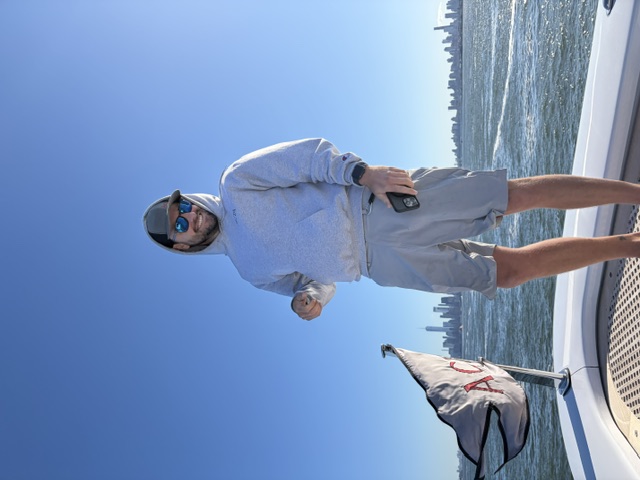
Chief Engineer aboard a 168-foot private motor yacht.
Woodrow Bach, who goes by Woody, grew up in Savannah, Georgia, before his family settled in Wellington, Florida, in 2003. His parents met while working on sailboats, traveling the world together long before he was born. That early exposure to boats and open water stuck with him.
At Wellington High School, Woody stayed busy. He played travel soccer for Wellington Wave and competed on the varsity men’s volleyball team, all while keeping his grades sharp enough to graduate in the top one percent of his class in 2009. From there, he headed to the University of Florida in Gainesville, where he studied Business Administration with a minor in Sports Management, graduating in 2013.
Instead of chasing a desk job, Woody chose the water. He followed the same industry his father had built a career in, working as a consultant and refit specialist for large private motor yachts. Woody started as a maritime engineer and spent the next 13 years working his way up through the ranks, gaining hands-on experience across Europe, the Caribbean, and the United States. That climb eventually led him to the role of Chief Engineer, a position he has held for the past two years aboard a 168-foot motor yacht.
The work keeps him away from home for long stretches, but Woody makes a point of prioritizing family time whenever he’s back in South Florida. On his days off, he’s usually on a golf course or out on the water with friends. He has also picked up construction skills along the way, helping friends renovate homes and build out commercial spaces for new businesses. It’s a life built on curiosity, patience, and staying close to the people who matter most.
What is your typical day, and how do you make it productive?
When I’m on rotation, my day starts early with a full walk-through of the engine room before the crew briefing. I check systems, review any maintenance flagged the day before, and prioritize what needs attention. I try to knock out the physically demanding tasks first, before the heat sets in, and leave the paperwork and reporting for the afternoon when things slow down.
How do you bring ideas to life?
I sketch things out on paper first, even simple diagrams, before I touch a tool or a system. It helps me spot problems before they become expensive ones. Then I talk it through with whoever else is involved, because a second set of eyes almost always catches something I missed.
What’s one trend that excites you?
I like seeing more yachts move toward hybrid propulsion and smarter energy management systems. It’s changing how engineers think about efficiency, and it means the job keeps evolving instead of staying static.
What is one habit that helps you be productive?
I do a full inspection walk every single day, no exceptions. Small issues are cheap to fix. Big ones aren’t.
What advice would you give your younger self?
Slow down and ask more questions early on. I spent some of my first years trying to prove I already knew the answer instead of learning the fastest way possible.
Tell us something you believe almost nobody agrees with you on?
I think being away from home for months at a time can actually strengthen relationships, not strain them. It forces better communication instead of relying on just being physically present.
What is the one thing you repeatedly do and recommend everyone else do?
Call your family regularly, even when there’s nothing new to report. It keeps you grounded no matter where in the world you are.
When you feel overwhelmed or unfocused, what do you do?
I step outside, even just to the deck, and reset with a few minutes of quiet before going back in.
What is one strategy that has helped you grow your business or advance in your career?
I made it a point to learn every system on every vessel I worked on, not just the ones tied to my job title. That range is what got me promoted faster than most.
What is one failure in your career, how did you overcome it, and what lessons did you take away from it?
Early on, I underestimated how long a repair would take and gave the captain a timeline I couldn’t hit. I learned to build in buffer time and communicate delays before they become surprises.
What is one business idea you’re willing to give away to our readers?
A remote parts-sourcing service for yachts stuck in ports without easy access to specific marine equipment. Engineers lose days waiting on shipments that could move faster with the right local network.
What is one piece of software that helps you be productive? How do you use it?
I use a maintenance tracking app to log every task and part replacement. It keeps history organized so nothing gets missed between rotations.
Do you have a favorite book or podcast you’ve gotten a ton of value from and why?
I read broadly, not just about engineering. Nonfiction on decision-making under pressure has helped me handle situations at sea where I have to think fast with limited information.
What’s a movie or series you recently enjoyed and why?
I enjoyed a docuseries about commercial fishing crews. It reminded me a lot of yacht life: long stretches away, tight teams, and no room for sloppy work.
Key learnings
- Learning every system on a vessel, not just the ones tied to a job title, can speed up career advancement.
- Building buffer time into repair estimates prevents small delays from turning into trust issues.
- Daily inspection habits catch small problems before they become costly ones.
- Staying in regular contact with family helps offset the strain of long stretches away from home.