
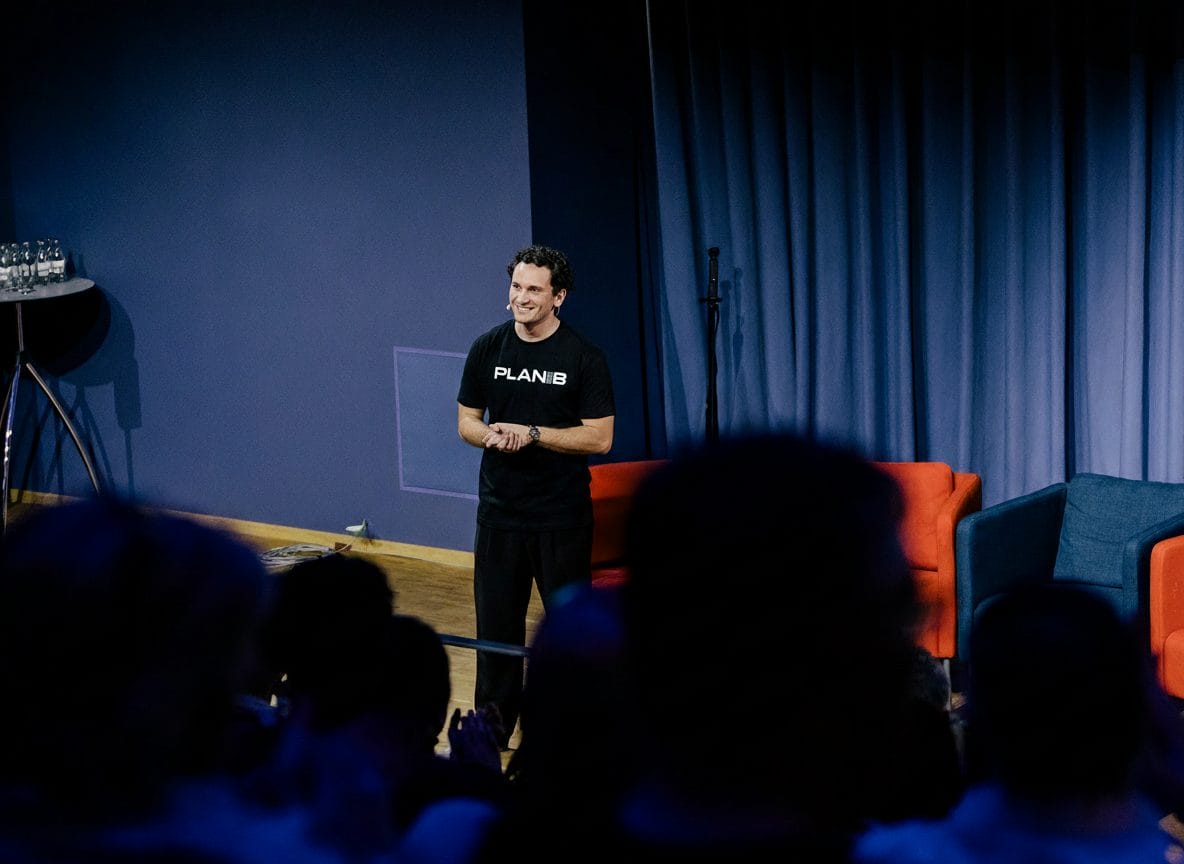
Bradley Mundt is the founder and CEO of Plan B Net Zero, a Swiss-based greentech company revolutionising the energy sector through technology, community engagement, and lifestyle integration. Since founding the company in 2023 with an initial investment of €10 million, Bradley has led Plan B Net Zero to €60 million in projected revenue by the end of 2025, establishing it as one of Germany’s fastest-growing energy providers.
Named to Business Punk’s Top 100 Watchlist in 2024, Bradley is recognised as a leading innovator in the energy transition. He pioneered the concept of “Neo-Energy,” transforming sustainable electricity from a commodity into a lifestyle product through AI optimisation, gamification, and a comprehensive ecosystem of non-energy services.
At 26, Bradley’s unconventional path to entrepreneurship combines technology expertise gained at Apple with financial market experience in day trading. Coming from an entrepreneurial family, he chose to leave university after his first semester to pursue his vision for accessible, intelligent energy solutions. This decision was catalysed by the 2022 energy crisis following the Ukraine conflict, when Bradley recognised the need for affordable, sustainable energy accessible to everyone regardless of income level.
Under his leadership, Plan B Net Zero has distinguished itself through rapid customer onboarding (10 minutes versus industry standard 45 minutes), transparent weekly pricing updates, and positioning among Germany’s top three cheapest green electricity providers. The company’s technology platform integrates AI-driven optimisation, battery storage systems, and smart home connectivity to deliver measurable cost savings while reducing environmental impact.
A former professional athlete, Bradley applies discipline from competitive sports to business leadership, maintaining rigorous routines including CrossFit training and meditation. He leads a team of energy industry veterans with 20-40 years of experience each, combining youthful innovation with deep sector expertise.
Bradley is preparing Plan B Net Zero for public markets, with clear IPO ambitions that reflect the company’s strong recurring revenue model and ambitious growth trajectory across German-speaking markets.
What is your typical day, and how do you make it productive?
I tend to work late and go to bed late, often past midnight. When I can, I sleep in a little. My sport usually happens in the evening, not the morning. It sounds like a strange routine, but it works for me.
I’ll do some form of sport – CrossFit, surfing if I’m near water, or just a run. Movement clears my head. Then I have a proper breakfast. I used to skip it when I was younger, thinking I’d save time, but I’ve learned that fueling your body properly actually makes you sharper throughout the day.
The rest of the day is meetings, decisions, and solving problems as they come up. I come from day trading, where you learn to make decisions without letting emotions drive them. I used to think emotional neutrality meant switching feelings off completely. What I’ve learned is that emotions don’t disappear; they just change form. The real work is noticing them early and deciding not to act on them.
What keeps me productive is that morning routine and knowing when to laugh. Taking work seriously without taking yourself too seriously makes a huge difference.
How do you bring ideas to life?
I tend to work late and go to bed late, often past midnight. When I can, I sleep in a little. My sport usually happens in the evening, not the morning. It sounds like a strange routine, but it works for me.
I’ll do some form of sport – CrossFit, surfing if I’m near water, or just a run. Movement clears my head. Then I have a proper breakfast. I used to skip it when I was younger, thinking I’d save time, but I’ve learned that fueling your body properly actually makes you sharper throughout the day.
The rest of the day is meetings, decisions, and solving problems as they come up. I come from day trading, where you learn to make decisions without letting emotions drive them. I used to think emotional neutrality meant switching feelings off completely. What I’ve learned is that emotions don’t disappear; they just change form. The real work is noticing them early and deciding not to act on them.
What keeps me productive is that morning routine and knowing when to laugh. Taking work seriously without taking yourself too seriously makes a huge difference.
What’s one trend that excites you?
The shift toward purpose-driven business that actually delivers results, not just good intentions.
For too long, people accepted that you either build a profitable company or build something that helps the world. I reject that completely. We’re proving at PLAN-B NET ZERO that you can revolutionize an entire industry, make energy fair and transparent, AND build something economically powerful.
What excites me is seeing more founders realize they don’t have to choose. You can change the world and build something viable. In fact, you have to do both – purpose without viability is wishful thinking, and profit without purpose is empty.
What is one habit that helps you be productive?
Two things that make a huge difference:
First, music between meetings. Even just a minute. It completely resets my mindset and sparks creativity. I’ll put on something completely different from what I was just doing – it clears my head and helps me approach the next conversation fresh.
Second, variety throughout the day. The more different the tasks and meetings are, the better I perform. If I’m doing three strategy meetings in a row, my brain gets tired. But if I go from strategy to operations to a creative discussion to something hands-on, I stay sharp. Switching contexts keeps me engaged.
What advice would you give your younger self?
Just keep going. Have fun. Stay on your own path and don’t look at what others are doing.
I never spent much time comparing myself to others. I always knew there would be someone stronger, faster, or further ahead than me. But that never shook me. I believed in myself and kept my focus on my own goals, not on what anyone else was doing.
The world will tell you to be realistic, to follow a proven path, to look at what successful people did and copy that. But your path is your own. Stop waiting to feel ready. Just start, keep going, and stay focused on where you want to go, not where others already are.
Tell us something you believe almost nobody agrees with you on?
That credentials don’t determine who gets to build the future.
I know this sounds controversial, especially in Europe where traditional education paths are highly valued. But when I look at what actually moves the needle on the biggest challenges, it’s not the people with the most prestigious degrees. It’s the people who refuse to accept that things have to work the way they always have.
Countries and political bodies give subsidies then take them back, make promises then reverse course. Banks and traditional corporations are losing their power and relevance. The future belongs to purpose-driven founders who believe they can create revolutionary change, regardless of their credentials.
That’s where transformation happens – not in boardrooms or policy debates, but in people building something better.
What is the one thing you repeatedly do and recommend everyone else do?
Build a strong team based on character, not just skills.
Right now, PLAN-B NET ZERO is scaling rapidly, transforming how an entire industry works. None of that happens without the right people. And I’ve learned that character matters more than credentials or experience.
I look for people who genuinely care about what we’re building. Not just employees showing up for a paycheck, but people who feel true ownership. People who will disagree when they think something’s wrong, who have fun with what they are doing, who want this to succeed as much as I do.
The key is incentivizing them to feel that ownership. When your team truly cares, when they’re willing to push back on your ideas because they’re invested in the outcome, when they’re fighting for success together – that’s when something special happens.
Skills can be learned. Character and genuine investment can’t. Build a team that actually gives a damn, and everything else follows.
When you feel overwhelmed or unfocused, what do you do?
I listen to my body and mind. Basics first – everything else follows.
When I’m off, it’s usually something simple: I haven’t eaten properly, I haven’t taken a break in hours, I’m running on fumes. Your body tells you what it needs if you actually pay attention.
So I do the basics: eat something real, take a short break, move around. Sometimes I’ll listen to music, go for a quick walk, surf if I can. But it always starts with the fundamentals – fuel your body, give your mind space to reset.
The key is catching it early. Don’t push through until you’re completely burned out. Notice when your focus is slipping, address the basics, then get back to it. Simple, but it works.
What is one strategy that has helped you grow your business or advance in your career?
Being an outsider was probably my biggest strategic advantage.
I came into the energy industry without a single year of experience in it. No preconceptions about how things were supposed to work, no loyalty to the old model. Analysts from major banks and institutions told me from the beginning that what I was building had never been done before. At first I found that hard to believe. But eventually I realized it was true, and that the reason it hadn’t been done was precisely because people inside the industry couldn’t see past how things had always worked.
My newcomer perspective let me ask questions that insiders wouldn’t ask. Why are customers left completely in the dark about what they’re paying for? Why does switching providers feel so complicated? Why is energy just a bill, not an experience? I wasn’t constrained by what was supposedly possible, so I could build toward what was actually needed.
The strategy that actually helped me grow was staying true to that outsider thinking even as the company scaled. The moment you start defending the status quo, you stop being the disruptor. I never let myself get comfortable with the existing playbook.
The lesson I’d pass on: not knowing how things are supposed to be done is not a disadvantage. It’s often the clearest competitive edge you can have.
What is one failure in your career, how did you overcome it, and what lessons did you take away from it?
Through 2024 and into 2025, we relied almost entirely on traditional comparison websites to acquire customers. It worked – we grew quietly and efficiently. But it also made us nearly invisible as a brand.
The failure was waiting too long to build PLAN-B NET ZERO as a recognizable name, not just a good deal on a comparison site. We were so focused on operational excellence and competitive pricing that we underinvested in marketing and brand presence.
We overcame it by making a dramatic shift. We increased our marketing budget by 10-20x, launched social media channels, started placing myself at industry events, began press relationships like this one, and built a comprehensive marketing strategy.
The lesson: If you’re building something revolutionary, people need to understand why it’s revolutionary. Being the best-kept secret isn’t a virtue when you’re trying to change an entire industry. You have to show up and tell that story.
What is one business idea you’re willing to give away to our readers?
A platform that helps people understand how every innovation builds on what came before – a visual map of technological progress.
Most people think breakthroughs happen in isolation, but progress compounds. Every modern innovation stands on the shoulders of dozens of earlier discoveries. There’s an opportunity to build something that shows those connections – how the smartphone wouldn’t exist without the transistor, which wouldn’t exist without quantum mechanics research, which wouldn’t exist without earlier mathematical breakthroughs.
This would be valuable for students, investors, policymakers, and anyone trying to understand where innovation actually comes from. It would show people that revolutionary change comes from many ideas working together, not one lone genius.
Someone should build this. Understanding how progress actually happens would help more people contribute to it.
What is one piece of software that helps you be productive? How do you use it?
Honestly, I try to minimize software complexity. Too many tools become a distraction rather than a productivity aid.
What matters more to me is the principle behind good software: it should solve problems invisibly. The energy optimization algorithms we’re building at PLAN-B NET ZERO work in the background, making people’s lives better without requiring them to think about it or manage settings.
That’s the standard I hold everything to. If a tool requires constant management and attention, it’s not actually making you more productive – it’s just creating different work.
The most useful “software” for me is probably just my phone’s Do Not Disturb function. Sometimes productivity comes from knowing when to disconnect and ground yourself.
What is the best $100 you recently spent? What and why?
Two video games – Resident Evil (the latest one) and Arc Raiders. Gaming online with friends is honestly some of the best time you can spend. You’re completely in the moment, laughing, strategizing, just having fun together. No business talk, no pressure, just playing.
I also grabbed “The Ultimate Guide to Rebuilding Civilization” recently. It’s not a serious read – more of a fun, entertaining reference full of survival basics and cool information. Great vibes, interesting to flip through, the kind of book that sparks random conversations.
The best investments aren’t always the most productive ones. Sometimes they’re the ones that remind you to actually enjoy life, connect with friends, and not take everything so seriously. For me, that’s gaming with people I care about and reading something just because it’s interesting, not because it’ll help me build a better business.
Do you have a favorite book or podcast you’ve gotten a ton of value from and why?
Two podcasts I genuinely love:
Joe Rogan – for the fun and interesting non-serious topics. It’s great to just listen to conversations that aren’t about business or strategy, where people are just exploring ideas, being curious, having fun. It’s a reminder that not everything has to be purposeful or productive.
Diary of a CEO – this one’s genuinely addictive. Every episode is endlessly relevant, whether it’s business, psychology, personal development, or just how successful people think. Highly recommended. I find myself going back to specific episodes when I’m working through something.
I don’t listen to many podcasts, but these two cover different needs – one for fun and curiosity, one for actually learning and growing. Both are worth the time.
What’s a movie or series you recently enjoyed and why?
I rewatched the entire Marvel Infinity Saga, for the first time since Endgame. And it was better than I expected. The way the stories of the individual characters interweave is really impressive. I normally never watch things twice, but here I went through the whole sequence. Absolutely worth it.
Key learnings
- Purpose-driven business can be revolutionary and economically powerful simultaneously – you don’t have to choose between changing the world and building something successful.
- Action beats perfect planning – change happens through trial and error in much smaller steps than you imagine. Just start, learn by doing, adjust as you go.
- Being genuinely first in your category matters more than being marginally better – revolutionary concepts attract resources and attention that incremental improvements never will.
- Character over credentials in team building – skills can be learned, but genuine investment and the willingness to fight for success can’t be taught.
- Listen to your body and mind first – basics like eating well and taking short breaks aren’t luxuries, they’re the foundation that makes everything else possible.