
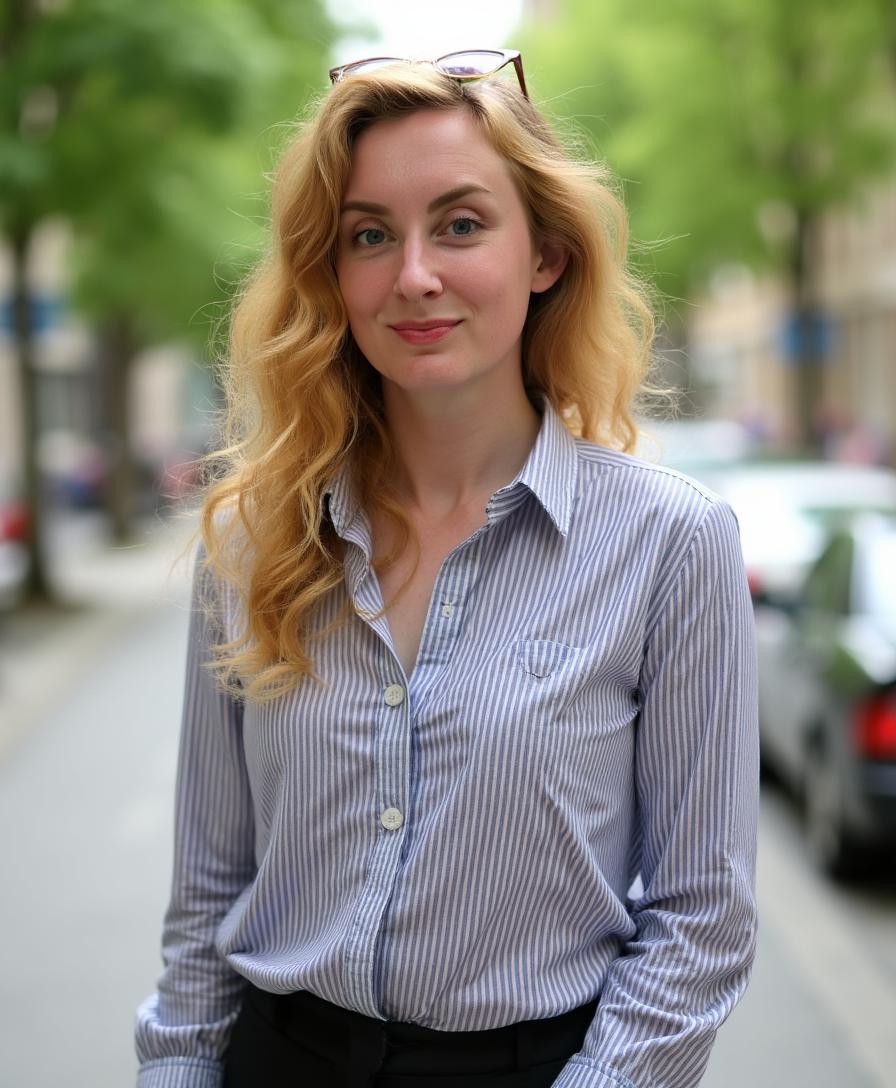
Briana Gilmore has served as the Head of Global Accessibility Policy at Uber in Washington, DC, since 2022. In this role she develops internal policy and operational goals, and aligns cross-functional product and engineering strategy. Briana Gilmore has co-designed several accessibility features alongside users and community disability experts, launching in-app personalization enhancements and a feature designed for older adults.
Briana Gilmore previously spent four years as a policy and strategy consultant working with various technology, government, and non-profit organizations, preceded by more than three years as the director of policy and planning at a NYC-based supportive housing, crisis respite, and peer support organization. She has also worked as a psychiatric survivor and housing advocate, Medicaid/ Medicare policy and financing strategist, and has designed and executed trainings and credentialing standards for peer support providers and harm-reduction-informed suicide prevention specialists.
In 2016, Briana Gilmore received the Advocacy Champion Award for her advocacy work that led to the creation of Crisis Intervention Teams in New York City. She has published several articles on urban planning and public health strategies during her career. She has taught university classes as an adjunct professor at New York University, Columbia University, and Towson University. She is also a published poet and sought-after keynote speaker.
She graduated with honors from Hofstra University with a degree in political science and sociology. She continued her education at the University of Amsterdam, earning a master of science in urban planning and international development with honors.
What is your typical day, and how do you make it productive?
I’m proud of the energy I bring to my paid work, but I don’t hold any value around productivity and actively try to interrupt the shame-reward cycle that often accompanies dedication to productivity.
My goal every day is to listen to my own rhythm and balance that with my daily obligations and weekly goals. Some days that looks like motivated 12-hour stretches at my laptop and in collaborative work. And some days that means spending an entire Tuesday morning journaling, reading speculative fiction novels, exercising, and doing my intuitional and meditation practices. Not only does this keep me more creative and “productive” overall, but it also disrupts the ableism and sexism inherent to the typical corporate workday.
I’m grateful for the flexibility I have that enables me to be body-, energy-, and spirit-led in the ways I move through my day.
How do you bring ideas to life?
I’m a dialectic processor and generate and create in conversation and hyper-analysis. So, a spark of an idea scribbled on a napkin or in my notes app is most often—depending on the space it inhabits in my life—explored with my closest friends, product managers, users, experts, and then often analyzed out loud to myself on long walks. I also often analyze ideas in “conversations” that I materialize—playing both conceptual roles in my mind or out loud—with authors while reading their articles or books.
In order for me to activate an idea, I need to explore the breadth and depth of it first, challenging every assumption I can conceive of and understanding what others have already created with and surrounding it. I feel like my process is incredibly stressful for allistic people! It can look like procrastination or even thought-paralysis, because a lot of it happens at rest and in a physical flow-state. But for my neurodivergent brain, it’s the most efficient and effective way to execute an idea.
What’s one trend that excites you?
I’m excited about the trends in women’s entrepreneurship.
American women are opening 50% of all new businesses; the rate of new companies opened by women have doubled in the past four years. I think this trend is correlative with the ways women are sharing more of our stories about misogyny, sexual assault and harassment, and narcissistic abuse that we’ve encountered in the workplace. Women want agency and safety in a working environment and are tired of navigating coercion while spending their energy investing in companies that harm our communities.
Women are predominantly opening businesses focused on social entrepreneurship, environmental sustainability, and Femtech. One of my friends and I are launching a coaching business later this year and aligning with her on the work we want to do has been liberating and motivating.
What is one habit that helps you be productive?
I read almost every morning for 20 to 60 minutes. Reading has been my favorite hobby since I was a kid, but in 2020, I had a tough realization: I hadn’t finished a book in a year, and when I tried to pick one up at the beginning of quarantine, I could barely read a page before I got distracted or my attention shifted to my phone.
Technology had eaten away at this form of focus and singular attunement. So, I started retraining the muscle. I set an alarm for 5 minutes, then 10 minutes, and gradually increased my ability to stay present again with the page. Perhaps unsurprisingly, I regained focus in every area of my life and was better able to manage periodic anxiety. One of my favorite quotes of all time is James Baldwin’s: “You think your pain and your heartbreak are unprecedented in the history of the world, but then you read.
It was books that taught me that the things that tormented me most were the very things that connected me with all the people who were alive, who had ever been alive.” Reading improves my clarity, empathy, creativity, and intrinsic attunement. Each of these skills is essential for me to stay embodied and connected with my work; they help me make clear decisions and instantly recognize complex dynamics impacting a decision or system.
If you’re unmotivated: read. If you’re overly stressed and have no free time in your day: read. If you feel too overwhelmed by the state of the world to be productive: read. If you’re fighting with your partner: read. Take your time, and you’ll find the space and freedom you’re looking for.
What advice would you give your younger self?
I’m really into learning about the recent-ish quantum entanglement simulations that point to the ability to impact the past through present action. There’s a lot I wish I could change for my younger self—and I mean my younger self of 20 and 30 years ago and my younger self of six months ago. She went through things she didn’t deserve and had to figure a lot out that she should have had guidance and support to navigate. Now I’m finally the adult that she needed and didn’t have.
I have a strong relationship with my past selves that I cultivate consistently. It’s as important as any relationship I maintain with a friend or family member. I speak to her compassionately and give her guidance she never had. If you extrapolate the early-stage theoretical basis of current quantum entanglement research, I can project into the future to assume that my future, even-wiser self is in active and loving relationship with me at my present-state. She’s mentoring me toward the life of our dreams.
Tell us something you believe that almost nobody agrees with you on.
I think the Americans with Disabilities Act gives disabled Americans about as much freedom and protection as the “don’t ask, don’t tell” policy impacting LGBTQIA military service members did.
The foundational law governing our protections should be celebrated and fiercely protected. And also, it was never met with the funding required to uphold it; it’s currently outdated in an era of tech-enabled hyper-personalization, and it resides in a 1990s-era liberalist fantasy that systems will correct around function as long as people keep their mouths shut and don’t remind everyone that they have unique needs.
The ADA is meant to respect our privacy, but we have to go to court to beg for access and humiliate ourselves to prove that we’re disabled enough for benefits and accommodations. I’m not certain how controversial this really is within the disability community. I’ll defend the ADA with everything I have, but I also recognize that we’re living with a disjointed legal foundation.
What is the one thing you repeatedly do and recommend everyone else do?
Tell your friends you love them. Make it weird in the best of ways. Text them to make sure they got home safe. Buy little things that remind you of them and gift them on days that have no significance. Make them dinner when it’s not a special occasion. Send them silly cards in the mail.
When you feel overwhelmed or unfocused, what do you do?
I take a walk, talk to my plants, call a friend, wash some dishes, or listen to the “K-Pop Demon Hunters” soundtrack and try to hit the high notes.
What is one strategy that has helped you grow your business or advance in your career?
My career choices don’t usually make sense to people when they see what roles I’ve taken. I’ve never done the next-obvious thing. In each of my jobs, mentors and bosses and colleagues always had ideas about what my next goal should be: the next promotion schedule on the policymaker table, the next leadership rung in an advocacy system, the next executive role in the service organization, or maybe a horizontal pivot from a program to a payer, a consultant gig to a full-time role executing the vision. And I did none of that. I just followed the thing that bothered me the most.
I followed the thing that kept me up at night because it wasn’t changing fast enough or in the right direction. I would find a team or entry point that could offer a new approach or at least a commitment to creative adjustment, and I’d dive in. I think that if you’re moving in the direction of a conviction, you’re also going to be motivated to adapt, learn new skills, and stay curious about what’s possible. I’ve always been able to use this approach to build momentum and find my trusted collaborators.
What is one failure in your career, how did you overcome it, and what lessons did you take away from it?
I overcome failures every day, and I don’t know that I consider the big ones I’ve overcome as particularly interesting. I only think about the ones I didn’t overcome—the ones I couldn’t “lean in” to or “resilience” my way into a success narrative.
A few years ago, when I was taking consulting contracts, I had the honor to support one of my mentors as she transitioned out of an executive director role nearing the end of her life. Her cancer prognosis was suddenly urgent, and her small but influential nonprofit advocacy organization wasn’t equipped to manage a search for her successor. But they also weren’t equipped to hire the right person. My mentor had chronically overworked and undersold her labor for years, and we lost the perfect candidate when the salary offer wasn’t commensurate with the reality of the job. The second-perfect candidate was overlooked for the wrong reasons. I advocated against extending the offer to the third candidate, but as a consultant, it didn’t feel like my role to intervene when they decided to anyway. And that candidate quickly mismanaged longstanding contracts, degraded the organizational culture, and stole from the nonprofit before moving out of state without notice.
It’s been devastating to watch the failure unfold and recognize my role in it. I regularly look at this lesson and try to answer the questions it presses on me: how can community-based advocates build collective power through financial abundance so they can personally thrive, rather than settle in a scarcity outlook? How do we build enough safety in our systems where we can balance attunement to culture with insistence on accountability? How can we slow down enough to stay in integrity, when the people around us move quickly in ways we’re convinced disrupt a values system? How do we keep the courage to change course even, and especially, after the wrong decision has been made? I look at this as a lesson in the tension between collective momentum and personal responsibility.
Sometimes we can get lost in what role we’re supposed to have instead of moving in full integrity. I’ve learned I can’t be so egotistical as to believe that I don’t have tremendous power. I have to remember that each of my decisions and words can fundamentally impact the trajectory of the world around me. I have to be fearless in my commitment to personal integrity in every aspect of my life and compassionate enough to figure out how to slow down the people around me when they are acting in a way that threatens shared values or collective well-being. And then I have to point to the gap gently, listen, hold a hand, or help build a bridge toward the right solution.
What is one business idea you’re willing to give away to our readers?
I am desperate for someone more talented than me to solve my longest ongoing mental spiral.
Every day, there are millions of people exercising in roughly 100,000 gyms in the US alone. Each of these people is generating energy through physical exertion. And it goes NOWHERE. Every machine and weight in every gym should be connected to a battery, and all of that stored energy should be reused.
If it’s inefficient to send back to a grid, the energy at minimum could surely be used to simply power the energy used by the gym itself. Am I delusional? Is that not possible? Please someone figure that out or at least explain to me why it’s infeasible!
What is one piece of software that helps you be productive? How do you use it?
I’ve had a meditation practice since 2009 but, in recent years, I’ve really struggled to connect with it. I’ve always avoided meditation apps because I have a very particular practice, and I assumed their approaches would feel performative or derivative. But a few months ago, I decided to try Headspace, and now I’m hooked! I fell back in love with my practice.
I think the app is designed simply and intuitively, with enough room to explore without being overwhelming. The approaches in the guided meditations are broad enough to encompass all philosophical methods without becoming vague or diluted. I also like that there’s a balance of acknowledging progress without gamifying your intuitional practice.
What is the best $100 you recently spent? What and why?
I spend about $100 a month on supplies I keep in my car to hand out to my neighbors who live outside. I fill Ziploc bags with socks, snacks, and some cash, and hand it out the window when I see someone asking for money.
Most unhoused folks who sacrifice their pride and self-concept to ask for money deal with the daily humiliation of being ignored, dehumanized, and sometimes attacked by people for no reason. Smiling and saying hello and giving someone the smallest things that might make their day easier is the simplest way I’ve found to feel closer to my community and humanity.
I know this might read as self-righteous, so I want to acknowledge that it’s somewhat selfish. I think most of us feel really lonely, disconnected, and overwhelmed by the state of our world right now. Sometimes handing someone a sports drink or a cigarette out of my car window is the only moment in my day when I feel explicitly and tangibly useful.
Do you have a favorite book or podcast you’ve gotten a ton of value from and why?
I’ll never have enough time to gush about the books and podcasts I love Adrienne Maree Brown’s “Pleasure Activism,” N.K. Jemisin’s “The Broken Earth” trilogy, and Siddhartha Mukherjee’s “The Emperor of All Maladies” will forever ripple through my life.
The way these books weave together in me would help anyone understand what’s most important to me and my values: my pleasure politic; my dedication to the intimate practice of knowing, loving, and forgiving my disabled colonizer’s body; and my humble efforts to become a good ancestor.
I’m also thrilled by current trends in American surrealistic fiction, so honorable mentions must go in particular to the haunting worlds created by Anne de Marcken in “It Lasts Forever and Then It’s Over” and everything Mona Awad has published.
I listen to podcasts for approximately eight hours a day, because my brain stays focused and creative when it has a separate and consistent talk-track in the background. Caleb Hearon’s “So True” podcast has made me a smarter, funnier, and happier person. We’re so lucky to live at the same time as these creators.
What’s a movie or series you recently enjoyed and why?
I recently started rewatching the TV series “The Magicians,” which is an adaptation of Lev Grossman’s book trilogy, which is an all-time favorite and is also, in my opinion, the best-produced audiobook I’ve listened to. The fantasy story offers a helpful allegory for our current political and cultural climate and may be particularly relevant to people in my Millennial generation.
On the whole, it’s a somewhat classic modern coming-of-age fantasy about a group of college-age students learning about life and love while they clumsily wield magic in an epic battle between good and evil. But as the story develops, a devastating throughline emerges about the ways nostalgia for our childhood cultural cues can become complicated by the realization that they were informed and intertwined with the priorities of child sexual predators.
And while the story follows a band of people, there’s a mid-trilogy shift in protagonist focus when one of the characters—isolated from her classmates and the main setting throughout the story—battles an unexpected and brutal Jungian-esque narcissist demon and has to become strong enough to save them all because and in spite of her extreme trauma. Just… Watch it. It’s excellent.
Key learnings
- Productivity can be achieved by rejecting the corporate “shame-reward cycle” in favor of an adaptive approach that balances personal rhythm with professional obligations.
- Professional advancement can be gained by ignoring the conventional “next-obvious thing” and instead pursuing the problems that cause the most frustration, as deep conviction motivates skill adaptation and helps identify trusted collaborators.
- Neurodivergent people often bring ideas to life through a process of “dialectic processing,” which requires intensive exploration, challenging assumptions through conversation and hyper-analysis, and often happens during rest or physical flow-states.
- Personal integrity and recognizing one’s own power are paramount lessons in navigating career setbacks; one must be fearless in commitment to personal values, even if it means slowing down collective momentum to protect shared values and well-being.
- Training focus by reading and meditating daily is a fundamental habit that improves clarity, empathy, creativity, and the ability to recognize complex dynamics impacting decisions.