
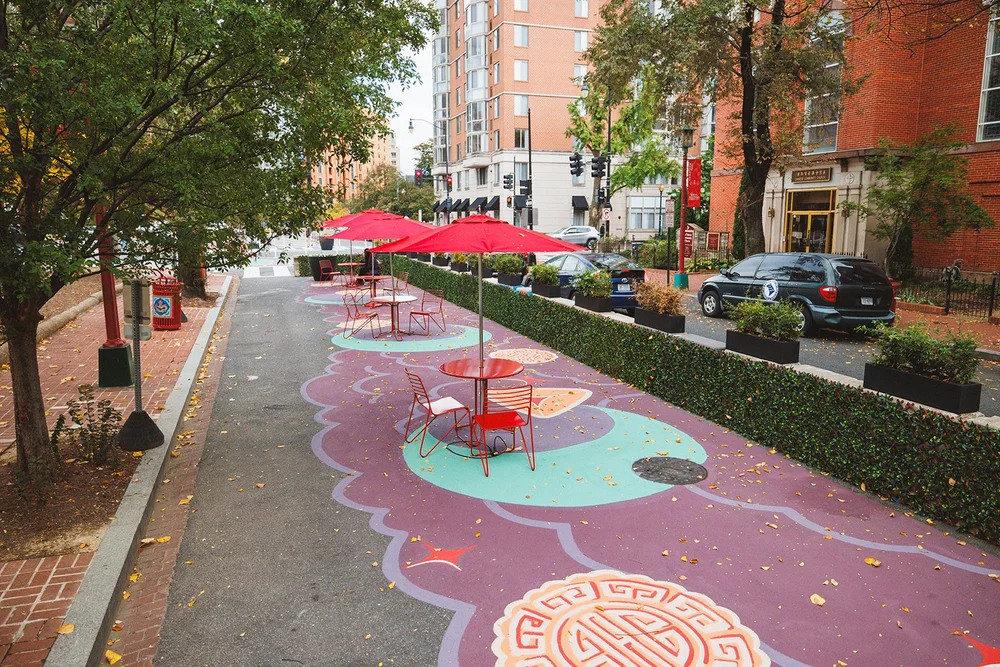
In 2013, Chelsea Ritter-Soronen picked up a stick of sidewalk chalk and started drawing in a St. Louis sidewalk. She wasn’t looking to start a business. She just wanted to brighten a grey space with colour and curiosity, connect with neighbors, and learn about the city from a different perspective.
Chelsea followed her passion from St. Louis to Napa, California, and later to Washington, D.C. Each move shaped the business, taught new entrepreneurial lessons, and opened new doors of opportunity. The chalk art practice eventually evolved into a company producing large-scale pavement murals used to calm traffic and spark conversation about safe streets.
Chalk Riot has created over 300 murals across the U.S. and abroad. Their art appears in neighbourhoods, schoolyards, and busy intersections. They work with city planners, developers, NGOs, and Fortune 500 companies to make streets safer and more welcoming.
Their team, led entirely by women and non-binary artists, values collaboration, listening, and community input. In between commissions, they also provide free and low-cost training for youth groups and community organisers, passing on tools that helped them grow.
Chelsea didn’t begin with a business plan, but followed her curiosities and passions. Chalk Riot continues to thrive not because it chases trends, but because it keeps showing up, with colour, care, and the belief that the ground we walk on can be a vehicle for change.
What is your typical day, and how do you make it productive?
Funny you ask — we just made a Youtube video about this! Each day starts early, usually with a stretch, team check-in, and we love to write our daily tasks on a dry erase board. There’s no real typical day in the studio, but we bounce between cleaning and organizing, meetings, and production. When our brains are feeling full, I advocate for walks around the block to recharge! We have a shared studio space with several other artists, so being able to bounce ideas and challenges off of each other is crucial to our collective success every day.
How do you bring ideas to life?
That’s a big question! Our traffic calming murals are consistently rooted in a sense of place. This means that we almost always begin with historical research of the site, and then go from there. Hyper local flora and fauna also play a huge role in our designs.
What’s one trend that excites you?
We’re excited by cities rethinking streets as public spaces not just for cars, but for people. Open streets, slow zones, and walkable infrastructure all creates space for public art to take both a leading and supporting role in our cities. I’m also learning a lot about pavement cooling techniques, I think there’s a huge future in artistic applications of colorful solar reflective coatings, and more!
What is one habit that helps you be productive?
Lately, I’ve been starting each day with reading ten pages of a book. It warms up my brain without diving headfirst into work. I also make sure to drink lots of water and manage my phone notifications — sometimes I hide my phone in another room entirely! Also it sounds funny, but I like to do a lot of squats and pushups in between emails.
What advice would you give your younger self?
Stop comparing yourself to other artists! Every person’s journey is unique, and the art world would be tragically boring if everyone was moving at the same pace.
Tell us something you believe almost nobody agrees with you on?
That sidewalks are emotional spaces. Most people see them as neutral, but we believe they shape how safe, seen, and connected we feel.
What is the one thing you repeatedly do and recommend everyone else do?
Talk to strangers when you’re creating in public. Some of our best feedback and ideas came from random passersby.
When you feel overwhelmed or unfocused, what do you do?
Put the phone down and go for a walk outside! Even better if a friend can join.
What is one strategy that has helped you grow your business or advance in your career?
Saying “yes” to things I had no clue how to do. I still do that. I think it’s how I learn best, to be honest.
What is one failure in your career, how did you overcome it, and what lessons did you take away from it?
Not following my instinct on a client that was a bad match for the business. I was too focused on making money at the time. When we operate from a place of scarcity or fear, it can really affect our decision-making skills. I’ve learned to consult a wise council of select friends and peers if I’m on the fence about something — that’s an important thing to emphasize. No artist or small business owner can succeed on their own. You absolutely need a team of cheerleaders, consultants and friends.
What is one business idea you’re willing to give away to our readers?
A business fully dedicated to hopscotches.
What is one piece of software that helps you be productive? How do you use it?
You know, we only recently started using Slack. Because we’re a small team, it has been an extraordinarily helpful tool for communication. I’ve also just started to learn GIS skills, and hope that will serve us well in the very near future with mapping sites and creating online visual storytelling.
Do you have a favorite book or podcast you’ve gotten a ton of value from and why?
Book: I just finished Arrested Mobility by Charles T Brown. I think it should be required reading for anyone working in any level of planning concerned about racial equity.
Podcast: 99% Invisible. A classic podcast that helps us think more deeply about the everyday design choices that shape our world. I also love Booked on Planning, my professor introduced me to it, it’s literally a podcast about urban planning books, but the discussions can be educational and thought-provoking.
What’s a movie or series you recently enjoyed and why?
There’s an older British series called Living History, available on YouTube. My boyfriend and I are huge history nerds, and we love to see how certain aspects of daily life were experienced throughout different centuries of human civilization.
Key learnings
- Creativity grows when paired with consistent action—even small steps every day make a difference.
- Public art is most impactful when shaped by the people who live near it.
- Saying yes before you’re ready can open doors to unexpected opportunities.
- Emotional connections to public space influence how safe and welcome people feel.
- Failure often teaches the practical lessons that lead to long-term growth.