
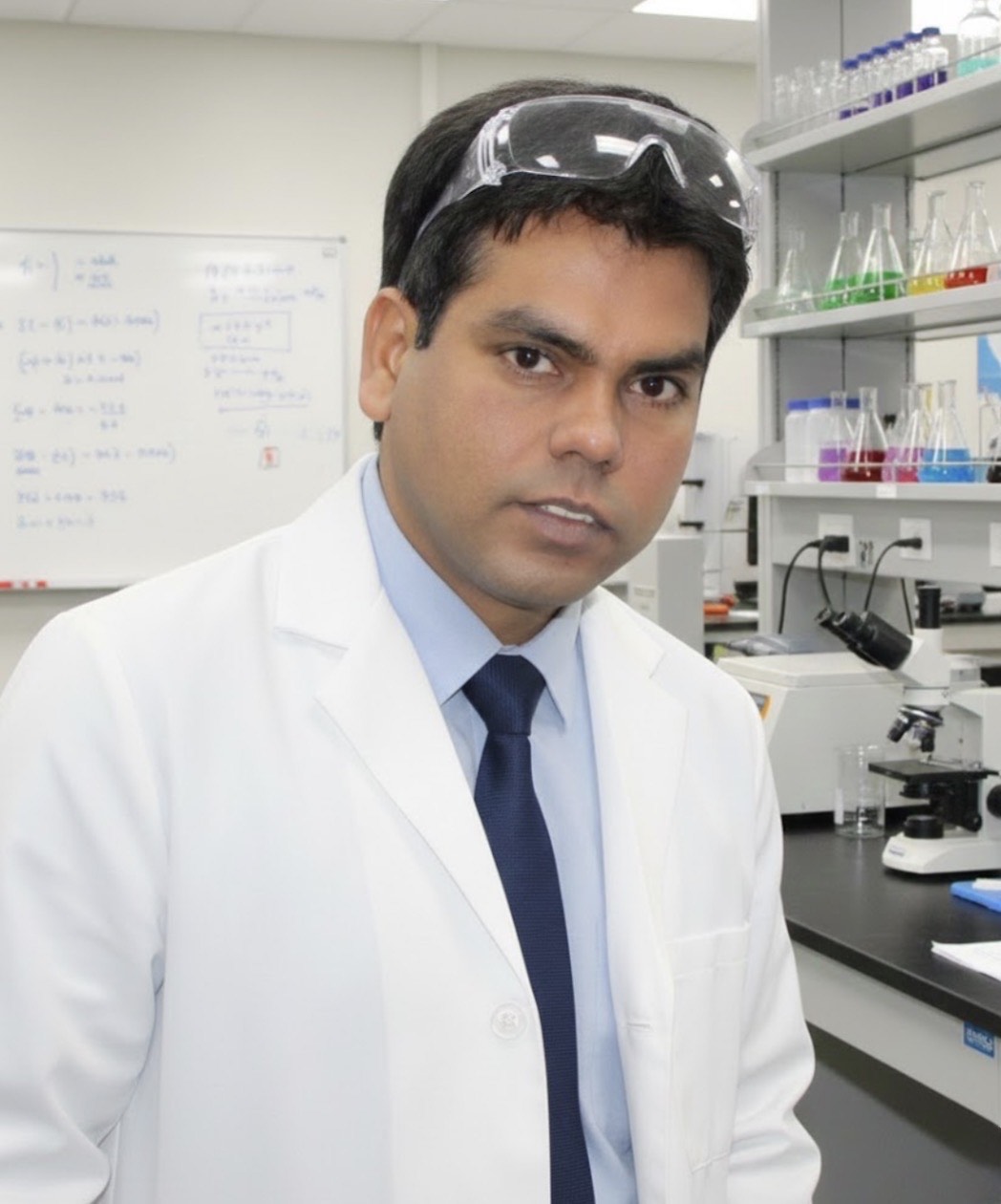
Dilip Shah grew up in Nepal, a place where nature and curiosity often intersect. As a child, he was fascinated by how things worked — from mixing colors to wondering why the sky changed shades at sunset. That early curiosity became the foundation of a lifelong journey in science.
He earned his B.Sc. in Chemistry, M.Sc. in Biochemistry, and Ph.D. in Biochemistry through competitive government fellowships from Nepal and India. During his doctoral research, he investigated how oxidative stress modulates immune cell homeostasis, uncovering mechanisms by which antioxidants such as glutathione regulate inflammation in autoimmune diseases like lupus and rheumatoid arthritis. His Ph.D. work earned multiple accolades, including oral and poster presentation awards, abstract recognitions, and several competitive travel grants to national and international scientific conferences.
As his career evolved, Dr. Shah expanded his research portfolio. He explored laser-based vaccine adjuvants, integrating physics and molecular immunology to enhance antigen presentation and vaccine performance. His subsequent work centered on mitochondrial dysfunction in premature infants, identifying how impaired mitochondrial signaling contributes to the development of bronchopulmonary dysplasia.
Today, Dr. Shah contributes to advancing targeted immunotherapies — including CAR-T cell engineering, antibody–drug conjugates (ADCs), and tumor-associated antigen profiling — with the goal of enabling more precise and effective cancer treatments. His scientific path is defined by perseverance, curiosity, and a commitment to understanding complex biological systems to support progress in cancer research and improve human health.
Outside the laboratory, he enjoys soccer, cricket, and watching the Super Bowl — a reminder that balance fuels creativity and scientific insight.
What is your typical day, and how do you make it productive?
My day starts early, usually around 6:00 a.m., with coffee and a quick review of scientific journals or recent studies. It’s my way of staying connected to what’s happening in the field. I block my mornings for hands-on lab work — experiments, data collection, or reviewing results with my team. Afternoons are for writing, mentorship, and collaboration calls. To stay productive, I limit multitasking. I focus on one problem at a time. That’s something research has taught me — focus creates breakthroughs.
How do you bring ideas to life?
Most of my ideas start as questions. I sketch them out in a lab notebook and discuss them with colleagues. Collaboration helps refine the raw thought into something testable. I believe in experimenting early and often, even if the first attempt fails. One of my most successful studies — using lasers to boost vaccine effectiveness — started as a simple “what if” on paper.
What’s one trend that excites you?
I’m fascinated by the merging of bioinformatics and AI. We’re now able to analyze molecular data at a scale that was impossible 10 years ago. AI isn’t replacing researchers — it’s empowering us to see patterns we couldn’t before. That excites me because it’s helping us move from observation to prediction in biology.
What is one habit that helps you be productive?
I end every workday by writing down three things: what I accomplished, what I learned, and what I’ll focus on tomorrow. It keeps me grounded and ensures progress, even on days that feel slow.
What advice would you give your younger self?
Don’t rush. Science rewards patience more than speed. Some of my best insights came from failed experiments that forced me to pause and rethink. I’d also remind myself to take breaks — discovery needs balance.
Tell us something you believe almost nobody agrees with you on?
I believe that over-optimization can limit creativity. In research, not every variable needs to be controlled from the start. Sometimes, allowing a bit of unpredictability leads to unexpected breakthroughs.
What is the one thing you repeatedly do and recommend everyone else do?
I take 15 minutes of quiet reflection each morning. No screens, no distractions. Just thinking. It helps me sort ideas and set intentions for the day.
When you feel overwhelmed or unfocused, what do you do?
I step outside. Fresh air, even a short walk, helps me clear my mind. I often find solutions come when I stop forcing them.
What is one strategy that has helped you grow your business or advance in your career?
Mentorship. I’ve learned that sharing knowledge strengthens your own understanding. Teaching young scientists has helped me see problems differently and think more clearly.
What is one failure in your career, how did you overcome it, and what lessons did you take away from it?
Early in my career, I rushed to publish before fully verifying data. A reviewer pointed out inconsistencies, and it was a humbling experience. I learned that credibility is everything. Since then, I double-check every result. It taught me to value accuracy over recognition.
What is one business idea you’re willing to give away to our readers?
A platform that connects independent scientists worldwide to share experimental data, protocols, and negative results openly. We learn as much from what doesn’t work as what does.
What is one piece of software that helps you be productive? How do you use it?
GraphPad Prism. It’s my go-to for data analysis and visualization. Seeing patterns in graphs helps me communicate results clearly to collaborators from different disciplines.
Do you have a favorite book or podcast you’ve gotten a ton of value from and why?
The Emperor of All Maladies by Siddhartha Mukherjee. It’s both poetic and scientific — showing how persistence shapes progress in medicine.
What’s a movie or series you recently enjoyed and why?
The Martian. It’s the perfect blend of science and storytelling — proof that problem-solving, even in isolation, starts with optimism and resourcefulness.
Key learnings
- True innovation starts with curiosity, not certainty.
- Mentorship and collaboration strengthen scientific understanding.
- Precision matters more than speed — accuracy builds trust.
- Taking time for reflection improves focus and creativity.
- Openness in sharing both success and failure accelerates collective progress.