
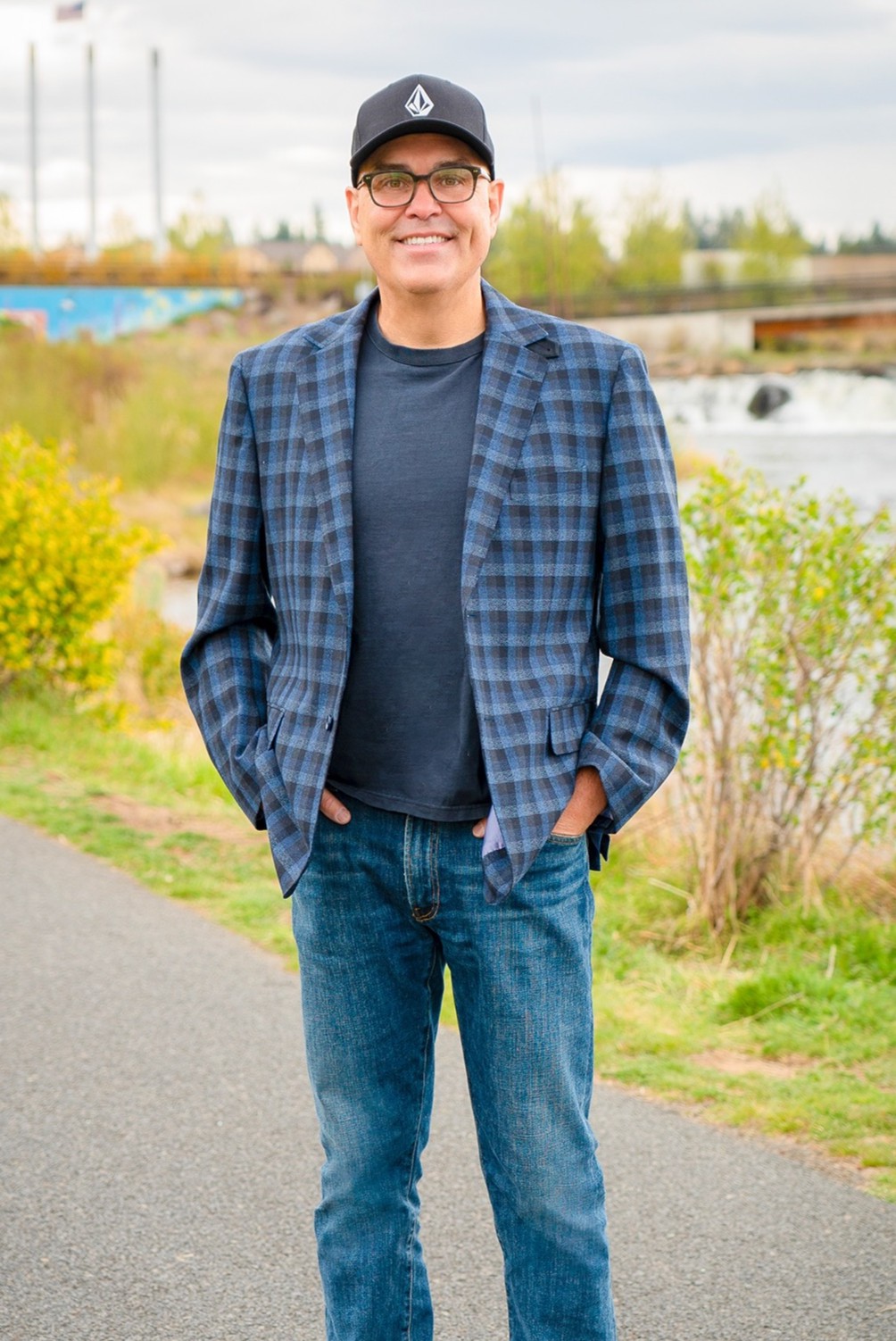
Douglas Layman has spent his life building things—companies, teams, adventures, and conversations that actually matter.
Born in Syracuse, New York and now splitting his time between Bend, Oregon and the East Cape of Baja Sur, Doug built a classic “from scratch” entrepreneurial career before deliberately stepping off the traditional ladder. After earning a B.S. in Industrial Engineering from Oregon State University and an International MBA from Georgetown, he cut his teeth in management consulting at Accenture and later managed large-scale technology initiatives at Verizon, leading hundred-person teams and multi-million-dollar budgets.
Doug’s first major entrepreneurial leap was CareerRewards, an internet-based recruiting software company he founded in the dot-com era. He raised $12.5M in venture capital, grew the team rapidly, and successfully exited to Manpower International. His second—and defining—act was Kadix Systems, an information technology and security firm serving federal intelligence and homeland security agencies. Starting with just $100 and an idea, Doug grew Kadix over seven years to more than 350 employees, multiple locations, and over $50M in annual revenue. Under his leadership, the company twice landed on the Inc. 500 list of fastest-growing companies in America, was repeatedly recognized for excellence by federal clients, and ultimately was acquired in a deal honored as “Deal of the Year” under $100M by the Association for Corporate Growth.
After serving as Senior Vice President and General Manager of the Homeland Security division at the acquiring public company, Doug did something most executives only talk about: he walked away from the corporate world. He chose a life built around curiosity, adventure, and meaningful experiences instead of titles and corner offices. Since then, as Managing Partner of Arve Capital Advisors, he’s focused on angel investments, capital management, and select consulting projects, blending his strategic background with a strong instinct for human potential.
Outside of work, Doug lives the way he builds: in motion. About 70% of his hobbies involve an elevated heart rate—skiing in the Italian Alps, kiteboarding in Baja, mountain biking in Oregon, hiking with gorillas in Uganda, and, more recently, disappearing across the water on an eFoil board.
What is your typical day, and how do you make it productive?
Most days start at sunrise because that’s when the world is quiet and I can convince myself I’m the kind of person who “rises with purpose” instead of the kind who just wakes up early because he can’t sleep past 6 anymore.
I usually get moving right away—pickleball, biking, hiking, or anything that qualifies as exercise without feeling like a gym sentence. If I’m in Baja, that might mean sand between my toes before breakfast. If I’m in the Pacific Northwest, it might be a trail, a bike, or a paddleboard with questionable balance.
From there, the day shifts into whatever adventure is unfolding: planning the next trip, scouting a new outdoor spot, or heading off to explore somewhere I probably shouldn’t be exploring alone. My friends call it “restless curiosity.” I call it “totally normal behavior.”
Productivity, for me, comes from staying in motion, staying curious, and keeping the day anchored by things that actually matter—good people, nature, laughter, and the kind of small moments that make a day feel bigger than it is. A little spontaneity, a lot of sunlight, and the firm belief that life is better when you say yes to things—that’s pretty much the system.
How do you bring ideas to life?
Usually it starts with a spark—an odd thought, a half-baked plan, or a “Wouldn’t it be crazy if…” moment that hits me while I’m biking, hiking, or somewhere mildly inconvenient like halfway up a climbing route.
Once the idea shows up, I test it the same way I test a trail: poke around, see if it leads somewhere interesting, and make sure it isn’t going to drop me off a cliff. If it still feels exciting after a little reality-checking, I dive in.
I’m a big believer in momentum. I sketch something out, try it, break it, rebuild it, and keep moving until it either becomes something real or becomes a funny story I tell later. Most ideas don’t arrive fully formed—they show up wearing flip-flops and need some coaching.
The real secret is staying curious and saying yes to exploration. New ideas come alive the same way adventures do: you take the first step, stay open to what happens, and don’t overthink the map. Half of my best outcomes started with “Let’s just see where this goes…”
What’s one trend that excites you?
The trend I’m most excited about is the rise of people designing their lives around experiences instead of stuff. More people are choosing travel over clutter, sunsets over screen time, and “Let’s go try this” over “Maybe someday.” I love that. It feels like the world is slowly waking up to the idea that adventure isn’t something you save for vacations; it’s something you build into your everyday life.
Plus, this trend has created a whole new category of people who think it’s completely normal to take pickleball paddles on international flights, plan their work around surf conditions, and say things like “I can live anywhere as long as there’s good coffee and Wi-Fi.” These are my people.
If this trend keeps going, the world may finally become full of location-independent, outdoorsy women who can hold a conversation, travel light, and actually enjoy the chaos of an unplanned adventure—and honestly, that’s a trend worth rooting for.
What is one habit that helps you be productive?
Saying yes to movement before I say yes to anything else.
If I start the day with pickleball, a bike ride, or something that vaguely resembles exercise, the rest of the day snaps into place. It’s like my brain won’t turn on until my body has had its morning adventure. Once that switch flips, everything feels easier—decisions, planning, even pretending to be a responsible adult.
I also have a habit of doing the one thing that matters most before I let myself wander off into the day. Sometimes that’s booking a trip, sometimes it’s fixing something I’ve ignored for weeks, and occasionally it’s just drinking water like a functional human being. But knocking out one meaningful thing early keeps me from drifting into chaos.
The short version: move first, focus second, wander later. It works shockingly well for someone who is otherwise highly distractible by beaches, mountain trails, and any dog that looks like it has a story to tell.
What advice would you give your younger self?
I’d tell my younger self to relax a little and chase experiences sooner. All the “wait until the timing is right” moments? Turns out the timing is rarely right—go anyway.
I’d also remind him that the things that feel risky at 25 (traveling more, taking the scenic route, saying yes to the unknown) usually end up becoming the best stories later. Meanwhile, the things that felt “safe” were often just…boring.
And I’d definitely say, “Trust yourself more. Overprepare less. Take the trip. Say what you feel. And stop thinking you need permission to live the life you actually want.”
Oh, and buy Bitcoin at $200. No need to over-spiritualize that one.
Tell us something you believe that almost nobody agrees with you on.
I genuinely believe that most of life’s best decisions start with the sentence “This might be a terrible idea…but let’s try it anyway.”
People love plans and certainty. I’m convinced half the magic happens when you ditch both and follow the spark instead. Some call it irresponsible. I call it field research.
I also think humans underestimate how much clarity you can get from a long hike, a spontaneous trip, or a wildly competitive pickleball match. Forget boardrooms—put two people on a trail or a court, and you’ll know who they are in ten minutes.
And here’s my most unpopular belief: adventure is actually a form of organization. Not chaos, not escapism, just a different kind of order where curiosity leads and everything else falls in line.
Most people disagree with all of that…and honestly, that’s half the fun.
What is the one thing you repeatedly do and recommend everyone else do?
I recommend doing one small thing every day that gets your heart rate up and your brain out of its own way. For me, that’s getting outside—a bike ride, a hike, pickleball, or even a “quick walk” that mysteriously turns into six miles because I saw a trail and got curious.
It’s amazing how much clearer life feels once you’ve moved your body and let your mind wander somewhere besides a to-do list.
And here’s the part nobody talks about: almost every good decision I’ve made started on a walk, a trail, or somewhere I probably should’ve packed more snacks.
So my advice? Get out the door. Every day. Even when you don’t feel like it—especially when you don’t feel like it.
It’s the simplest reset, the best stress relief, and the cheapest therapy I’ve found that doesn’t involve me talking to a cactus in Baja.
When you feel overwhelmed or unfocused, what do you do?
I go outside and let nature sort me out. If I’m overwhelmed, the worst thing I can do is sit still and stare at a problem like it’s going to crack under pressure. So I lace up my shoes, grab a bike, or hit a trail and let movement reset everything.
Sometimes I’ll end up on a long walk where I start out stressed and end up accidentally solving my own problem halfway through…usually while talking to myself like a mildly unhinged life coach.
If I’m in Baja, the cure is even simpler: beach, barefoot, long stretch of sand, and the kind of horizon that forces you to remember your life is bigger than whatever you’re wrestling with.
And when all else fails? I do the one small task I’ve been avoiding. It’s shocking how much order returns to life when you finally deal with that one thing that’s been haunting you from the corner.
Movement plus sunlight plus one tiny win equals instant reboot.
What is one strategy that has helped you grow your business or advance in your career?
My most reliable strategy has always been this: say yes to the opportunity, then figure out the details while moving.
It’s basically the business version of stepping onto a trail you’ve never hiked before. You don’t wait for perfect conditions; you start walking, pay attention, and adjust as you go. That mindset helped me grow my tech company from just me to more than 400 people in eight years, which still sounds slightly unreasonable when I say it out loud.
I learned early on that momentum beats perfection. When you move quickly, stay curious, and surround yourself with people smarter than you, problems get solved and opportunities multiply. That approach turned a tiny idea with $100 of initial capital into a national company supporting major federal agencies.
So the strategy is simple but powerful: start, move, learn, adapt, repeat. It works in business, adventure, and pretty much every situation except assembling IKEA furniture.
What is one failure in your career, how did you overcome it, and what lessons did you take away from it?
Early in my career, I made the classic mistake of doing what everyone expected instead of trusting my own instincts. During the dot-com era, I built CareerRewards—an online recruiting platform—and, like many people in that moment, I raised more venture capital than the business actually needed. At the time, that was considered the smart move. In hindsight, it was like packing for a weekend trip and bringing fourteen suitcases.
When the bubble burst, the investors wanted a quick exit—even though the company still had plenty of cash and a strong product. So the business was sold for far less than its potential simply to get capital back to the fund. It wasn’t a disaster, but it was definitely a painful lesson in how misaligned incentives can drive the wrong outcome.
What I took away from that chapter was simple but life-changing: only take the minimum outside funding required, stay lean, and keep control long enough to let the real value emerge.
It also taught me something bigger: society will always nudge you toward the “safe,” conventional path, but progress almost never comes from playing it safe. After that, I stopped organizing my decisions around expectations and started building things the way I knew they should be built. That shift is a big part of what later helped me grow my next company from one person to 400 in eight years.
And honestly? I’m grateful for the failure. At the very least, it cured me of the idea that more money automatically solves more problems. Spoiler: it doesn’t.
What is one business idea you’re willing to give away to our readers?
The Pack Once Travel Capsule—AI-generated, prepacked micro-wardrobes shipped to your door for specific trips.
Hear me out. Most people are terrible at packing. They either bring 1,400 items for a 4-day trip or forget the one thing they actually need. So the Pack Once Travel Capsule does it for them.
You choose:
• Destination (Bali, Baja, Banff, etc.).
• Trip style (romantic, adventure, work-ish, “finding myself but with good lighting”).
• Climate tolerance (runs warm, runs cold, runs dramatic).
• Activity mix (beach, hiking, pickleball, “I might end up at a wedding somehow”).
Then AI builds a minimalist, mix-and-match travel wardrobe—clothes, toiletries, accessories—optimized for carry-on only.
A warehouse assembles the capsule. A box arrives at your door. You open it, and boom: your entire trip wardrobe is done.
Return it when you get home, keep anything you love, and repeat anytime you travel.
It’s like Rent the Runway meets Away luggage meets “please save me from my own packing anxiety.”
This solves:
• Overpacking.
• Underpacking.
• Packing procrastination.
• The “I’m going to Mexico and accidentally brought three sweaters” problem.
• Couples’ fights caused directly by packing habits.
• The existential crisis of deciding how many socks a human needs for six days.
Someone is absolutely going to build this. It’s sustainable, it’s efficient, and it solves a universal pain point.
What is one piece of software that helps you be productive? How do you use it?
TripIt. Hands down. I forward it a confirmation email, and it magically assembles my entire trip like some kind of travel sorcerer. Flights, hotels, rental cars—it organizes everything before I’ve even finished wondering why I booked a 6 am departure again.
I use it to keep my travel life from turning into a scavenger hunt for lost emails. TripIt tells me where I’m going, when I need to be there, and which airport I should not accidentally show up at.
It’s basically Google Maps for my entire existence. If it ever stops working, I’m not convinced I’d make it home.
What is the best $100 you recently spent? What and why?
A stainless-steel spatula. Yes, really. I bought it to go with my stainless-steel pots and pans, and it has instantly elevated my kitchen game from “guy who wings it” to “guy who at least looks like he knows what he’s doing.”
Why was it the best $100? Because using it makes me feel like a competent adult who could, at any moment, sauté something impressive. It’s sturdy, shiny, indestructible, and has this deeply satisfying heft that says, “You got this, chef.”
Plus, it will probably outlive me. I’m pretty sure archaeologists could dig this thing up in 1,000 years and go, “Wow, someone was serious about pancakes.”
Do you have a favorite book or podcast you’ve gotten a ton of value from and why?
Klara and the Sun (written by Kazuo Ishiguro, the Nobel Prize–winning author known for giving readers emotional damage in the most elegant possible way) is a favorite of mine. It’s one of those books that sneaks up on you—told entirely from the perspective of a non-human observer who’s trying to understand humanity, love, loyalty, and all the strange things we do that don’t make any logical sense…but somehow make perfect emotional sense.
What I love about it is how Klara sees the world with total sincerity. No ego, no assumptions, no “I read a blog once, so now I’m an expert.” Just pure curiosity. Watching her try to interpret human behavior is equal parts touching and hilarious. You start realizing how bizarre we all are when seen from the outside.
It gave me a fresh way of looking at connection—how much of it is unspoken, how much we project onto each other, and how often we misunderstand things simply because we assume we already know.
Also, it’s a great reminder that if a fictional AI can observe humans with patience and grace…I can probably manage to do the same.
What’s a movie or series you recently enjoyed and why?
I recently watched The Peanut Butter Falcon and loved how honest and heartfelt it felt. It’s a story about two people trying to figure out who they are in a world that doesn’t always make room for them, and the friendship that forms between them is both messy and beautiful. The film captures fear, hope, and the kind of quiet courage it takes to keep going when life feels stacked against you. It stayed with me long after the credits rolled.
Key learnings
- Embracing movement, nature, and daily outdoor routines can help maintain clarity, reduce stress, and support consistent productivity.
- Taking action before everything feels “perfect” creates momentum and opens doors that planning alone often doesn’t.
- Lean, thoughtful decision-making—especially around funding and risk—can prevent misaligned incentives and preserve long-term potential.
- Genuine connection, curiosity, and a willingness to say yes to new experiences often lead to meaningful personal growth.
- Stepping back from overwhelm by changing environments or tackling one small task can reset focus more effectively than force or intensity.