
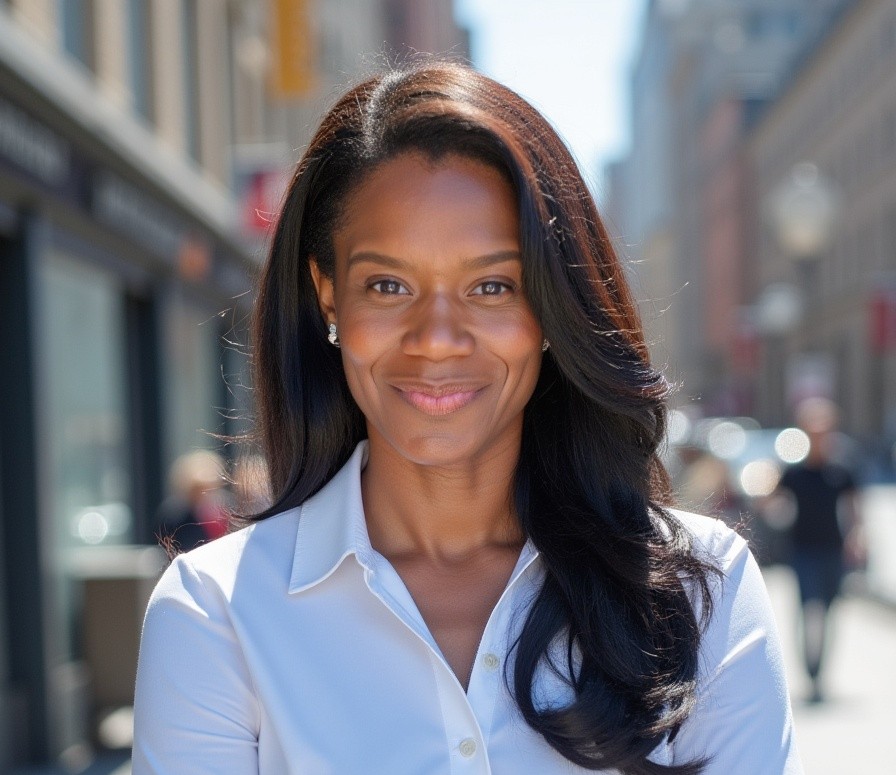
Based in New York City, New York, Jamie Hickman is a decorated U.S. Army Lieutenant Colonel who has served in a variety of leadership roles since beginning her military career in 2001. In her most recent position, Major Jamie Hickman served as executive officer for the U.S. Army Missile Defense Agency in Huntsville, Alabama, where she provided direct advisory support to the MDA Executive Director on strategic priorities and agency-wide operations.
Major Hickman’s other notable roles included military executive officer and assistant executive officer to the Deputy Chief of Staff for the Directorate for U.S. Army Logistics at the Pentagon, and executive director of the 115th Brigade Support Battalion, 1st Armored Brigade Combat Team, at Fort Cavazos, Texas.
Aside from her service with the U.S. Army, Jamie Hickman has extensive teaching experience as an assistant professor and adjunct assistant professor at the University of Maryland, the U.S. Military Academy at West Point, and Central Texas College, among others. Since 2025, she has been a research consultant at the University of Chicago, specializing in strategic research and policy to develop high-impact initiatives for military-affiliated populations.
Dr. Hickman holds an Ed.D in adult learning and leadership from the Teachers College at Columbia University and a master’s degree in defense and strategic studies from the United States Naval War College. In her free time, she enjoys playing golf and volunteering. Since 2024, she has been actively volunteering with the Coaching Club at Teachers College, Columbia University.
What is your typical day, and how do you make it productive?
I wish I could say that I sleep in…but that would be untrue. I start early, usually reviewing priorities and correspondence before 6 am. My first phone call in the morning is always to my daughter, then mother and father. I structure my time in blocks: deep work in the morning for writing, analysis, or research; collaborative work midday for meetings, advising, or stakeholder outreach; and a wind-down period in the evening for reflection and professional reading. I keep a running priority list and ask myself each morning, “What moves the mission forward today?” That single question keeps me from getting lost in busy work. I’ve also learned that rest is productive—protecting time for exercise, family, and recovery isn’t indulgent, it’s strategic. Self-care is a must.
How do you bring ideas to life?
When something clicks, I ask three things: who does this serve, what’s the real problem, and what’s the first credible step. Then I find the people who need to be in the room.
What’s one trend that excites you?
Two trends that I watch closely—and that I believe deserve far more attention than they currently receive. The first is the convergence of artificial intelligence and national security decision-making. I spent my final years of military service working adjacent to some of the most complex technical programs in the Department of Defense, and the question of how AI can enhance, not replace, human judgment in high-stakes environments is one of the most consequential design challenges of our time. The second is the growing body of evidence around adaptive athletics and veteran rehabilitation, specifically golf. The research on how golf supports recovery from PTSD, mental health challenges, and physical injuries in the veteran community is compelling and underreported. Golf is uniquely suited to rehabilitation: it demands presence and focus (which counters hypervigilance), involves time in natural outdoor environments (which reduces cortisol), and can be modified for almost any physical limitation. As someone who loves the game personally, I am genuinely invested in seeing this pathway expanded and better resourced.
What is one habit that helps you be productive?
Daily reflection. Keeping a calendar. Connecting with loved ones and community. Every Sunday evening, I spend 20 to 30 minutes reviewing the past week, what I accomplished, what I avoided, and what I learned. I ask myself three questions: What did I do well? What do I wish I’d done differently? What’s the most important thing I need to do this coming week? This habit has compounded dramatically over time. It’s not glamorous, but it’s the practice that most consistently keeps me honest, intentional, and forward-moving.
What advice would you give your younger self?
Be brave. Never stop learning. Be kind to others always.
What is the one thing you repeatedly do and recommend everyone else do?
Pursue formal education at every stage of your career, not just at the beginning. I completed my doctorate at Teachers College, Columbia University while serving as an active-duty Army officer. I earned my masters degrees mid-career. Education gave me frameworks to understand what I was experiencing, language to articulate it, and credibility to influence change at higher levels. I recommend it especially for people who feel stuck, as re-entering a learning environment has a way of resetting your sense of what’s possible.
When you feel overwhelmed or unfocused, what do you do?
I go back to first principles, and then I go to the golf course. When everything feels urgent and nothing feels clear, I ask: what is the actual mission here? Not the noise around it, but the core objective. Usually, overwhelm is a signal that I’ve allowed too many competing priorities to stack up without a hierarchy. Golf has become one of my most reliable reset mechanisms. The game demands that you be fully present because you cannot execute a good shot while mentally replaying yesterday’s meeting or planning tomorrow’s call. That forced presence is medicinal. It’s also why I’m a strong advocate for golf as a rehabilitation tool for veterans dealing with PTSD and physical injury. The same qualities that make it useful for me on a difficult workday—outdoor environment, full cognitive focus, low-impact physicality, and a clear framework for progress—make it genuinely therapeutic for people managing far heavier challenges.
What is one strategy that has helped you grow your business or advance in your career?
Positioning myself at institutional seams. The spaces between organizations, disciplines, or communities that don’t naturally communicate. My career has been built at these intersections: between military and academia, between the Department of Defense and university research, between the consulting world and the nonprofit sector. In each case, I brought value precisely because I could translate across boundaries. As a research consultant at the University of Chicago’s Office of Military-Affiliated Communities, I’m doing this in real time by helping a premier academic institution understand and navigate the DoD ecosystem. That kind of bridging work is increasingly rare and increasingly valuable.
What is one failure in your career, how did you overcome it, and what lessons did you take away from it?
In my Army career, I was passed over for a leadership opportunity I had prepared for and genuinely believed I was ready for. It was a formative blow to my confidence. I felt I had done everything I thought was expected of me, and it still wasn’t enough. What I eventually came to understand was that preparation is necessary but not sufficient. I had focused heavily on task performance and not enough on relationship-building. I overcame it by deliberately investing in mentorship relationships and by asking for feedback with enough specificity to act on it. The lesson: excellence in execution is the floor, not the ceiling. You also have to ensure you maintain positive relationship-building in that process.
What is one business idea you’re willing to give away to our readers?
A professional narrative and positioning firm built specifically for transitioning military officers. Not a resume service, but a deep-dive translation and coaching practice that meets officers where they actually are: at one of the most psychologically complex crossroads of their lives.
The gap is real and documented. Senior military professionals carry extraordinary credentials but also the weight of moral injury, identity disruption, and a civilian world that has no framework for what they’ve actually done or who they’ve actually become. Corporate hiring managers aren’t the problem, they simply don’t have the language and neither do most transition programs that skim the surface with LinkedIn tips and handshake events.
A boutique firm that combines executive coaching, narrative development, and sector-specific placement strategy—grounded in the psychology of transition and the hard truths of military identity—could serve these officers with the depth the moment actually demands. The focus: defense consulting, national security policy, academia, and corporate governance, where military experience has genuine currency when it’s translated with precision and intention.
The clients exist in the thousands every year. The talent is exceptional. The transition struggle, the grief, the moral injury, the loss of tribe, the disorientation of rank becoming meaningless overnight is real and almost entirely unaddressed in the existing market. That’s not a gap. That’s a mission.
What is one piece of software that helps you be productive? How do you use it?
Notion has become central to how I manage my consulting practice, research projects, and personal knowledge base. I use it as an operating system for my work, tracking deliverables, storing research notes, managing relationships, and maintaining a running library of ideas and reference material. What I appreciate most is its flexibility; it adapts to how I think rather than forcing me into a predefined structure. For someone who works across multiple clients, institutions, and projects simultaneously, having a single integrated workspace has dramatically reduced the cognitive overhead of tracking everything.
What is the best $100 you recently spent? What and why?
Kalshi bet.
Do you have a favorite book or podcast you’ve gotten a ton of value from and why?
Two come to mind immediately. Emma Grede, both her podcast and her new book, “Start With Yourself.” What I appreciate about her is that she built something real without the conventional blueprint. She dropped out of high school, grew up working-class in East London. Nothing about her background suggested she’d go on to build a multibillion-dollar portfolio. But she did it through sharp instincts and the ability to read a room and a market at the same time. That speaks to me personally. When you’ve built your own path, you pay close attention to people who did the same at a high level.
And in “Call Her Daddy,” Cooper has created a space where the conversation is completely unfiltered. No performance, no packaging. In a world where everyone is carefully managing their narrative, there’s real value in watching someone just say the thing. I respect that more than people might expect.
What’s a movie or series you recently enjoyed and why?
I’m drawn to documentaries above almost any other format. To me, I think they are the artform that most honestly captures how the world actually works. Recently I’ve been moved by films documenting the intersection of athletics and human recovery, including works that follow veterans using sports as a pathway back to themselves. There’s something about the documentary form—the unscripted moment, the real face, the voice that hasn’t been polished for an audience. It’s what I find more instructive than any dramatization. My favorite golfer, Rory McIlroy, has been the subject of some compelling documentary coverage in recent years and watching how elite athletes process pressure and identity has direct resonance for the leadership work I do every day. That resonance deepened recently watching Gary Woodland’s return to the winner’s circle at the Houston Open, a man who had undergone brain surgery, then spoke publicly about battling PTSD before going out and dominating a field in his own backyard. That’s not a script. That’s a man rebuilding himself in real time, and the cameras caught it. It also brought back the grief of Grayson Murray, the young Tour winner whose death by suicide in 2024 reminded the entire golf world—and frankly, anyone paying attention—that performance and pain can coexist invisibly inside the same person. Both stories underscore what the best documentaries already know: the most profound human moments don’t announce themselves. You have to be watching and willing to see.
Key learnings
- Rest is productive and self-care is a must.
- Task prioritization and weekly reflection combined with asking “what will move the mission forward today?” fosters productivity and increases the likelihood of success.
- Relationship building is critical for success in both personal life and professionally.
- Golf offers mental and physical health benefits for those experiencing everyday stress and general overwhelm, as well as people with physical injuries or conditions like PTSD.