
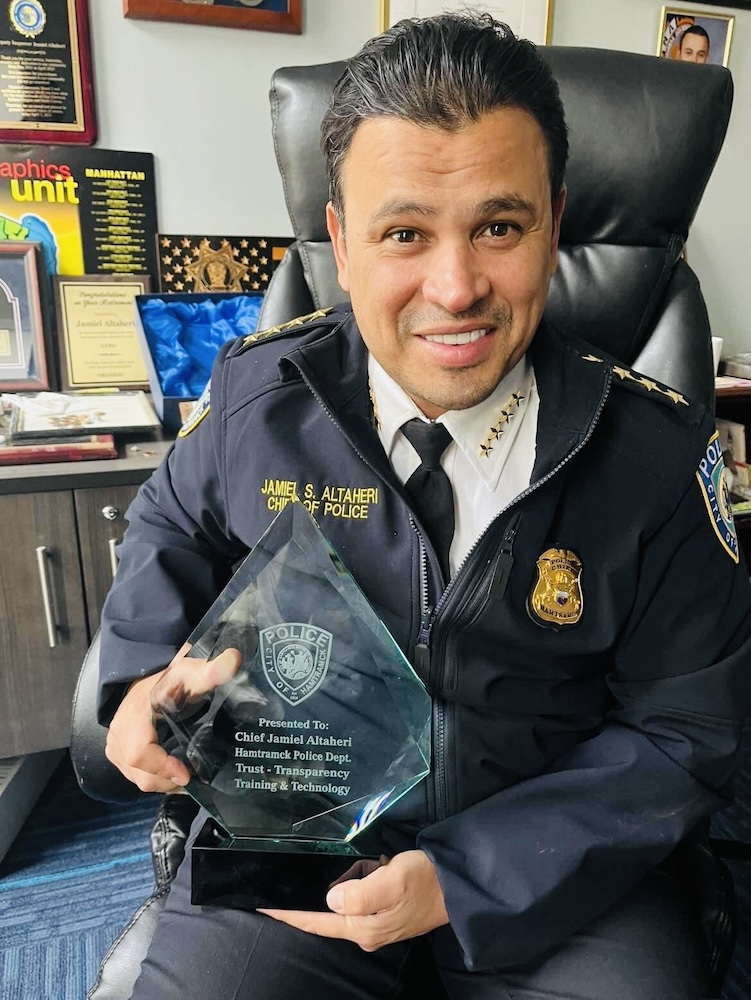
An accomplished law enforcement professional, Jamiel Altaheri served for more than 20 years in the New York City Police Department, where he rose to the rank of deputy inspector. He later became the chief of police in Hamtramck, Michigan, where his responsibilities included overseeing departmental operations, personnel, and public safety. Jamiel Altaheri’s education includes advanced degrees and certifications from Seton Hall University, John Jay College, the FBI National Academy, and the Naval Postgraduate School.
While with the NYPD, Mr. Altaheri worked on improving community trust and increasing minority representation in the department. He co-founded the Muslim Officers Society and later helped establish the Yemeni American Law Enforcement Officers Association. Both organizations support officers in underrepresented groups and strengthen relationships between the police and the community. He also founded the Yemen United Soccer Club, which provided an outlet for youth involvement outside of school.
As the Chief of Police in Hamtramck, Mr. Altaheri created the Department’s first Youth and Citizens Police Academy, introduced CompStat to address crime conditions effectively, and created the department’s first internal affairs unit. His work emphasized transparency, accountability, and cultural awareness in a diverse community.
What is your typical day, and how do you make it productive?
Typical day is meeting with my CEO and staff. Review current projects and follow up on recent developments and projects.
How do you bring ideas to life?
I bring Ideas to life through strategic planning and implementation.
What’s one trend that excites you?
A trend that excites me is when I take on opportunities that have greater value and positive impact on organizations and community at large.
What is one habit that helps you be productive?
My constant desire to work for a higher purpose and goal.
What advice would you give your younger self?
Don’t share all my ambitions and trust less.
Tell us something you believe that almost nobody agrees with you on.
That God works in mysterious ways and that God’s plans are more dominant than our ambitions.
What is the one thing you repeatedly do and recommend everyone else do?
Constantly seek knowledge and don’t stay in your comfort zone.
When you feel overwhelmed or unfocused, what do you do?
I pray and speak to my mother. During stressful situations, relying on personal support systems and faith, such as prayer and speaking with trusted family members, can help maintain emotional balance and resilience.
What is one strategy that has helped you grow your business or advance in your career?
Constantly seeking more knowledge and seek training and educational opportunities.
What is one failure in your career, how did you overcome it, and what lessons did you take away from it?
Trusted certain people without letting them earn my trust. Learned to face critics face on. Learned the importance of creating boundaries.
Trust should be earned over time, and leaders benefit from carefully evaluating trust rather than giving it too quickly.
Constructive criticism and opposing viewpoints should be addressed directly and professionally, helping leaders grow and strengthen their decision-making.
Establishing clear personal and professional boundaries helps maintain respect, accountability, and healthy working relationships.
Effective leadership requires self-awareness and reflection, allowing leaders to learn from experiences and improve how they interact with others.
What is one piece of software that helps you be productive? How do you use it?
One piece of software that helps me be productive is Notion.
I use Notion to organize my tasks, notes, and projects all in one place. For example, I create to-do lists to keep track of assignments and deadlines, which helps me stay organized and avoid forgetting important work. I also use it to take notes while studying or learning new topics because I can easily format the notes, add headings, and insert checklists. Another helpful feature is that I can create separate pages for different subjects or projects, so everything stays neat and easy to find.
Overall, Notion helps me stay focused, manage my time better, and keep all my important information organized in one convenient workspace.
What is the best $100 you recently spent? What and why?
The best $100 I recently spent was on leadership books like “First, Break All the Rules” and “The One Minute Manager.” These books provide practical advice on managing teams, motivating employees, and improving communication. As a manager or leader, learning better leadership strategies can help build stronger teams and increase productivity. Investing in leadership knowledge is valuable because the skills can be applied in many professional situations.
Do you have a favorite book or podcast you’ve gotten a ton of value from and why?
One of my favorite books as a law enforcement officer and motivated leader is “Extreme Ownership” by Jocko Willink and Leif Babin. The book teaches that leaders must take full responsibility for their team’s actions and outcomes. This mindset is valuable in law enforcement because it promotes accountability, strong decision-making, and trust within a team.
What’s a movie or series you recently enjoyed and why?
My favorite movie series is “The Godfather” because it shows powerful lessons about leadership, loyalty, and decision-making. Characters like Michael Corleone demonstrate how leaders must stay calm under pressure and make difficult choices to protect their organization and family. The series also explores themes of responsibility, strategy, and the consequences of power. These leadership and moral challenges make the story interesting and meaningful beyond just being an entertaining film series
Key learnings
- Effective leaders prioritize accountability, communication, and trust to build strong and reliable teams.
- Successful leadership in high-pressure environments, such as law enforcement, requires calm decision-making and clear judgment during critical situations.
- Continuous learning through books, training, and professional development helps leaders improve their skills and adapt to new challenges.
- Strong leaders focus on developing and supporting their team members, recognizing that a well-trained team leads to better outcomes.
- Discipline, integrity, and consistency are essential qualities that help leaders maintain respect and credibility within their organization.