
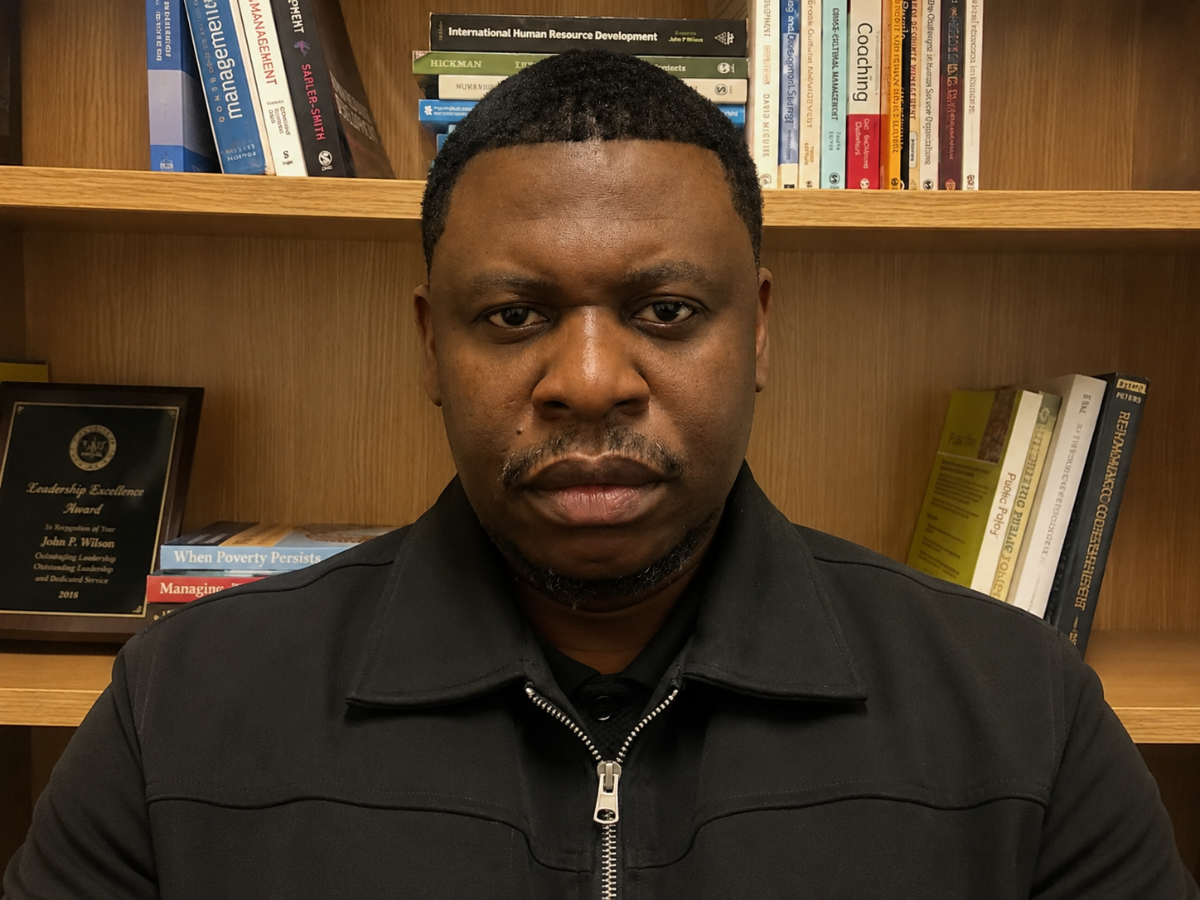
Dr. Kelechi Ekuma has always been fascinated by how ideas become action. Growing up in Nigeria, he saw firsthand how education, public institutions, and leadership could shape opportunities for individuals and entire communities. Those early experiences sparked a lifelong interest in development, governance, and the role technology can play in creating positive change.
After earning his bachelor’s degree at the University of Lagos, he moved to the United Kingdom to continue his education, eventually completing a PhD in Development Policy and Management at The University of Manchester. Rather than focusing on technology alone, he became interested in the bigger picture: how governments, organizations, and educational institutions adapt to change, and how emerging technologies like artificial intelligence can improve lives when paired with thoughtful leadership and sound policy.
Today, Dr. Ekuma serves as a Senior Lecturer at the Global Development Institute at The University of Manchester, where he teaches artificial intelligence, digital transformation, leadership, workforce development, and higher education reform. He also serves as the Institute’s Chief Examination Officer and Employability Lead, helping prepare students for a rapidly evolving world of work.
Beyond the classroom, he has founded several technology and social-impact ventures, including Melon, the African Skills and Innovation Network (ASIN), PolicyAtlas, and Coevolution. Through these initiatives, he works to expand access to education, digital skills, financial inclusion, and innovation, particularly across Africa.
Whether he’s teaching students, advising organizations, or building new initiatives, Dr. Ekuma remains driven by a simple belief: technology creates its greatest value when it helps people, strengthens institutions, and opens doors for future generations.
What is your typical day, and how do you make it productive?
I think of my day as three different conversations. The first is with ideas. That’s when I read, write, or work through research before the world becomes noisy. The second is with people. Teaching, mentoring students, meeting colleagues, and collaborating on projects all happen once I’ve already spent time thinking. The final conversation is with myself. Before I finish for the day, I ask what surprised me, what I learned, and what deserves more attention tomorrow. That habit keeps me from confusing activity with progress.
How do you bring ideas to life?
I don’t fall in love with ideas. I interrogate them. When I think something is promising, I ask whether it solves a genuine problem or simply sounds impressive. Then I look for the smallest possible way to test it. Whether it’s a research project, a course, or one of my ventures, I would rather learn from a small experiment than spend years protecting an assumption that turns out to be wrong.
What’s one trend that excites you?
The shift toward using artificial intelligence to enhance human capability rather than replace it. Some of the most interesting work isn’t about automation for its own sake. It’s about helping teachers teach better, helping policymakers make more informed decisions, or helping workers develop new skills throughout their careers. That’s where I believe AI can make its greatest contribution.
What is one habit that helps you be productive?
I deliberately challenge my own assumptions. Whenever I become convinced that I’ve found the right answer, I look for evidence that proves me wrong. That habit has shaped both my research and my work as an entrepreneur. It forces me to ask better questions, listen more carefully, and avoid becoming attached to ideas simply because they’re my own. I think intellectual humility is one of the most underrated productivity tools we have because it prevents us from wasting time defending bad assumptions.
What advice would you give your younger self?
I’d tell myself to stop worrying about whether I belonged in the room. Moving between countries, disciplines, and sectors, I often felt pressure to prove that I fit a particular mold. Looking back, I realize my greatest advantage came from not fitting neatly into one category. The ability to connect ideas from development, policy, technology, and education became one of my greatest strengths.
Tell us something you believe almost nobody agrees with you on?
I think organizations spend too much money chasing innovation and too little time improving institutions. People often assume digital transformation begins with new technology. I think it begins with culture, leadership, and governance. If those things aren’t working, the newest technology usually magnifies existing problems instead of solving them.
What is the one thing you repeatedly do and recommend everyone else do?
Stay curious about people whose experiences are completely different from your own.
Some of my best ideas have come from conversations with community leaders, entrepreneurs, students, civil servants, and people working far outside my own discipline. Innovation often begins with listening rather than talking.
When you feel overwhelmed or unfocused, what do you do?
I return to first principles. Whether I’m working on research, policy, or one of my ventures, I ask myself, “What problem am I actually trying to solve?” Complexity has a way of pulling us toward symptoms instead of causes. Going back to the original question almost always brings clarity.
What is one strategy that has helped you grow your business or advance in your career?
I stopped trying to separate my different interests. For a while, it felt as though I needed to choose between being an academic, an entrepreneur, or someone interested in public policy. Eventually, I realized those roles strengthened one another. Research helps me ask better questions. Entrepreneurship forces me to test those ideas in the real world. Policy helps me understand the wider systems in which both exist.
What is one failure in your career, how did you overcome it, and what lessons did you take away from it?
One of my early ventures taught me a lesson I’ll never forget. We spent months refining the concept, improving presentations, and making sure every detail looked polished. What we hadn’t done was spend enough time listening to the people we hoped would actually use it.
When adoption was slower than expected, we resisted the temptation to simply market harder. Instead, we stepped back, simplified the offering, spoke directly with users, and rebuilt parts of the project around their feedback. That experience fundamentally changed how I think about innovation. Today, I believe good ideas should earn their way into the world through evidence, not enthusiasm.
What is one business idea you’re willing to give away to our readers?
I’d love to see someone create a lifelong digital skills passport powered by AI. Instead of relying only on degrees or job titles, people could build a secure record of everything they’ve learned through work, volunteering, short courses, certifications, and practical experience. As careers become less linear, we’ll need better ways to recognize continuous learning.
What is one piece of software that helps you be productive? How do you use it?
Notion. I use it as a central place for research notes, teaching plans, writing projects, reading lists, and long-term ideas. Having everything connected makes it much easier to see relationships between projects that would otherwise remain separate.
Do you have a favorite book or podcast you’ve gotten a ton of value from and why?
One book I frequently return to is Seeing Like a State by James C. Scott. It challenges readers to think carefully about why well-intentioned policies sometimes fail and why local knowledge matters. It reminds me that development, governance, and technology are ultimately about people, not systems alone.
What’s a movie or series you recently enjoyed and why?
I recently enjoyed The Diplomat. What interested me wasn’t the politics as much as the leadership. It shows that complex problems rarely have perfect solutions and that good judgment often comes from asking better questions rather than having immediate answers. That’s true in research, business, and public policy as well.
Key learnings
- The strongest innovations begin with listening carefully to the people they are meant to serve.
- Digital transformation depends as much on leadership, culture, and institutions as it does on technology.
- Reading across different disciplines often leads to the most valuable insights and creative solutions.
- Long-term impact is built through trust, experimentation, and continuous learning rather than rapid growth alone.
- Artificial intelligence delivers its greatest value when it strengthens human capability instead of replacing it.