
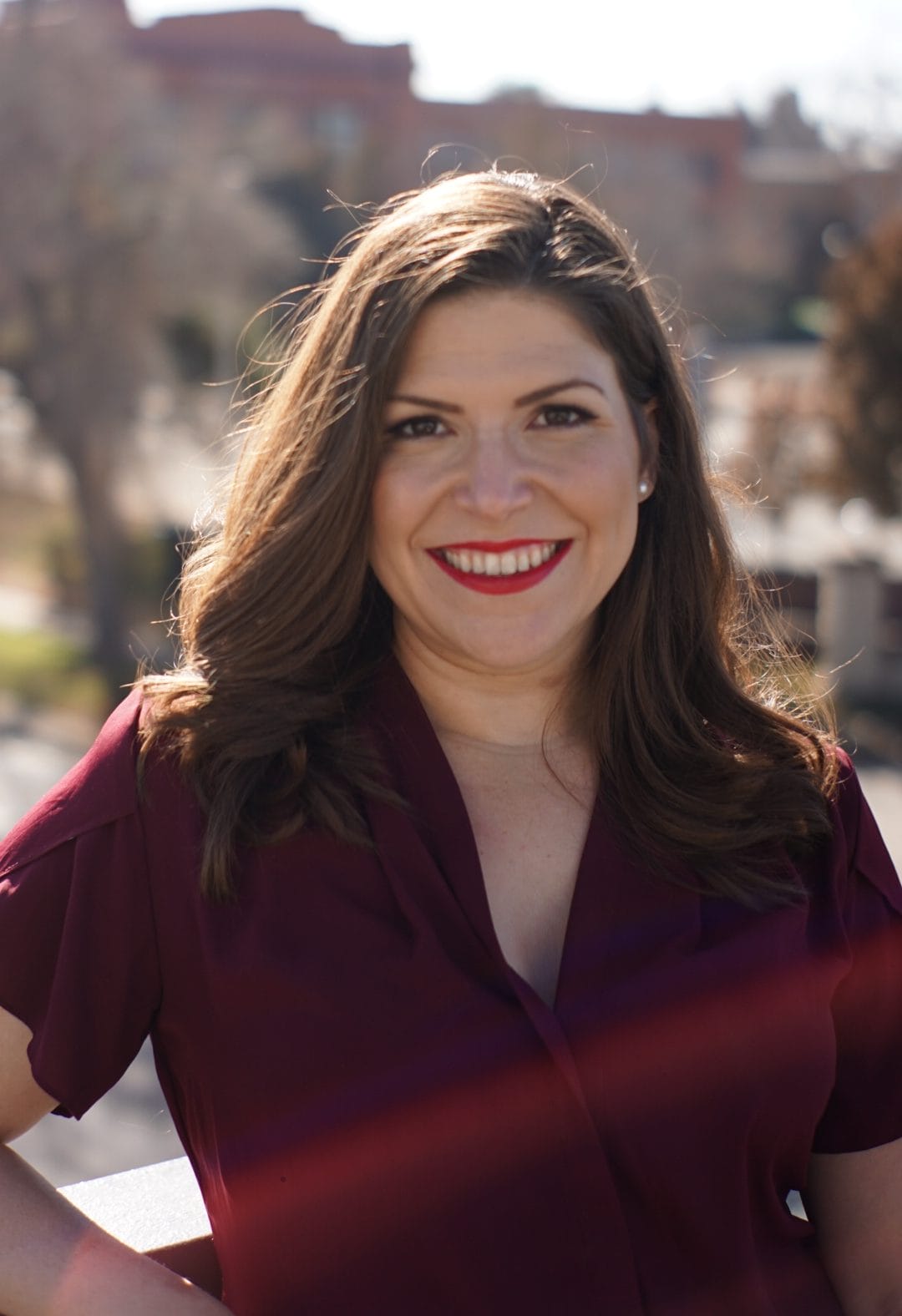
Muzzio is an opera singer and voice instructor based in Billings, Montana. She has recently taught operatic courses at Rocky Mountain College, Luther College and the University of Northern Colorado. Kristi Muzzio worked at Northern Colorado’s School of Music from 2020 to 2023, during which time she taught applied voice, class voice, and lyric diction, while also serving as an academic advisor and president of the School of Theatre Arts and Dance (SNATS).
Kristi Muzzio previously worked as development coordinator with Best Buddies, Inc., where she scheduled, planned, and oversaw budgets for fundraising events. She also worked seven years as a teaching artist at the Patel Conservatory at the David A. Straz Jr. Center for the Performing Arts and as a performing artist with Opera Tampa, having had mainstage roles in Macbeth by Verdi and Il barbiere di Siviglia by Rossini.
A community-minded singer, Kristi Muzzio has performed in diverse settings, including singing the national anthem at sporting events and being soprano section leader in church choirs. She has also been a judge and adjudicator for music contests. She holds a Doctor of Arts in music performance (voice) from the University of Northern Colorado, and earned vocology certification from the Summer Vocology Institute at the University of Utah.
What is your typical day, and how do you make it productive?
As a professional opera singer and singing teacher, my days tend to be a balance between maintaining my own artistry and supporting the growth of my students. My mornings are reserved for quiet time and journaling to awaken my creative thinking for the day. Singing is a physical craft so I practice yoga to maintain my alignment and get my blood flowing. I’ll often do a gentle vocal warm-up before breakfast—not to “practice” yet, but simply to check in with how my instrument feels that day. I also like to review my schedule and set intentions. If I have rehearsals, lessons, or a performance later, I’ll plan meals and energy around those events. Productivity for me is really about pacing my energy, since the voice is a finite resource.
During midday I do the bulk of my vocal practice including technical work such as scales, breath exercises, and resonance balancing, work through repertoire and learn new roles, and do score study. I aim for four 30-45 minute blocks with a 10 minute break between in order to prevent fatigue.
Teaching voice lessons takes up a good portion of my afternoons. I love this part of my work because it’s both creative and analytical—each student needs a slightly different approach, and helping them discover freedom in their sound keeps me energized.
If I’m in rehearsal for an opera or concert, afternoons or evenings may be devoted to staging rehearsals, coachings, or ensemble work. Those sessions require stamina, so I schedule my teaching and practice in a way that leaves space to be vocally and mentally fresh.
How do you bring ideas to life?
When I approach a new role or aria, I begin with the composer’s intention- the score and the text. My job is to step inside that framework and discover what it means for me personally. I study the language to determine the meaning and subtext of the text, the rhythm and the harmony to clarify how the music reflects the emotions of the text, and how the vocal line interacts with the orchestra to bring these emotions to life.
Then I experiment vocally and physically. I try different colors of sound, gestures, and pacing until I feel connected to the character through my own experiences. Often, I’ll record myself, listen back, and refine. I often put the music “on it’s feet” as soon as possible by moving within a space as the character would or singing in environments that connect me to the character such as outside under the stars or in the sea. The “life” comes when the music is no longer just notes and words on a page, but an emotional experience that appears to come naturally in performance.
What’s one trend that excites you?
One trend that excites me in opera is the growing use of intimate or nontraditional settings for performances.
For so long, opera has been associated with grand houses, elaborate sets, and large budgets—which are magnificent, but can also feel intimidating or inaccessible to some audiences as well as unattainable for smaller budget companies. Recently, I’ve seen more companies creating chamber productions in smaller theaters, warehouses, galleries, or even outdoor spaces. These stripped-down stagings highlight the raw immediacy of the human voice and the drama, allowing audiences to connect with opera in a more personal way. This also creates a convenient and cost effective method to provide more opportunities for audiences to see operas in their area.
What is one habit that helps you be productive?
One habit that helps me stay productive as a performer is ending each day with a practice journal reflection.
As a singer, my instrument is my body, so I can’t just measure productivity in hours worked or pages read. Instead, I keep a short journal where I note:
• what felt easy or free in my singing that day,
• what still needs attention,
• how my energy and focus held up during teaching, rehearsal, or practice.
This habit keeps me honest and intentional. Instead of drifting through routines, I see clear patterns—like when certain foods, rest habits, or warm-ups make me more efficient—and I can adjust my schedule accordingly. It also keeps my growth visible, which is motivating in a career where progress can sometimes feel intangible.
What advice would you give your younger self?
I would tell my younger self to trust the process and don’t confuse speed with progress.
When I was starting out, I often felt pressure to “arrive” quickly—to master technique, land roles, or have my career all mapped out before the age of 28 when singers suddenly “age out” of young artist programs. But singing is a lifelong craft. The voice matures on its own timetable, and artistry deepens with experience. I’d remind myself that consistency and patience yield far more than rushing ever could.
I’d also say: take care of your whole self, not just your voice. Sleep, hydration, mental health, and healthy boundaries are just as vital as practice. The most sustainable artistry comes from a balanced life, not relentless striving.
And finally: your unique voice is enough. Don’t spend so much time trying to sound like others—cultivate the instrument you were given and let authenticity be your compass.
Tell us something you believe almost nobody agrees with you on?
I believe that silence is just as important to singing as sound—and I’ve found that not everyone agrees with me on that.
Most people think of singing as projecting, producing, and filling space with sound. But I’ve learned that the moments of silence—the breath before a phrase, the stillness after a climactic note, the way you withhold sound—can be just as powerful as the music itself. Silence shapes tension and release, invites the audience in, and often communicates more vulnerability than the sung line. Leaning into silence deepens both artistry and stamina. So my slightly contrarian belief is that the most moving moments in opera aren’t always the high Cs—they’re often the silences wrapped around them.
What is the one thing you repeatedly do and recommend everyone else do?
The one thing I repeatedly do, and encourage every singer to do, is record yourself regularly and listen back with curiosity, not judgment.
When we’re in the act of singing, teaching, or even speaking, our internal perception is skewed. Listening back creates a mirror that reveals habits, strengths, and blind spots we can’t catch in the moment. I make a habit of recording practice sessions, lessons, and even performances, then reviewing them with the same objectivity I’d give a student.
The key is curiosity: instead of criticizing, I ask questions. “Why did that phrase feel harder than it sounds?” or “What technical adjustment gave that resonance?” Over time, this practice builds both self-awareness and confidence.
When you feel overwhelmed or unfocused, what do you do?
When I feel overwhelmed or unfocused, I come back to the body first. Singing is so tied to breath and alignment that I’ve learned my mind often settles once my body does. I’ll step away from whatever I’m working on, close the score, and spend a few minutes breathing slowly, stretching, or even just walking outside.
If it’s vocal work that’s overwhelming me, I’ll simplify. Instead of trying to power through an entire aria, I might sing one phrase on a neutral vowel or speak the text rhythmically until it feels grounded again. That act of narrowing my focus resets my perspective.
What is one strategy that has helped you grow your business or advance in your career?
One strategy that has helped me grow both as a performer and teacher is building genuine relationships through collaboration, not competition.
Early in my career, I thought advancement was mostly about singing perfectly and being “the best.” Over time, I realized that the most meaningful opportunities came from people I had connected with authentically—directors, conductors, and colleagues who trusted me not only for my skill, but for my reliability, openness, and generosity in rehearsal.
In opera, cultivating relationships has meant being someone others want to work with—musically prepared, yes, but also collaborative and respectful. That reputation has opened far more doors than any audition win on its own.
In short: the strategy is relationship building over rivalry—and it has advanced my career more than anything else.
What is one failure in your career, how did you overcome it, and what lessons did you take away from it?
One of the biggest failures I faced early in my career was a high-stakes audition where my nerves completely took over. I had prepared musically, but I walked into the room with so much tension that my breath collapsed, my high notes cracked, and I left knowing I hadn’t shown even a fraction of what I was capable of. At the time, it felt devastating—I worried that one poor performance had ruined my chances.
To overcome it, I had to shift how I approached both auditions and failure itself. I sought guidance from mentors, worked with a performance anxiety coach, and started treating auditions less like “tests” and more like opportunities to share my artistry in that moment. I also built routines—breathing exercises, visualization, and structured preparation—that helped me ground my body and focus my mind.
The lesson I took away is twofold: first, failure is not final—it can be a turning point if you treat it as information, not identity. Second, growth in this field is not just about vocal technique, but also about resilience, mindset, and the ability to show up fully human in high-pressure situations. That audition didn’t end my career; it helped shape it.
What is one business idea you’re willing to give away to our readers?
One business idea I’d gladly give away is this: create micro-opera experiences that pair with local businesses.
Imagine a 30–40 minute opera or opera-inspired program performed in a winery, brewery, bookstore, or gallery. The business gains a unique cultural event that draws in new customers, while singers and musicians gain an intimate, engaged audience without the overhead of a full-scale production. Tickets could include a glass of wine, a tasting flight, or even a themed pairing inspired by the music.
This idea excites me because it meets people where they are. Many who might feel intimidated by a traditional opera house would happily sit in a cozy venue with a drink in hand and discover that opera is visceral, emotional, and deeply accessible. It also creates a sustainable model for emerging artists to perform more often, collaborate with their community, and build new audiences.
Opera doesn’t always need a grand stage—it just needs human connection. Partnering with local businesses makes that both possible and profitable.
What is one piece of software that helps you be productive? How do you use it?
One piece of software that has been a gamechanger is ForScore.
On the performance side, I keep databases of repertoire I’m working on, role preparation notes, translations, and practice logs—so I can track progress and revisit old insights without losing them in scattered notebooks or needing to carry a heavy bag of sheet music. What makes it especially productive is that it keeps everything in one place. Instead of juggling multiple apps or paper systems, I can move seamlessly from score analysis to lesson notes to scheduling, all in a structure that I’ve customized to fit how I think. That reduces decision fatigue and frees up more energy for the artistry itself.
Do you have a favorite book or podcast you’ve gotten a ton of value from and why?
Yes—I often return to Jerome Hines’ book Great Singers on Great Singing.
It’s a remarkable resource because it collects the insights of some of the most celebrated voices of the 20th century—singers like Pavarotti, Tebaldi, and Sutherland—speaking candidly about their craft. What I value most is that you see just how different their approaches can be: one singer swears by a certain technical method, while another achieves the same result through an entirely different pathway.
That book taught me two things: first, there isn’t one “correct” way to sing—there are principles, yes, but each singer must discover how their unique instrument responds. Second, even the greatest artists never stop being students. Their humility and curiosity remind me to keep experimenting and refining, no matter how many years I’ve been singing or teaching.
What’s a movie or series you recently enjoyed and why?
I recently enjoyed the series The Gilded Age, particularly because of how it represents opera as a cultural centerpiece of that era.
What struck me is how accurately the show portrays opera not just as entertainment, but as a marker of social standing, taste, and community identity. The rivalry between the “old money” supporters of the Academy of Music and the “new money” push for the Metropolitan Opera mirrors real history—and highlights how opera has always been about more than music. It reflects ambition, belonging, and even rebellion.
As a singer and teacher, I found it fascinating to see opera woven into the storyline with such detail. It reminded me that while we often view opera today as purely an art form, for audiences of the Gilded Age it was also a social and political arena. That layered context deepens my own appreciation for the tradition I work in and teach every day.
Key learnings
- Opera is evolving – from intimate, nontraditional performances to modern storytelling approaches that make the art form more accessible.
- Productivity in singing comes from balance – managing energy, practicing reflection, and caring for the body as much as the voice.
- Failure is a teacher – setbacks like poor auditions can become turning points when approached with resilience and curiosity.
- Relationships matter most – genuine collaboration and community-building often open more doors than competition alone.
- Authenticity is key – every singer must cultivate their unique instrument and voice, rather than chasing someone else’s sound or path.