
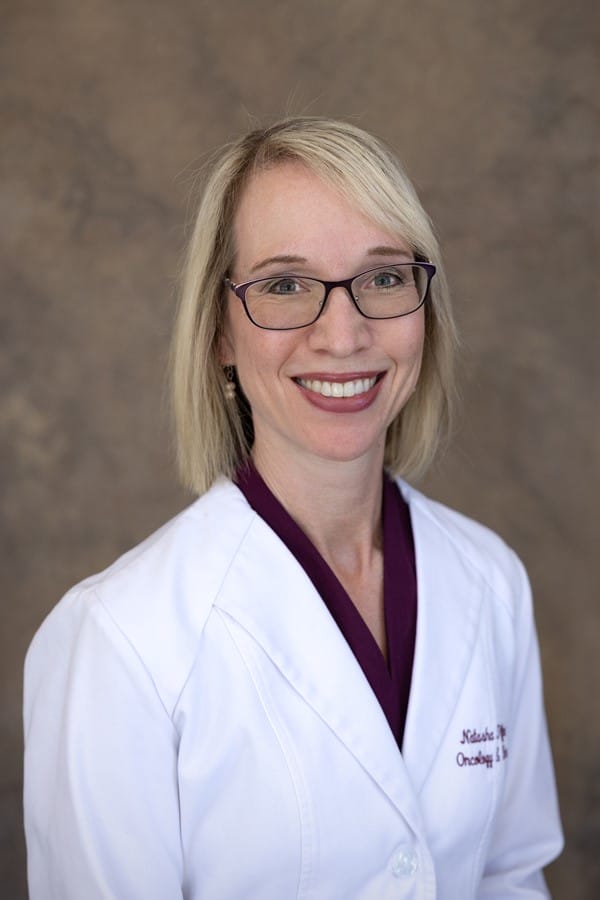
Based in Bend, Oregon, Natasha Tiffany, MD, is the Medical Director of Medical Oncology at the St. Charles Cancer Center. She joined the St. Charles in September 2024, after spending 20 years in private practice in Salem, Oregon with Oregon Oncology Specialists. Throughout her career, she has been very active in building cancer institutes as a member and chair of numerous committees, including the Breast Committee and Thoracic Committee. Natasha Tiffany, MD, continues seeing patients at St. Charles Medical Center, focusing on breast and lung cancer, although she continues to see patients with all cancers and blood disorders. She served at Oregon Health Sciences University as an affiliate assistant professor from 2004 until 2020. Her responsibilities with the school include staffing the medical oncology and hematology fellow’s clinic.
Dr. Tiffany is working to increase the clinical trial offerings at St. Charles Medical Center and is thrilled to be associated with such a great group of medical and radiation oncologists. She sees patients in Bend and Redmond, and continues to keep her contacts with her colleagues at OHSU.
Dr. Tiffany received her medical degree from Oregon Health and Science University. She served as the chief fellow of the university’s medical oncology and hematology program in addition to her internal medicine training at Massachusetts General Hospital and Harvard Medical School.
What is your typical day, and how do you make it productive?
I typically get up at 4:30, workout with my husband at Orange Theory from 5-6 am. Then, I get ready for work and am typically start seeing patients by 8 am, frequently after a 7 am meeting. I see patients from 8-5 or 5:30, typically without any break for lunch. I then spend about 60 minutes going through all my messages, labs, and CT, MRI, or PET scans to review. I usually spend 1-2 hours preparing for clinic the next day, reviewing the charts of the patients I will see and making sure I have a good plan for them. I enjoy having dinner with my family. I definitely am productive and help many people throughout the day.
How do you bring ideas to life?
I believe in hard work and dedication. If I have a dream, I know I will never realize it unless I make it happen. I take one step at a time and enlist others to help me when needed.
What’s one trend that excites you?
I love playing pickleball, which has gained tremendous popularity in recent years. I think it is an excellent way to work out and have fun at the same time. It is something that people can enjoy in their older years and is a great way to stay fit.
What is one habit that helps you be productive?
I find my days are more productive when I exercise first thing in the morning. I go to Orange Theory four times a week at 5 am, and I find that I am more able to focus better on those days.
What advice would you give your younger self?
If I could give advice to my younger self, I tell myself that it is okay to just do your best. No one can do better than their personal best, and that is good enough. You will be productive, you will help others, and you will be a great physician. You do not need to worry so much about each exam, each test along the way.
Tell us something you believe almost nobody agrees with you on?
We have always had cats, and I have struggled with the fact that cats like to kill mice. It hurts my soul that my beloved cats will torture a mouse by playing with it for hours before they finally kill it. I try to keep my cats mostly indoors, but one of them strongly prefers to go outside and hunt. Several times, I have spent significant time and energy trying to catch and save a mouse that my cat has brought, still alive, into the house to play with. My cat was quite upset with me after I took his hard-won prize away. To his dismay, I force him to wear a loud jingle bell on his collar, which is intended to make it harder for him to catch mice and other rodents. My family and neighbors think I am crazy to try to protect rodents, and they wish I would allow my cats to hunt freely to protect us from an over-abundance of mice in our neighborhood. Nature is so cruel at times. I understand the need to kill to eat, but I do not understand the desire to “play” with prey before you kill it.
What is the one thing you repeatedly do and recommend everyone else do?
I always ask my friends, colleagues, team members, and patients how they are doing and if there is anything I can do to help them. I clearly listen to their response, try to ensure that they realize I truly care. If they identify a problem that is fixable, I make sure to take action and do all that I can to address their concerns. Many problems have been solved by listening to a colleague tell me that they are frustrated by a process that I have the power to change. I have learned so much from colleagues and team members about problems that I didn’t know existed.
When you feel overwhelmed or unfocused, what do you do?
I tend to start listening to music. I used music to get me through my hardest courses in college and medical school, and it always gives me a burst of energy. Sometimes, I will play the piano to reset my focus.
What is one strategy that has helped you grow your business or advance in your career?
I have always been very involved in my community, through volunteering on boards, through helping with fundraising, and through promoting community health awareness. That has helped me make contacts that turned out to help me through my career. I have learned a lot from others by sitting on the board of directors for multiple organizations. I have also always believed that where you train is important. I was fortunate to train at Massachusetts General Hospital for internship and residency, and that helped to make the physician that I am today.
What is one failure in your career, how did you overcome it, and what lessons did you take away from it?
I didn’t get into Harvard Medical School. At first, I was fairly upset. However, I saved over $100,000 by going to Oregon Health Sciences University for medical school, where I was much closer to family. I received an excellent education and was honored to be inducted into the Alpha Omega Alpha medical honor society. Through my hard work and success in medical school, I was chosen to go to the Harvard Medical School teaching hospital for internship and residency.
What is one piece of software that helps you be productive? How do you use it?
As a physician, I still remember paper charts, and honestly, it was so much easier practicing medicine back then. Everything was in its place behind a physical tab. Now, we have computerized medical records and massive programs that are complicated and not user-friendly. It can be hard to find things that you are looking for. However, I am grateful for UpToDate, a medical database that summarizes the most cutting-edge treatments for most medical conditions. You can also use it to check for interactions between multiple medications. I can’t imagine going back to practicing without UpToDate or similar programs to help me stay abreast of the rapid advances in medicine.
Do you have a favorite book or podcast you’ve gotten a ton of value from and why?
I loved the book When Breath Becomes Air by Paul Kalanithi. He was a neurosurgeon and was facing death to cancer. It helps me to remember to make the most of each day that I am lucky enough to be alive.
What’s a movie or series you recently enjoyed and why?
I always love Dead Poet’s Society, as it reminds me of how inspirational a good teacher can be. It also reminds me about the power of music and poetry to help us find meaning in life. Robin Williams’ character was helping to guide young men through a difficult time and encouraged them to take time to enjoy life along the way. The system was trying to force the young men to all be of one mold, but he asked each student to discover their own passion and pursue it.
Key learnings
- Never give up.
- Listen to others and let them know you care.
- Strive to give your best effort in everything that you do but remember that doing your best is enough.
- Giving back to your community can promote both personal and professional growth.
- Maintain a customer-first mentality and address any barriers preventing you from providing the best customer service.