
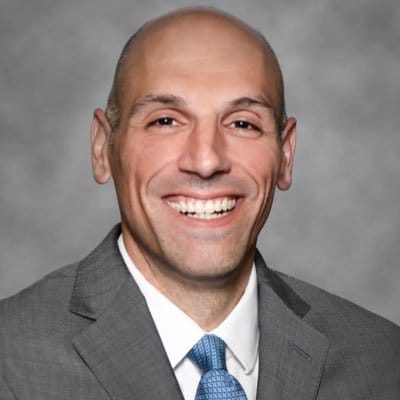
Nicholas Mirisis is the CEO and a Board Member at HomeTown Ticketing, an EdTech SaaS company dedicated to maximizing revenue for educational institutions through cutting-edge management platforms. His mission is to help educational leaders overcome challenges in events, operations, and fundraising, thereby optimizing financial resources for the benefit of students and their programs. Since 2023, he has also served as an Operating Partner at Fulcrum Venture Group.
With over two decades of experience in growth-oriented executive roles, Nicholas has a proven track record in developing acquisition, revenue generation, and retention strategies. At SamCart, he served as the Chief Revenue Officer and President/GM of eCommerce, driving growth from $11 million to $30 million in Annual Recurring Revenue (ARR). His earlier roles include Chief Marketing Officer and Chief Revenue Officer at GoCanvas, where he doubled ARR from $19 million to $46 million. At Dude Solutions, he played a key role in expanding the company from 30 employees and $1 million ARR to over 750 employees and $100 million in revenues post-Series-B funding.
Nicholas holds a Master’s degree from Johns Hopkins University and a Bachelor’s degree from North Carolina State University. He has served on the boards of the Consortium for School Networking and the National Business Officers Association. Renowned as a customer-centric thought leader, Nicholas excels at translating vision into actionable plans, building high-performing teams, and scaling GTM strategies to drive organizational success.
What is your typical day, and how do you make it productive?
There is nothing typical, other than coffee and a workout early in the morning before going to the office. Common for most Leaders is to anticipate the unexpected, and that tends to be typical for me. I like to maintain a regular routine to build good habits, so the day starts after I wake-up with coffee, a quick scan of NYTimes/CNBC and then looking at the schedule to see if anything should be prioritized/re-prioritized in terms of meetings, focus, and important goals. I’ll write down the items that are top of mind or goals that I want to get done for the day, and then grab a workout before getting to the office. I set a goal to have an employee (skip-level, not direct report) meeting and a customer meeting, every day; Both ensure we are focused on the right outcomes as business and not missing an opportunity, or a challenge, that might occur in the future.
How do you bring ideas to life?
Some smart person years ago made the statement about ‘working in your business versus working on your business’ and to me that axiom holds true. The best ideas come from our customers – understanding the challenges they face on a daily basis, what frustrates/occupies too much of their time, or what they are not passionate or interested in solving – that we, as their partner, can help solve for them. This summer, we released three wildly impactful value areas in our platform, that all came from listening to our Athletic Directors, being on campus and watching the event management process play out in real-life, and re-imagining the solution, by putting their needs first.
What’s one trend that excites you?
We’d had a wonderful opportunity to work with, and be mentored by, some of the former leaders and builders at $1B+ companies. One of their most powerful lessons is for the leadership team, and all departments/teams/individual contributors to think about how we spend our time each day, and is it of the highest value/utility in serving our customers, and ensuring their success. The exercise (Automate/Delegate/Eliminate) has been healthy for us to re-examine every journey point and interaction, to critically assess, which items can we better rely on technology for (to do some of the rote tasks that occupy time) to allow us to recapture time in areas (strategy, analysis, best practices, consultative help, on-site professional services) that our customers value more. So while “AI” is now all the rage, this notion of computing power and intelligence/automation has existed for decades – and it does excite me that we can remove some of the most time consuming, low utility tasks from our team – and allow them to spend more time, customer-facing, solving problems and improving the environment of schools and student athletics.
What is one habit that helps you be productive?
I use an AI powered email client that helps separate noise from necessary; If I could train Slack to do the same, I’d do a backflip.
What advice would you give your younger self?
Starting out in your career, you are told the ‘myth’ that the manager should be the smartest person in the room. That frankly is the dumbest guidance to give a new manager. The best advice is:
Hire people way smarter than you
When you get something wrong (which happens all the time) – admit it, learn from it, understand why it occurred and work to not repeat the mistake again
When you don’t know something, just say that – instead of MSU (Making S**t Up)
And finally, ask for help. It is not a sign of weakness to ask for help, it is a combination of maturity, low-ego, and efficiency. The best ideas occur by pressure testing your own hypothesis, seeing how others did it, or asking for feedback, to improve your own idea and make it even better.
Tell us something you believe that almost nobody agrees with you on?
I’ve said before that we should turn off/remove these office “communication” tools – as it leads to more miscommunication, misinterpretation and wasted time. My guidance has been, if you go more than 3 volleys and still haven’t solved a problem, pick up the damn phone.
What is the one thing you repeatedly do and recommend everyone else do?
I learn best by visiting with our customers, in their environment. Travel is not glamorous and takes a toll, however we find we understand their stressors and environment better when we see a day in our life (and not a filtered version that someone tells me). I also love meeting the broader team who interact with HomeTown; I’m always listening to and learning about how they collaborate, solve problems, implement teamwork – lessons and tools we can bring back into our own business. And I get to thank them for the important work they do.
When you feel overwhelmed or unfocused, what do you do?
Putting on some music and going for a walk helps recenter me when I feel overwhelmed. However the best is time with family and friends, as that helps recharge me and remind me what’s important and that we work to live, not the other way around.
What is one strategy that has helped you grow your business or advance in your career?
Sure – this is a long one and lots of credit goes to many people who helped us create these two step-changes in the business.
When I first became Marketing Leader for SchoolDude, one of the immediate charters was moving the organization from push/reactive/tactical and traditional marketing to pull/proactive/strategic and digitally focused marketing. It was vital, as our buyer was evolving from the traditional 60 year-old operations professional who had dedicated their whole life to the public sector – being replaced by the 30-40 year old tech-savvy buyer with experience in the private sector. It was also critical from a business continuity and growth perspective, as we were too reliant on the push/traditional marketing channel with 90% of leads generated via relationship, in person, trade show or event marketing.
The transition of the buyer from the traditional operations professional (they were a joiner and attended in person events and were members of their regional and local association) to the tech savvy operations professional (research online, connect virtually, do more homework before speaking to Sales) left us vulnerable in our GTM approach.
Marketing led the way to create a user-generated best practices online community as our new web strategy and replacing our static brochure-type website. The goals were:
Digital ecosystem where user-generated content and best practices would create a vibrant knowledge base
Allow access and registration by clients and non-clients, giving us a channel to target the ‘searcher’ buyer persona at a low CAC
Allow client advocates to champion their results, impact and success, a more credible reference than a sales generated cold call
Index all the user generated content to help with our SEO, relevance and domain authority
Use operational data, insights and KPIs as a hook for clients and non-clients. For Clients, an upsell mechanism to see value in products they were not using based on the savings data we shared for other affinity/cohort clients. For non-clients, the ability to see the types of data, reports and executive dashboards they could receive if they were a Client.
The Community was ultimately integrated into our CRM, SSO authentication, product applications, Marketing Automation and even our Google Analytics account.
We were able to track digital body language and syndicate that activity into CRM for the company to have a full 360 of every account and contact level interaction.
We could dynamically target contacts based on their content engagement or add them to nurtures/drips based on their scoring and patterns.
We could adjust paid/display search campaigns based on search intent inside the Community.
And we could dynamically create best practices content landing pages for them based on their search and content consumption within the community.
All of this contributed to our sales pipeline growth within 24 months (184% in 2013 and 260% in 2014).
The Community and the KPIs/data became the technology-enabled platform that allowed our Services team to triage accounts, as well as establish the prescriptive health checks to ensure renewal/retention and expand share of wallet.
The second significant growth inflection point came after our Series A when we had a difficult innovation period. The vast majority of the investment was allocated to engineering to build a new, scalable platform, which meant we would halt all evergreen engineering efforts to allow the 100% focus on the new build. In concert with this, our investors wanted a price escalation for 2015, however we now didn’t have the ability to use engineering resources to monetize new features/benefits for existing clients.
The GTM organization took the leadership role of examining existing IP and determining if/how we could commercialize it. I led the cross-functional team that included representatives from Sales, Marketing, Support, Service, Operations, Finance, and Product Management. Our goals were:
Illustrate value and innovation to the market, during a 24-36 month window when engineering would NOT be releasing new products or major enhancements.
Examine and monetize existing IP or assets.
Simplify the solution offering to reduce friction in the sales process.
Establish a new pricing framework with annual escalations and the value proposition to support them.
We researched Share of wallet/penetration rates of Clients, Implementation statistics, Success ratios and finally, Investment – the CAC to sell the various solutions to clients
The research yielded clear clusters and buying patterns, which formed the basis for our initial product bundling and packaging work. This also served to reduce our CAC by not deploying a sales rep to sell the incremental/upsell unit at a higher marginal cost.
The COGS analysis allowed us to financially model our Clients with several dimensions (propensity of spend, resource cost, renewal rate, profitability, etc.) and we authored a CLTV model of our full Client profile. We constructed a simplified services package/offering that was matched to their CLTV/profitability – with high CLTV clients receiving higher value (and resource intensive) services that could also generate incremental subscription revenue and the low CLTV/profitability Clients moved into self-service formats.
With the research completed and CLTV models in place, we simplified our packaging and positioning – reducing 35 solutions down to a core of 5 value prop suites and 15 products. The mass-market / most common entry product “reactive maintenance” was bundled with our preventive maintenance and inventory solution (which were previously sold ala carte) and repackaged into an “Essentials” offering. New Clients would purchase the new “Essentials” bundled product, which included seamless integration between the three prior stand-alone solutions. In addition, the additive effect of the bundle solution allowed us to increase pricing to 45% more than the prior total contract value for the three independent solutions.
For existing Clients, we built upon the work that Marketing had pioneered with the Community and data platform. We leveraged that prior IP and commercialized it to a new product called “Dude Data” and added additional KPI libraries, advanced reporting, executive dashboards and automated reports with natural language narratives.
To not distract the sales organization from the New Client acquisition and upsell work, we established a GTM task force of Marketing, Quota Carrying Account Managers and Support team members. This team was chartered with: (1) making proactive outreach to the Client cohort (prior to their next renewal) and (2) position / sell the value of Dude Data and/or the Essentials bundle product offering, to secure the price escalation for their 2015 contract.
The team, which contacted all 6,000 clients using the CLTV and propensity profiling we developed, had scripted talk tracks based on buyer sophistication and prior satisfaction score with us. At the conclusion of the Task Force’s 18-month charter, 70%+ of the accounts had migrated to new contract pricing, netting the business an incremental $15M of subscription revenue.
What is one failure in your career, how did you overcome it, and what lessons did you take away from it?
There are many; Foundationally it all comes down to people and hiring/working with the right people. The times I got this wildly wrong in my professional career I was overly enamored by someone’s resume or academic degree – and the person never really wanted to roll-up their sleeves and ‘get it done’. Finding ‘match’ in your career is about probing during the interview process to understand your/their shared values, their philosophy on success, motivation, teamwork, their ability to recover from and learn from a mistake.
Do you have a favorite book or podcast you’ve gotten a ton of value from and why?
Best recent read was ‘Thinking in Bets’. Often Leaders prepare only one strategy, and the better approach is the cascading decision tree, thinking four branches ahead about what are the interdependencies or the considerations that may present themselves.
What’s a movie or series you recently enjoyed and why?
An odd one, as I don’t own a TV, however I did binge Yellowstone on some recent long red-eye flights and very much enjoyed the cinematography and the quality/depth of the character development.
Key learnings
1.The best ideas come from our customers – understanding the challenges they face on a daily basis, what frustrates/occupies too much of their time, or what they are not passionate or interested in solving – that we, as their partner, can help solve for them.
2. When you get something wrong (which happens all the time) – admit it, learn from it, understand why it occurred and work to not repeat the mistake again.
3. Ask for help. It is not a sign of weakness to ask for help, it is a combination of maturity, low-ego, and efficiency. The best ideas occur by pressure testing your own hypothesis, seeing how others did it, or asking for feedback, to improve your own idea and make it even better.
4. Marketing can lead the way to create a user-generated best practices online community, that is both revenue generating and accretive to growth.