
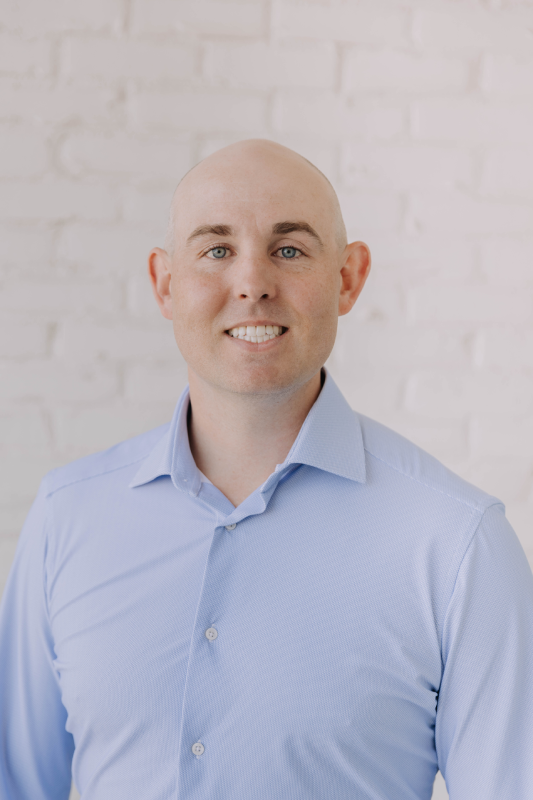
Parker McCumber is the owner of Rookery Studios, a podcast and video production studio in Orem, Utah that helps business owners build authority through consistent, high quality content. Rookery Studios handles podcast production, video production, and social media management, giving entrepreneurs and professionals a complete system for turning one recording session into content that works across every platform.
Rookery Studios is the natural extension of Parker’s work as a business coach. Through Mission Ready Systems and his flagship Commanders Club mastermind, Parker coaches business owners on leadership and team development, drawing on his military experience to teach systems that scale leadership, teams, and outcomes. The two go hand in hand. Coaching builds the leader and the team behind the business, and the studio builds the authority and audience in front of it.
Parker’s approach is grounded in over twelve years of service in the United States Army, with active duty assignments in Germany, Afghanistan, and Korea before transitioning to the Utah Army National Guard in 2016. He currently serves as a Captain in the field artillery, where he has led up to 100 soldiers and been responsible for 25 million dollars in assets. He studied business management at Utah Valley University, holds an MBA, and is currently working on a Doctorate of Business Administration with an emphasis in organizational leadership.
As an entrepreneur, Parker launched his first ecommerce company in 2016 and has since built multiple seven and eight figure businesses, generating over 75 million dollars in lifetime online sales. His work has earned ClickFunnels’ Two Comma Club and 2CCX awards along with Shopify’s 100,000 Orders award. He is the author of How the Hell Are You Doing This?, a book on life and leadership drawn from his military and business experience, and the host of the Based Business Podcast, recorded at Rookery Studios.
Outside of business, Parker serves on the Vineyard City Council and coaches football. He lives in Vineyard, Utah with his wife Emmeline and their kids.
What is your typical day, and how do you make it productive?
My day starts in the gym before the sun comes up. That’s not a productivity hack, it’s a non-negotiable. Discipline in the morning sets the tone for everything after it.
From there my days vary. I’m running Rookery Studios and my coaching business, I serve as a Captain in the Utah National Guard, I sit on the Vineyard City Council, I’m working on a doctorate and trying to spend time with my family.
So I can’t afford to wing it. What makes it all work is the same thing I teach my clients. Systems, not hustle.
I run my week on a battle rhythm I borrowed from the Army. We start the week with a mission brief so my team knows what winning looks like and why it matters. We end it with an after action review, what worked, what didn’t, what we change. In between, my leaders have decision rights. They know the intent, so they don’t need me to approve every move. I used to be the bottleneck in my own company. Every order, every email, every decision ran through me. Building a team that runs on my judgment instead of my hands is what freed my calendar, and it’s now the core of what I teach.
The other half of productivity is knowing when to stop. My workday ends around 5. That’s a hard line unless im training with the military or performing city council duties. If the work is done at 4:40, I’m playing Pokemon with my kids. My family is the why behind all of it, so a productive day isn’t one where I did the most. It’s one where the mission moved forward and I was home for dinner.
How do you bring ideas to life?
I move the needle every day. That’s the whole system.
Early on I learned that swinging for home runs is how ideas die. My first business idea was to become a government contractor selling military gear, like the guys in War Dogs. It failed fast. We couldn’t compete on scale. So I pivoted, and I kept pivoting until something worked. That taught me that ideas don’t come to life in your head. They come to life in contact with reality, and reality will change them.
So my process is simple. First I get clear on the mission. What are we actually trying to win, and why does it matter. In the Army we call that commander’s intent, and I don’t start anything without it. Then I take continuous action. Small moves, every day, even when I don’t feel ready. Especially when I don’t feel ready. Then I review honestly. We run after action reviews on everything. What worked, what didn’t, what we change. No ego, just improvement.
The last piece is people. I don’t bring ideas to life alone anymore. I hand my team the intent and the decision rights, and they surprise me with how they get it done. An idea that only lives in the founder’s hands isn’t a business. It’s a job.
What’s one trend that excites you?
The rise of the business owner as a media company. Ten years ago, if you wanted authority in your market, you needed a publisher, a network, or a massive ad budget. Now an insurance agent or a roofing company owner can sit down in a studio, record one honest hour of what they actually know, and build more trust than a decade of billboards. I’ve watched it happen. One of our clients came in with no audience and a failed podcast attempt, and within two months of doing it right he had twelve new clients. That’s the trend. Trust at scale, available to the little guy.
AI makes it even more interesting. Everyone can produce content now, which means the internet is about to drown in generic noise. That doesn’t scare me. It excites me, because when everyone sounds the same, the person with a real face, a real voice, and real stories wins bigger than ever. The tools got cheap. Authenticity got expensive. That’s a trade I like.
What is one habit that helps you be productive?
The after action review. It’s the highest leverage habit I took from the Army.
Every week, and after every event, launch, or drill, my team and I ask the same three questions. What worked. What didn’t. What do we change. No blame, no ego, no spin. Just an honest look at the gap between what we planned and what actually happened.
It sounds simple, but most people never do it. They finish something, feel good or bad about it, and sprint to the next thing carrying the same mistakes. The AAR forces the lesson out of the experience while it’s still fresh. It’s the difference between ten years of experience and one year of experience repeated ten times.
It works because it compounds. One review doesn’t change much. Fifty-two of them a year changes everything. It’s also how I get my team thinking like owners instead of waiting on me. When the guy who did the work is the one telling you what to fix, you don’t need to micromanage him. The system improves itself.
And I run it on myself too. My workouts, my faith, my marriage, my time with my kids. Am I better than I was last week, and if not, what changes. Constant improvement isn’t a poster on the wall. It’s a meeting you actually hold.
What advice would you give your younger self?
Two things. Invest in yourself earlier, and find mentors faster.
When I started, I treated investing in myself like a luxury I’d earn later, once the business made money. So I spent two years grinding alone, working for free, trying to figure out everything through trial and error. Some of that struggle built me, and I don’t regret the work ethic it forged. But a lot of those problems had already been solved by somebody else. I just didn’t know it, because I wasn’t in the rooms where those people were.
The proof came later. Since then I’ve invested well over a hundred grand into coaching, masterminds, and mentorship, and every dollar came back multiplied. Not because the information was magic, but because a mentor who’s already been through the wall can walk you around it in a conversation. What took me two years of grinding, the right mentor could have compressed into two months. In the Army nobody expects a private to figure out war on his own. You get NCOs, training, doctrine, a whole system of people pouring into you. Then we get into business and try to be self-made. That’s just slow learning with extra ego.
I actually got a taste of it early and didn’t fully appreciate it. My first mentors were the guys at the warehouse where I worked for ten dollars an hour. They saw my work ethic, offered to help me start my business, and let me use their equipment after hours. That generosity changed my trajectory. Younger me should have taken the lesson and gone looking for more of that, immediately and relentlessly.
So the advice is simple. Your business can’t outgrow you, so you are the investment. Pay to be in rooms with people ahead of you. Ask for help before you think you’ve earned the right to. The tuition for a mentor is always cheaper than the tuition for a mistake.
Tell us something you believe almost nobody agrees with you.
Your work ethic is probably the thing holding your business back.
That sounds like heresy, especially in the entrepreneur world where everyone wears their eighty hour weeks like a medal. But I believe effort is not the answer, and I believe it because I lived the opposite.
There’s a lie running most owner led businesses, and it sounds like virtue. If I want it done right, I do it myself. Nobody cares the way I care. I just need to push harder this quarter. I call it the Operator’s Lie, and the reason it’s so hard to kill is that it used to be true. Being the best at the work is exactly what got you off the ground. It built the business. It closed the deals. It’s your superpower, and that’s precisely why it becomes your ceiling. Every time you personally save the day, you train your team to wait for you. Every rep of being the hero deepens the dependency. You end up with a company that can’t move without you, and you call it dedication.
The version of this that really gets pushback is when I say being gone is not how you provide for your family. Guys tell me the grind is their sacrifice, the price they pay for the people they love. I tell them the grind was never the sacrifice. The grind is the trap. It’s the thing they’re avoiding fixing.
I run my company on the opposite belief. My workday ends around 5, and I push my team out the door too. People hear that and assume we get less done. We don’t. Judgment beats hours. A leader who transfers intent to a team beats an operator who carries everything, every single time. I learned that in the Army, where the mission has to survive the loss of any one person, including the commander. Most owners have built a business that can’t survive a two week vacation, and they’re proud of the work ethic that built it.
Hard work matters. But past a point, more effort from the owner isn’t dedication. It’s a leadership failure with good PR.
What is the one thing you repeatedly do and recommend everyone else do?
The mission brief, paired with the after action review. They’re two halves of the same habit, and I run them on everything.
The mission brief happens before the work. Every Monday my team gets clear on three things. What we’re trying to win, why it matters, and who owns what. That’s it. It takes minutes, and it changes everything downstream, because when people know the intent, they can make decisions without running everything through me. In the Army we’d never send soldiers out without knowing the mission and the commander’s intent. Most businesses do it every single day and wonder why their team keeps waiting for instructions.
The after action review happens after the work. What worked, what didn’t, what we change. No blame, no ego, just an honest look at the gap between the plan and reality. The brief points the effort, the AAR sharpens it. One habit aims, the other adjusts.
Anyone can run these. A ten person roofing company, a solo insurance agent, a family. You don’t need software or a consultant. You need a recurring meeting and the discipline to actually hold it.
When you feel overwhelmed or unfocused, what do you do?
Overwhelm, for me, is almost always a position problem, not a workload problem. I’m standing too close to the thing.
So the first move is to use the same three skills we just talked about. Serenity keeps me thinking instead of reacting. Detachment lets me step outside the situation, including outside my own emotions about it, and look at what’s actually happening. And ontological humility reminds me I don’t have to solve it from where I’m currently standing. I adjust my position and my scope of view. I zoom out to the end state and ask what we’re actually trying to accomplish, or I zoom in and ask what the next single action is. Sometimes I change position by bringing in someone who sees the problem better than I do. Getting better informed is usually the whole cure. Clarity produces calm, and calm produces focus. Overwhelm is what it feels like to fight a problem you can’t see clearly yet.
What is one strategy that has helped you grow your business or advance in your career?
Consistent long-form content, turned into an omnipresence system. I call it the Authority Engine.
The strategy is simple. Every week I record at least one long-form podcast episode, an hour or more of real conversation where I actually teach and tell stories. Then my team at Rookery Studios clips it into fifteen or more short pieces, and we post across every platform, multiple times a day. Facebook, Instagram, LinkedIn, X, YouTube, TikTok, all of it. One hour of recording becomes a week of presence. So by the time someone gets on a call with me, they already know who I am, how I think, and whether we’re a fit. I’m not cold to anyone anymore.
But here’s the part that matters, because I got it wrong first. When I started making content, I optimized for views. Chasing numbers, chasing the algorithm. And the views didn’t pay me. The fix was realizing the goal isn’t views, it’s the right conversations that lead to the right conversions. A video that gets eight hundred views but starts three conversations with owner operators beats a video that gets eighty thousand views from people who will never buy. Once I rebuilt the engine around that, it generated six figures. Content isn’t a megaphone. It’s a filter and a handshake, running while you sleep.
What is one failure in your career, how did you overcome it, and what lessons did you take away from it?
We’d grown to the point where we needed a more robust CRM system, and instead of doing the hard work of defining exactly what we needed, I turned to a leading CRM company in the market and just threw money at them. Big name, big promises, big contract. What we got back wasn’t useful to us, but by then we were locked in, and it cost the business tens of thousands of dollars. One of my greatest Ls in business, and the worst part is that it was completely avoidable. I bought the brand instead of defining the mission. In the Army I would never have accepted that. You don’t sign off on equipment without knowing the exact requirement it fills. But in my own business I skipped my own process, because the vendor was doing what vendors do, selling the contract. Nobody scrutinizes your money like you do.
The second one is more recent and it stings more, because I broke my own rule from the other direction. I tried to outsource work that I could have done very effectively myself, work I was genuinely good at. It cost me tens of thousands of dollars and made an event unprofitable. The lesson wasn’t that outsourcing is bad. I preach delegation for a living. The lesson was that I outsourced my zone of genius. The thing that was actually working, the thing only I could do at that level, I handed to someone else and paid a premium for a worse result. Delegation is supposed to buy back your time on the things anyone competent can do, so you can double down on the things only you can do. I got it exactly backwards, and the market invoiced me for it.
Overcoming both was the same process. Run the AAR without flinching. No blame, no story, just what happened, why it happened, and what changes. Detachment helps here, because I can call my own decision a bad one without it becoming an identity crisis. I was wrong. Wasn’t the first time, won’t be the last.
The lesson I carry now is a filter I run before any significant spend. What exactly am I paying for, why am I paying for it, and is this inside or outside my zone of genius. If it’s outside, delegate it, and define the end state before a vendor defines it for me. If it’s inside, protect it. Some lessons you can read in a book. These two I paid full price for, so now they’re load bearing.
What is one business idea you’re willing to give away to our readers?
A placement agency that turns transitioning military NCOs into operations managers for home-service companies.
Here’s the model. Every year, roughly two hundred thousand service members leave the military. A huge chunk of them are sergeants and staff sergeants who’ve spent years running teams, managing millions of dollars in equipment, executing logistics, and holding standards under pressure. Then they get out, and most companies can’t read a military resume, so these proven leaders end up underemployed in jobs way below their capability.
Meanwhile, there are hundreds of thousands of plumbing, HVAC, electrical, roofing, and landscaping companies stuck at one to three million a year for one reason. The owner is the bottleneck, and he can’t find a second-in-command he trusts. He doesn’t need another technician. He needs someone who can run the schedule, hold the standard, manage the crews, and make decisions without him. That is literally the NCO job description.
The business sits in the middle. You recruit transitioning NCOs, run them through a short translation program that converts what they already know into business language, mission briefs become weekly team meetings, AARs become job debriefs, property books become fleet and inventory management. Then you place them as operations managers with trades companies and charge a placement fee, or better, a monthly retainer for the first year while you coach both sides through the transition. The veteran gets a career worthy of his skills. The owner gets his life back. You get paid to connect two groups that desperately need each other and speak different languages.
What is one piece of software that helps you be productive? How do you use it?
Honestly, Google Workspace. And I know that’s the least sexy answer I could give.
I run plenty of software. ClickFunnels for funnels and offers, Stripe for payments, Claude and ChatGPT and Manus on the AI side, Meta platforms for reach, and a whole stack of video tools in the studio. All of it earns its keep. But the one I touch every single day, for everything, is Google Workspace, and I think it’s totally underrated. Most businesses use maybe twenty percent of what it can do and then go pay for five other tools that duplicate the rest.
My email runs on it. My calendar runs on it, including appointment scheduling and call booking, which most people don’t realize is built right in. File storage, file transfers, shared drives with my team, docs and sheets we collaborate on in real time, event budgets, speaker lists, content calendars. When we planned our last live event, the whole operation lived in a shared Google folder. My event planner, my sales ops, and I all worked out of one master schedule and one budget sheet, no extra project management software required.
Here’s the principle underneath it, and it’s the same one I teach in business. Before you add a new tool, ask whether you’ve maxed out the ones you have. Most owners have a software stack like a garage full of unused exercise equipment. Every subscription is another login, another place information hides, another thing your team has to learn. Simple and fully used beats fancy and half adopted every time.
What is the best $100 you recently spent?
Taking my team out to lunch.
Not a strategy session disguised as a meal. Just lunch. Phones away, no agenda, real conversation. And for about a hundred bucks, I got things money usually can’t buy at any price.
My people felt seen and heard. That sounds soft until you understand what it produces. In the Army we say trust precedes disciplined initiative. My whole leadership model depends on people making decisions without me, and people only do that when they trust that I know them, I’ve got their back, and a good-faith mistake becomes a coaching moment instead of a public execution. You don’t build that trust in a weekly meeting. You build it over tacos, hearing about someone’s kid, their goals, what’s actually going on in their life.
It also creates organizational alignment in the most natural way possible. Around a table, off the clock, people tell you things they’d never bring up in a status update. What’s frustrating them. Ideas they’ve been sitting on. Where the friction really is. I learn more about the health of my business in one lunch than in a week of dashboards.
It’s a win-win in the most literal sense. They win because they’re valued as humans, not headcount. I win because trust, retention, and initiative all compound, and turnover is one of the most expensive problems a small business can have. A hundred dollars against the cost of replacing one good person isn’t even a rounding error.
If you have a small team, do this more often.
Do you have a favorite book or podcast from which you’ve received much value?
My favorite book is Atlas Shrugged. I know it’s a doorstop, and I know it’s polarizing, but there are so many lessons tucked into that story that are invaluable for anyone in business. It’s been valuable to me on two levels. Philosophically, it makes the case that production, competence, and the people who take responsibility for outcomes are what actually hold the world up, and that you should never apologize for building something excellent. Practically, the story is full of patterns I’ve watched play out in real life. What happens when the competent carry the incompetent indefinitely. What happens when people want the rewards of ownership without the responsibility of it. Who keeps things running when everything gets hard. For a kid who grew up poor watching good people feel powerless, the idea that you can produce your way to freedom, that your mind and your work ethic are assets nobody can take, wasn’t just a philosophy. It was a battle plan.
On the podcast side, outside of Based Business with Parker McCumber, and yes, that’s shameless self promotion, it’s either The Joe Rogan Experience or Modern Wisdom with Chris Williamson. Same reason for both. They bring on experts and interesting people from wildly different fields and walks of life. Scientists, athletes, comedians, historians, philosophers. That diversity is the value. Those shows expand my thought horizon, challenge my biases, and force me to form new perspectives as I’m exposed to more. Most people consume content that agrees with them, and their thinking calcifies. I’d rather sit in on a three hour conversation with someone who sees the world completely differently than I do. That’s ontological humility as a listening habit. I don’t need to be the smartest person in the room, and podcasts like those keep putting me in rooms where I’m definitely not.
What’s a movie or series you recently enjoyed and why?
I’ll go with my favorite movie of all time, Tombstone, because I never stop rewatching it. First of all, I love the one-liners. I’m your huckleberry. Say when. Half the reason to watch is Val Kilmer delivering lines like he invented the English language.
But the real reason I keep coming back is that underneath the gunfights and the mythology, Tombstone is secretly one of the best leadership movies ever made. It’s about identity, loyalty, courage, competence, restraint, and what happens when circumstances force a man to decide what he actually stands for. The movie keeps putting characters into situations where reputation, livelihood, friendship, and life itself are on the line, and then you find out who they actually are. That’s the truest thing in the whole film. Character isn’t built under pressure. It’s revealed there. Anyone can look confident when nothing’s at stake.
And Doc Holliday might be the most interesting character in it, because he’s a walking case study in the exact skills I try to live. He’s surrounded by enormous volatility, and he rarely lets the volatility around him determine his internal state. He’s dying, outnumbered, underestimated, and completely composed. That’s serenity as a competitive advantage. Add competence, because his confidence is backed by genuine skill, and loyalty, because he rides for Wyatt when he can barely sit a horse, not for money or glory, just for a friend. Composure, capability, self-awareness, and a strange detachment from fear, all in one character. That combination is very difficult to destabilize, on a dusty street in 1881 or in a boardroom today.
If I boiled the movie down to a leadership philosophy, it would go something like this. Remain serene, because emotion is information, not your commander. Know the mission, decide what’s actually worth fighting for. Become competent, because confidence backed by capability is hard to intimidate. Build your posse, because great missions require trustworthy people. Establish non-negotiables, because what you tolerate becomes culture. Confront reality, because avoiding a problem rarely eliminates it. Detach from ego, because you can be wrong without becoming less valuable. Act decisively once the facts are clear. Be loyal, because relationships are worth more than transactions. And remember you’re mortal. Build something worthwhile, but don’t forget why you’re building it.
Not bad for a western.
Key learnings:
- Perhaps I have some recency bias here. I love that I just got to talk about Brahmin and Naruto. I really love that simple evening.
- Relating the movie Tombstone to leadership development, also something that I’m a little bit proud of.
- But I think one of the best things I was able to share was that I shared some kind of unique skills and superpowers regarding serenity and detachment. Those aren’t things that people normally think of. Additionally leadership, but not just generic leading through ontological humility. I think those are things that people could really read and learn from and understand and become better with that knowledge.