
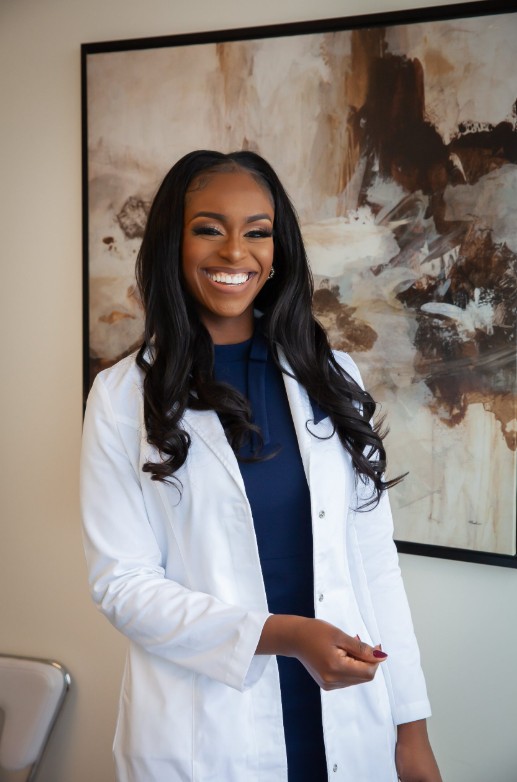
Dr. Phyllis Pobee, M.D., is a physician who has built her career by asking better questions about women’s health. Triple board-certified in Family Medicine, Aesthetic Medicine, and Obesity Medicine, she has spent years working with women who felt stuck despite following conventional health advice.
Early in her medical career, Dr. Pobee noticed a recurring pattern. Many women in midlife struggled with energy, cravings, and metabolic changes that standard guidance failed to explain. Over time, she watched frustration give way to self-blame—a disconnect that stayed with her and shaped her work.
Her professional focus became deeply personal when she experienced the same challenges herself. Even with medical training and discipline, her body did not respond as expected. That experience led her to explore genetics and metabolic biology. As she began to understand her own genetic patterns, long-standing questions finally had answers.
That insight became the foundation for GeneLean360°, a virtual wellness platform she founded to support women across North America. The program emphasizes genetics, hormones, metabolism, stress, and longevity, and is built around personalization rather than rigid rules. Its science-based approach has since been discussed in GeneLean360 reviews focused on individualized midlife health strategies.
Dr. Pobee is also known for developing the 12 Genetic Avatars™, a framework that explains why bodies respond differently to food, stress, and exercise. Her work reframes cravings and energy shifts as biological signals rather than personal failures.
Today, Dr. Pobee continues to shape conversations around midlife metabolic health, precision care, and healthy aging. Her approach blends science, compassion, and clarity, offering a thoughtful path forward for women seeking to understand their bodies more deeply.
What is your typical day, and how do you make it productive?
My day starts early, before emails and meetings. I spend the first hour reviewing research or internal data related to genetics, hormones, or metabolic patterns. That quiet time matters. It’s where I think clearly. Later, my day is divided between patient work, program refinement, and strategy sessions with my team. I stay productive by batching tasks. I avoid switching contexts. I’ve learned that focus creates better outcomes than speed.
How do you bring ideas to life?
I start with observation. Most of my ideas come from noticing patterns among women who received the same advice but had very different outcomes. I write those patterns down. Over time, they turn into frameworks. That’s how the 12 Genetic Avatars™ came to life. I don’t move ideas forward unless they make biological sense. If the body wouldn’t respond to it, neither will people.
What’s one trend that excites you?
The shift toward longevity and metabolic health excites me. More conversations are shifting away from short-term outcomes toward how hormones, inflammation, and mitochondria shape aging. That opens space for smarter, more respectful discussions about women’s health.
What is one habit that helps you be productive?
I start each day with one question: “What is the one thing that would make everything else easier today?” That keeps me from confusing activity with progress.
What advice would you give your younger self?
Stop trying to prove you’re disciplined enough. Biology doesn’t reward discipline. It responds to alignment. I spent years believing effort could override physiology. It can’t.
Tell us something you believe almost nobody agrees with you on?
I believe willpower is overrated in health. Most struggles labeled as “lack of discipline” are actually mismatches between biology and strategy. When the biology is supported, behavior follows naturally.
What is the one thing you repeatedly do and recommend everyone else do?
Track patterns, not perfection. Look at how your energy, cravings, sleep, and stress respond over time. Patterns tell the truth faster than rules.
When you feel overwhelmed or unfocused, what do you do?
I step away from stimulation. No screens. No inputs. I usually take a short walk or review handwritten notes. Overwhelm is often a signal that too many decisions are competing for attention.
What is one strategy that has helped you grow your business or advance in your career?
I stopped trying to appeal to everyone. When GeneLean360° became clear about focusing on genetics, metabolism, and midlife women, growth became steadier. Clarity attracts the right audience and filters out noise.
What is one failure in your career, how did you overcome it, and what lessons did you take away from it?
Early on, I leaned too heavily on generic health language because it felt safer. It diluted the message. Once I trusted the science and my lived experience, the work became more impactful. The lesson was that precision builds trust.
What is one business idea you’re willing to give away to our readers?
Create a “biology-first audit.” Instead of setting goals, spend 30 days observing how food, stress, sleep, and exercise affect you. No changes. Just data. Most people skip observation and jump straight to action.
What is one piece of software that helps you be productive? How do you use it?
Notion. I use it to document research insights, patient patterns, and program iterations. It’s my external brain.
Do you have a favorite book or podcast you’ve gotten a ton of value from and why?
I return often to books on systems thinking and human behavior. They reinforce the idea that outcomes are shaped by structure, not motivation.
What’s a movie or series you recently enjoyed and why?
I enjoy documentaries about human performance and aging. They remind me how adaptable the body is when given the right inputs.
Key learnings
- Biology-driven clarity creates better results than discipline-based pressure.
- Long-term success comes from observing patterns, not chasing perfection.
- Precision and focus outperform broad, generic strategies.
- Sustainable growth happens when ideas are tested against real human behavior.