
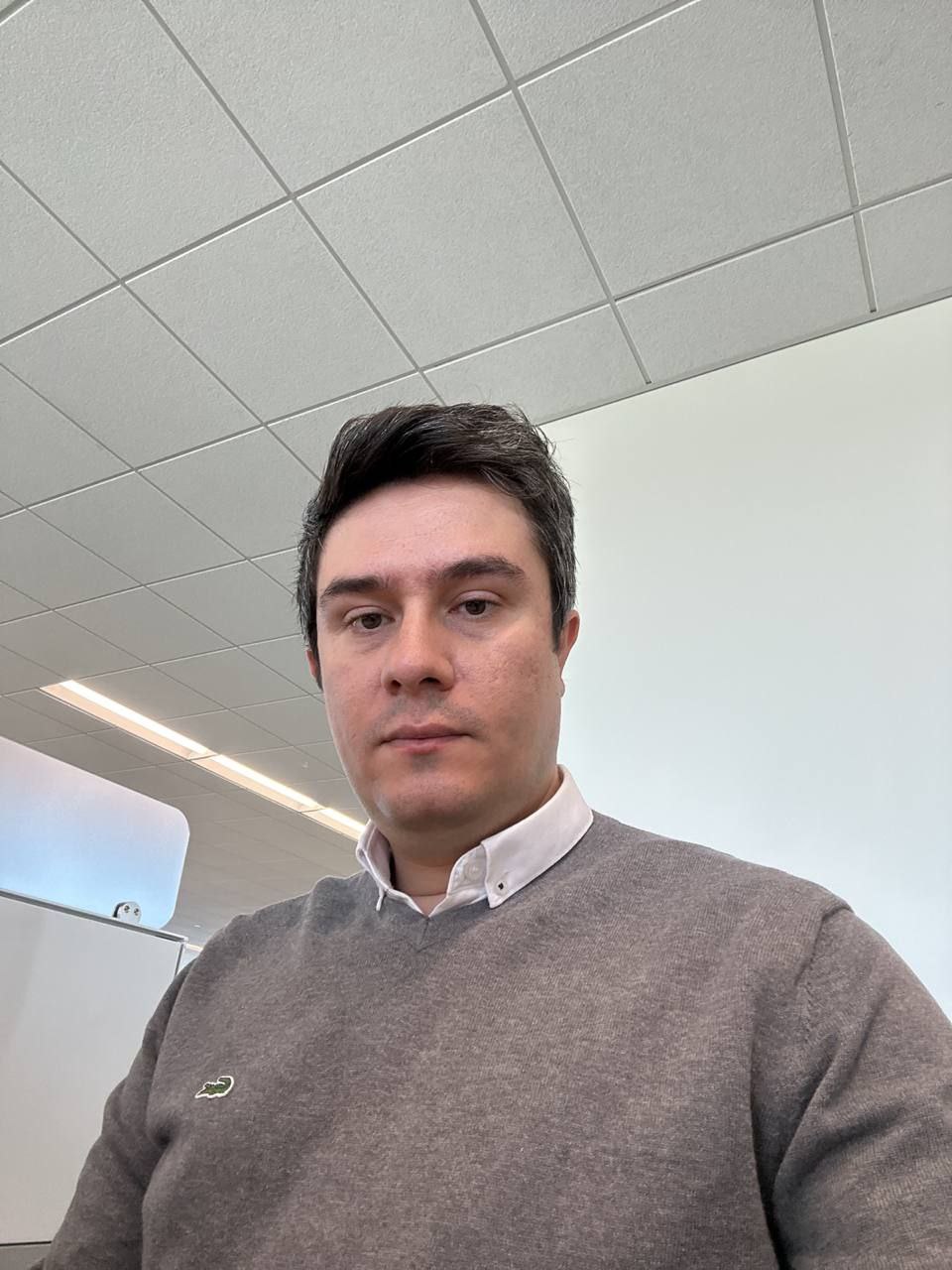
Pouya Asrar is a senior engineering leader and thermal science expert. He is experienced in advanced semiconductor packaging, consumer electronics, and high-performance thermal management. Pouya Asrar’s career spans customer-facing technical leadership, hands-on engineering, and academic research, combining rigorous analysis with practical execution across complex, global organizations.
Pouya Asrar currently serves as a senior manager in advanced packaging at Samsung. There, he leads customer-facing technical and business engagements across multiple advanced packaging technologies. In this role, he acts as a bridge between customer requirements and internal engineering execution, guiding programs from early business alignment through design, qualification, and delivery.
Before working at Samsung, Pouya Asrar worked as a thermal engineer at Amazon, where he designed and validated thermal management solutions for smart home devices across a wide range of form factors. His responsibilities included defining thermal architectures, building detailed CFD models, and guiding design decisions under tight size, cost, and schedule constraints. He also paired simulation-driven optimization with extensive laboratory testing to support confident thermal sign-off and production readiness.
What is your typical day, and how do you make it productive?
I write articles on Medium, and I stay up to date on recent semiconductor advanced packaging technologies, as well as novel cooling technologies for microelectronics.
How do you bring ideas to life?
I bring ideas to life by turning them into an executable plan with clear success criteria. I start with the customer problem and define measurable requirements and constraints (performance, cost, schedule, manufacturability, risk). Then I run fast validation loops: first-principles thinking and simulation to narrow the design space, followed by prototypes and data correlation to prove it works in the real world. I lean heavily on my thermal sciences background (heat transfer, fluids, materials) to make early decisions defensible and to converge quickly. Throughout the process, I pull in cross-functional partners early (package, SI/PI, mechanical, manufacturing, suppliers, and customers), document assumptions and tradeoffs, and deliver tangible outputs—models, test results, and a clear story—so the idea becomes something stakeholders can confidently build and scale.
What’s one trend that excites you?
One trend that really excites me is how chiplets and HBM-driven architectures are forcing thermal to become a first-class design constraint, not an afterthought. We’re packing more compute and memory into tighter footprints, so the winners will be the teams who codesign package, power delivery, and cooling together from day one. I like this trend because it’s the perfect intersection of physics, packaging, and product impact—and it creates room for real innovation, not just incremental improvements.
What is one habit that helps you be productive?
One habit that keeps me productive is starting each day by writing a short “priority stack” and time-boxing it: I pick the one to two outcomes that truly move the work forward, break them into the next concrete actions, and block focused time to finish those before I touch everything else. I also keep a running decision/assumption log as I go, so I don’t rethink the same trade-offs repeatedly and I can quickly align with cross-functional partners when questions come up. That combination helps me stay calm, execute fast, and make steady progress without getting pulled into low-impact noise.
What advice would you give your younger self?
I’d tell my younger self to optimize for learning and relationships, not perfection. Early on, I spent too much energy trying to have the “right” answer before sharing it. I’d remind myself that progress comes faster when you test ideas early, get feedback sooner, and iterate. I’d also emphasize communicating impact as clearly as you do the technical work, write down decisions, quantify results, and make it easy for others to build on what you’ve done. Finally, I’d say don’t underestimate consistency: small, focused steps every day compound more than occasional bursts of intensity.
Tell us something you believe that almost nobody agrees with you on.
I believe optimism is a practical discipline, not a personality trait, and that consistently taking action beats waiting until it’s “perfect” almost every time. A lot of people think positivity is naïve or that pushing forward without complete certainty is risky, but I’ve found the opposite: staying constructive under pressure and turning ideas into small, testable actions is how real progress happens. Even when the path isn’t clear, I’d rather move the work forward with a focused next step, learn quickly, and keep momentum than get stuck in analysis or negativity.
What is the one thing you repeatedly do and recommend everyone else do?
One thing I repeatedly do and recommend everyone do is turn ambiguity into a simple written plan before jumping in: clarify the goal, write down assumptions and constraints, define what “done” looks like, and pick the next smallest action that creates real evidence (a quick model, a prototype, a customer check, or a data pull). That habit keeps teams aligned, reduces rework, and builds momentum, because you’re always making measurable progress instead of debating opinions.
When you feel overwhelmed or unfocused, what do you do?
When I feel overwhelmed or unfocused, I pause and quickly reset. I write down everything on my mind, then pick the single-most important next outcome and break it into the smallest actionable step I can complete in 15 to 30 minutes. I silence distractions, time-box a short focus sprint, and build momentum by finishing that one step. If the overwhelm is coming from uncertainty or too many dependencies, I reach out early to clarify priorities or unblock decisions instead of carrying the ambiguity alone.
What is one strategy that has helped you grow your business or advance in your career?
One strategy that has consistently helped me advance is proactively building trust by delivering “proof,” not just ideas. Whenever I see an opportunity, whether it’s a technical gap or a business need, I translate it into a clear problem statement, propose a practical approach, and then quickly produce something tangible: a simple model, a validated analysis, a prototype plan, or a concise one-pager that shows the path and the trade-offs. That reliability earns credibility with leaders and customers, which then opens the door to bigger responsibilities and higher-impact projects. Over time, that pattern—identify a real need, move fast to de-risk it, and communicate it clearly—has helped me become the person teams call when something important needs to move forward.
What is one failure in your career, how did you overcome it, and what lessons did you take away from it?
One failure I’ve had was pushing a technically solid solution forward before I had fully aligned the right stakeholders on the problem definition and decision criteria. The idea itself was strong, but I underestimated how much context different teams needed and how quickly misalignment can slow things down, so we lost time revisiting assumptions, debating scope, and reworking pieces that could have been clarified upfront. I overcame it by stepping back, resetting expectations, and creating a simple alignment package: a one-page problem statement, clear success metrics, key assumptions/risks, and a short validation plan with owners and milestones. Once everyone agreed on the same definition of “done,” execution sped up dramatically. The lesson I took away is that bringing ideas to life isn’t only technical excellence, it’s also stakeholder alignment and communication discipline. Now, I invest early in writing down the goal, constraints, and decision points, and I validate assumptions with the right people before I go deep, which saves a lot of time.
What is one business idea you’re willing to give away to our readers?
Build a “Thermal Readiness Audit” micro-consulting business for chiplet/HBM and advanced-packaging teams: a fixed-scope, fixed-price engagement (two to four weeks) where you take a customer’s package stack-up, power maps/workloads, cooling constraints, and reliability targets, then deliver a concrete kit they can immediately use. (1) A ranked list of thermal risks with quantified margins and root causes; (2) a lightweight, reusable simulation template with clearly stated assumptions; and (3) a decision playbook that maps common design knobs (TIM choice, lid/heat spreader, underfill/material options, bump pitch/placement, cold plate assumptions) to expected temperature, cost, and risk impact. The differentiator is speed and practicality: it helps teams avoid late-stage surprises and expensive re-spins, and it can be sold as a standardized “productized service” with add-ons for lab correlation, vendor evaluation, and quarterly reaudits as power and package specs evolve.
What is one piece of software that helps you be productive? How do you use it?
One piece of software that helps me stay productive is Siemens Flotherm XT. I use it to quickly build and iterate 3D CFD thermal models for electronics (from package and board-level heat spreading to chassis and airflow paths), so I can identify hotspots, test cooling concepts, and quantify trade-offs early without waiting for multiple hardware spins. It’s especially useful for doing “what-if” studies fast (power changes, heat sink geometry, TIM assumptions, airflow rate, fan curves, material stacks) and producing clear, decision-ready outputs like temperature maps, thermal resistance trends, and sensitivity results that align cross-functional teams on the best path forward.
Do you have a favorite book or podcast you’ve gotten a ton of value from and why?
A podcast I’ve gotten a lot of value from is “Semiconductor Insiders” (by SemiWiki.com) because it stays very close to real, current innovation in the industry—chiplets and 3DIC, advanced packaging, memory (including NAND), photonics, and the EDA/manufacturing ecosystem—usually through practical conversations with people who are building the technology. I use it as a fast way to stay sharp on what’s changing, then I translate what I hear into a few action items for my work: what new constraints might matter (thermal, power density, integration), what questions to ask vendors/partners, and what design trade-offs are becoming non-negotiable as packaging and compute keep getting denser.
What’s a movie or series you recently enjoyed and why?
A series I recently enjoyed is “Pluribus” because it’s the kind of story that makes you think while you’re being entertained. It explores how complex systems form, how people make decisions under pressure, and how small choices can ripple into big outcomes. I liked it because it feels intellectually grounded and it connects to how I naturally think in real life: zooming out to see the system, then zooming in to understand what drives the result.
Key learnings
- Turn ideas into execution by defining measurable success criteria, constraints, and the smallest experiment that can validate the core value quickly.
- Use first-principles thermal sciences (heat transfer, fluid dynamics, materials) alongside simulation and lab correlation to make decisions defensible and reduce rework.
- Build momentum through tight iteration loops: model early, test targeted assumptions, and document trade-offs so progress is repeatable and scalable.
- Align cross-functional stakeholders and suppliers early to prevent handoff failures and ensure solutions are manufacturable, reliable, and cost-aware.
- Convert expertise into reusable assets (templates, playbooks, structured knowledge) so teams don’t restart from scratch on each new program.