
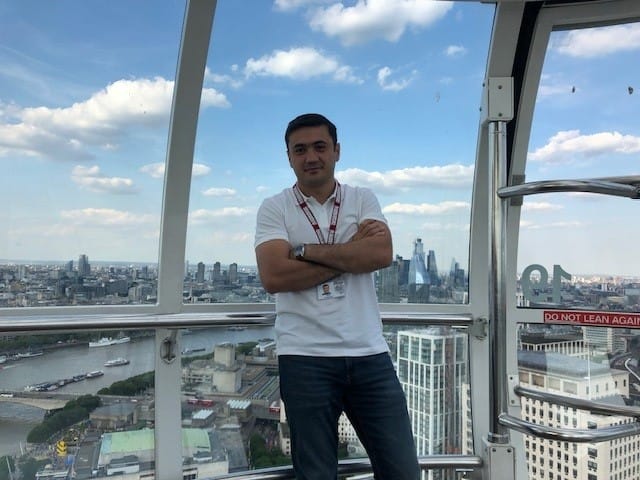
Ramil Asadulzade is an experienced executive known for steady leadership, sharp financial thinking, and a global career built through hard work. He was born and raised in Baku, Azerbaijan, in a humble family. His father served in the military, and his mother worked as a teacher. From a young age, he was drawn to discipline and performance.
As a student, Ramil loved mathematics and competed in Olympiads, often earning top awards. He also played basketball and served as a team captain, learning early how to lead under pressure.
He earned his Bachelor of Science from the Azerbaijan State Oil Academy, focusing on economy and management. Over time, he built more than 20 years of professional experience across multiple industries, with his strongest track record in oil and gas. He spent over 11 years at SOCAR, where he held senior leadership roles including CFO and later CEO.
His work has taken him across Azerbaijan, Turkey, Switzerland, and Romania. Along the way, he developed deep expertise in IFRS, risk management, internal controls, strategic planning, budgeting, forecasting, supply chain, commodity trading and M&A. He strengthened his global credentials as an ACCA member and later earned an MBA with honors from the University of Chicago Booth School of Business.
Outside of work, Ramil enjoys travel, professional reading, basketball, and Asian food. He also supports charitable causes quietly, believing humility matters as much as success.
What is your typical day, and how do you make it productive?
I start early. I wake up before 6 a.m. and read for 30 minutes. Usually it is professional literature on oil markets, finance, stock exchange or geopolitics. That gives me context before the day begins. I review key numbers next. Cash flow, exposure, major risks. I learned as CFO that if you understand the numbers early, you make better decisions later.
I block time for deep work. No meetings. Just thinking and structuring problems. In leadership roles, especially as CEO, I realized that reacting all day is not leadership. You must create space to think. In the evening, I try to move. A long walk or drive helps me reset.
How do you bring ideas to life?
I pressure-test them. I write them down in simple language. If I cannot explain the idea clearly, it is not ready. Then I map risks. Growing up competing in math Olympiads taught me to solve problems step by step. In oil and gas, big ideas fail because of small operational gaps.
When I was CFO, I worked on optimizing supply chain flows. The idea was simple: reduce inefficiencies in procurement and transportation. But implementation required detailed budgeting, internal controls, and alignment with standards. Big ideas need disciplined execution.
What’s one trend that excites you?
Energy transition. Not in a dramatic way. In a practical way. Oil and gas remain critical. But the integration of traditional energy with new technologies and efficiency standards is evolving. Companies that manage risk and capital allocation wisely will shape the next decade.
What is one habit that helps you be productive?
Daily review of numbers. Even at senior levels, I never disconnect from financial fundamentals. Budgeting, forecasting, liquidity. Discipline in numbers builds clarity in decisions.
What advice would you give your younger self?
Be patient. Early in my career, I believed speed meant success. Later I understood that timing and preparation matter more. When I was promoted to CEO in January 2024, it was not sudden. It was built on years of understanding operations, finance, and people management.
Tell us something you believe almost nobody agrees with you on?
I believe long meetings are often a sign of weak preparation. Many executives think discussion creates value. I think clarity before the meeting creates value. In large organizations, I saw hours wasted because data was not prepared in advance.
What is the one thing you repeatedly do and recommend everyone else do?
Learn continuously. I completed my MBA at Chicago Booth while holding a senior role. It was demanding. But structured learning changes how you see strategy and risk. I recommend constant education, formal or informal.
When you feel overwhelmed or unfocused, what do you do?
I step back and simplify the problem. I ask, what is the core issue? Mathematics taught me that complex equations break down into smaller parts. I also exercise. I use quite a basic recipe: one step; one variable upon a time.
What is one strategy that has helped you grow your business or advance in your career?
Take responsibility during difficult projects. In SOCAR, I worked across Azerbaijan, Turkey, Switzerland, and Romania. Large-scale projects require cross-border coordination. I volunteered for complex assignments. That built trust and expanded my leadership scope.
What is one failure in your career, how did you overcome it, and what lessons did you take away from it?
Early in my CFO tenure, I underestimated the cultural side of change during a restructuring initiative. Financially, the model was correct. Operationally, resistance slowed implementation. I learned that leadership is not only about analysis. It is about communication and alignment.
What is one business idea you’re willing to give away to our readers?
A structured mentorship platform for finance professionals in emerging markets. Pair senior executives with young accountants through quarterly case-based workshops. Focus on financials, risk, and ethics. It could strengthen financial ecosystems.
What is one piece of software that helps you be productive? How do you use it?
Excel. Simple but powerful. I build scenario models quickly. Sensitivity analysis helps me see downside risk. Complex systems are useful, but structured spreadsheets remain a core tool.
Do you have a favorite book or podcast you’ve gotten a ton of value from and why?
I value books on strategic thinking. Reading about global markets helps me stay objective. Oil and gas is influenced by geopolitics. Understanding broader context is critical.
What’s a movie or series you recently enjoyed and why?
The documentary directed by Jason Hehir – The Last Dance. There is everything I love: Leadership, Basketball, Chicago… Mentality which I share! I enjoy stories that show a unique mentality and motivation. They reflect real executive life. Watch the end of episode VII to understand what I am talking about.
Key learnings
- Strong financial discipline and daily review of fundamentals build long-term leadership credibility.
- Big ideas succeed when paired with structured execution and risk analysis.
- Continuous learning, including formal education, sharpens strategic thinking.
- Leadership requires both analytical skill and cultural awareness.
- Simplifying complex problems into smaller components improves focus and decision-making.