
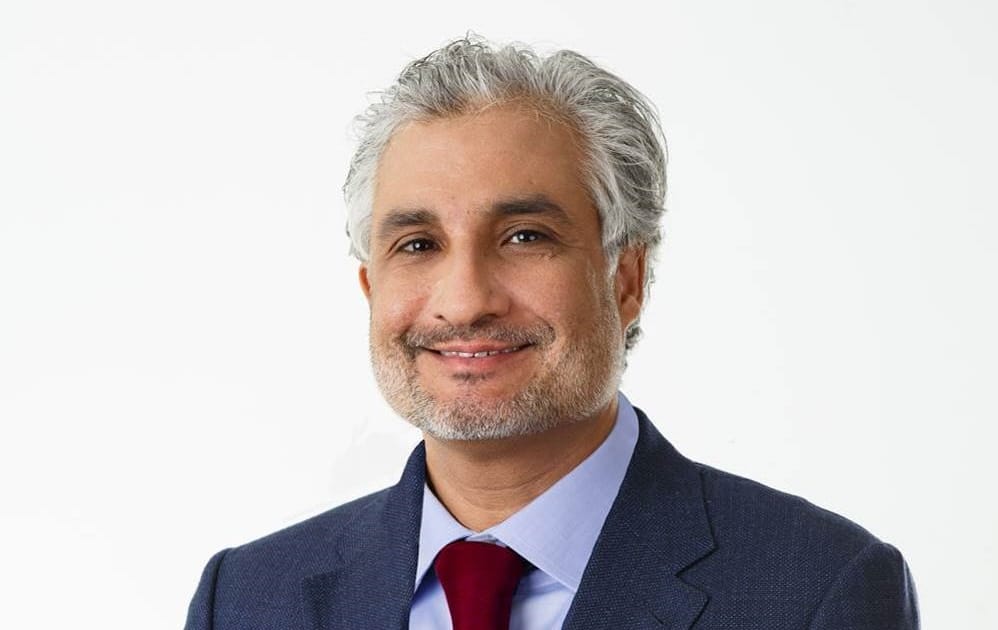
Reza Satchu is the founder and managing partner of Alignvest Management Corporation, a Toronto-based private investment company focused on long-term value creation. Satchu is also well-known as the founding chairman of NEXT Canada, an entrepreneurial network made up of hundreds of notable academics, innovators, investors, and founders. NEXT Canada’s mission statement reads: “We uncover Canada’s next generation of entrepreneurs and supercharge their ambition by showing them what’s possible. We accelerate their trajectory with access to education, mentorship, and funding.”
Young entrepreneurs and students alike are inspired by Satchu’s business success. He is a popular lecturer at Harvard Business School with courses such as “The Entrepreneurial Manager” and “The Founder Mindset.” His familiarization with these topics is personal — he has lived the experience of founding several dynamic companies with successful exits.
Reza Satchu received the Management Achievement Award from his alma mater, McGill University. He holds an MBA from Harvard Business School and was named one of “Canada’s Top 40 Under 40.”
How do you bring ideas to life?
First of all, ideas aren’t hard to find. Everyone has ideas. All you have to do is walk around, think about the problems in your life, you’ll get ideas. What people don’t have, usually, is the curiosity or the judgment to explore the ideas they have.
I’ve been a founder for over twenty years, and I’ve been a teacher for a long time. I know that the issue is not a lack of ideas. It’s whether you trust your judgment to explore whether or not it was a good idea. Most people don’t spend that time. They just assume that someone with far more resources has surely thought of this, and acted on it. The problem with that is, if it were true, most of the businesses we know today wouldn’t exist.
What’s one trend that excites you?
The longevity trend. Everyone’s interested in living longer, healthier, happier lives. And now with so many medical discoveries, combined with the accessibility of data, there’s an interesting intersection for growth. Things like wearable tech, glucose monitors, and anything related to personalized data in service of longevity. There’s a lot of capital in that area right now.
What is one habit that helps you be productive?
When I have an idea, I don’t assume others have thought of it. A habit, or a mindset, is that I explore ideas when I have them, even if it’s just in a small “c” commitment way. I think when it comes to issues around decision-making, most people revert to the status quo. They don’t realize that not making a decision is a decision. So I’ve trained my mind as a habit, that when in doubt about the quality of an idea, I’ll still act. I’ll explore. Because it requires judgment and decision-making, and those are good habits to form.
What advice would you give your younger self?
The advice I’d give is inspired by a Victor Frankl book, Man’s Search for Meaning. He talks about how the gap between stimulus and response is freedom. As a founder, parent, and leader, I’m constantly stimulated, and I’m often given information that’s not exactly what I want. And I often have to respond quickly. As I’ve gotten older, the Frankl concept that in the gap between a stimulus, and an emotional response to it, is freedom – the freedom to choose a response – has had more meaning for me. Operating in that gap between stimulus and response is a healthy place to be.
Tell us something you believe almost nobody agrees with you on?
From a founder perspective, I think the belief in a “founder market fit” is dangerous. What I mean by that is, there’s a belief that you must have extraordinary experience, extraordinary insights, extraordinary relationships to be a market-ready founder.
But there’s no need to be extraordinary. I think that mostly comes from an academic framework, where we have to make it seem really hard so we can teach it. The data shows that you don’t need extraordinary experience. So instead of a “founder market fit”, I’d argue that all you need is a “founder mindset fit”. And that comes from the concept of trusting your judgment.
What is the one thing you repeatedly do and recommend everyone else do?
What I recommend people do is around the aspect of decision-making. For me, I force myself to make decisions, even if it’s just to decide to stick with the status quo. We assume that not making a decision preserves other decisions – but again, not making a decision is an actual decision. So I recommend thinking purposely about what decision-making looks like.
The other thing – most people value optionality, greatly. They’re about collecting as many options as possible. But a life with 100 options, and no commitments, is a sad life. You have to figure out what you’re capable of.
What is one strategy that has helped you grow your business or advance in your career?
I’ve built a series of businesses, and I’d say there’s a single trait that’s made the difference, and that single trait is commitment. I’ve gotten a good number of no’s from investors, I’ve experienced when businesses I’d built were almost dead. But the commitment was what allowed us to get through. Now you’ve got to be logical. But if it was easy, everyone would do it. So many people will say no, that it requires commitment above all.
I’ve wanted to be a founder since the age of 27. For most people, being a founder means wanting money, power and prestige. And while those can be important, I think the thing that most people want to have is the freedom to have a positive impact on others. The ability to have an impact is critically important. So all your strategies as a founder, and any success you have, all lead to a greater probability of impact. And your resilience is predicated on that commitment.
What is one failure in your career, how did you overcome it, and what lessons did you take away from it?
When you put yourself in a situation to test your judgment, to lead under uncertainty, there’s always a risk of failure. As a leader, you’re always going to fail. But if you do fail, you want to have persevered for so long that you can fail well. You don’t want to fail poorly, where you break the rules or lose integrity.
So one failure I had, that I’ve learned a lesson from, was around partnership. I built a founding team, and I reverse-engineered it around skills, rather than values. When the inevitable crisis came, we discovered we were not aligned on values. I overcame it by appreciating the mistake, acknowledging it, and seeing how I’d put too much emphasis on skills, and not enough on values and objectives. I’ve taken that lesson into building subsequent businesses and have avoided the same mistake.
What is one piece of software that helps you be productive? How do you use it?
The software around longevity, as we discussed. I use a lot of it. I’m not diabetic, but I use the glucose monitors, I use the Apple Watch software. These things help me maintain my physical health and my mental health, and ultimately that makes me much more productive.
Key learnings
• Learning occurs when you’re making consequential decisions you’re accountable for. You’re testing a trait that all of us most want to improve – your judgment. You’re learning about decision-making, and over time, the more decisions you make, you’ll start to experience exponential learning.
• Learning occurs when your confidence is slightly greater than your capabilities. You want to explore your ideas, improve your judgment, and to do that, you have to have a certain level of confidence that’s greater than your capabilities. That’s not about being arrogant. It’s about the courage to expand your capabilities through experience.
• Most importantly, learning occurs when you learn what to commit to. There are so many distractions, with social media, entertainment, it’s hard to commit to anything. People think of commitment as jumping off a cliff into a rainstorm. Like it’s a swirling ocean, with no lifejacket. But it’s not. It’s a series of small “c” commitments that lead to a big one. If I have an idea, I spend 15-20 mins exploring it. And then I can have the courage to make a big “C” commitment because I’ve learned to trust my judgment.