
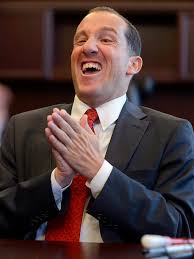
Richard Bernstein is a justice on the Michigan Supreme Court and a lifelong advocate for disability rights. He has been legally blind since birth due to retinitis pigmentosa. From an early age, he learned how to plan ahead, work steadily, and adapt to a world not built with everyone in mind.
He graduated summa cum laude from the University of Michigan and later earned his law degree from Northwestern University School of Law. After law school, Bernstein joined The Sam Bernstein Law Firm, where he focused on public service and disability rights. His legal work helped turn the promises of the Americans with Disabilities Act into real access for everyday people.
One of his most well-known cases improved accessibility at Michigan Stadium. The agreement added wheelchair seating and upgraded parking, restrooms, and routes, setting a national example for inclusion in large public spaces. The case showed how thoughtful legal action can create lasting change.
In 2014, Bernstein was elected to the Michigan Supreme Court, becoming the first blind justice in the Court’s history. He began his term in January 2015 and is known for his careful approach to justice, fairness, and equal access under the law.
Outside the courtroom, Bernstein is an endurance athlete. He has completed 27 marathons around the world and competed in Ironman events. After a serious accident in 2012 that left him hospitalized for months, he returned to training and racing.
Through law, service, and personal discipline, Richard Bernstein continues to build a life shaped by persistence, purpose, and public impact.
What is your typical day, and how do you make it productive?
My day starts early. I like structure. I review briefs using screen-reading software and audio notes. I take long walks to think through arguments before court sessions. Physical movement helps me process complex ideas. On the Court, I focus on preparation. I don’t rely on improvisation. Productivity comes from planning ahead and leaving room to think deeply, not rushing decisions.
How do you bring ideas to life?
I break ideas into steps. Big ideas fail when they stay abstract. When I worked on accessibility cases, like the Michigan Stadium agreement, the idea was simple—equal access. The work came from translating that idea into seating numbers, routes, timelines, and enforcement. I ask, “What does this look like on the ground?” Then I build from there.
What’s one trend that excites you?
Universal design. Not as a buzzword, but as a standard practice. When buildings, technology, and systems are designed for people with disabilities first, they usually work better for everyone. I’ve seen this play out in public spaces and transportation systems. It’s practical progress.
What is one habit that helps you be productive?
Preparation the night before. I review the next day’s priorities and organize materials so I’m not reacting in the morning. That habit came from navigating blindness. You learn quickly that preparation saves energy.
What advice would you give your younger self?
Don’t confuse speed with progress. I used to think doing more faster was the goal. Over time, I learned that steady effort, done well, compounds. Endurance matters more than intensity.
Tell us something you believe almost nobody agrees with you on?
I believe obstacles are useful data. Most people want to remove them immediately. I want to understand them first. Obstacles tell you where systems fail. That information is valuable if you pay attention.
What is the one thing you repeatedly do and recommend everyone else do?
Move your body every day. For me, it’s running or walking. I’ve run 27 marathons, not because I love racing, but because movement clears my thinking. Some of my best legal insights came during long training sessions.
When you feel overwhelmed or unfocused, what do you do?
I simplify. I narrow my focus to one task I can complete that day. After my accident in 2012, when I spent months recovering, I learned the value of small wins. Progress doesn’t have to be dramatic to be real.
What is one strategy that has helped you grow your business or advance in your career?
Turning principles into implementation. Advocacy only works when paired with execution. The Michigan Stadium case succeeded because we focused on details—how many seats, where they go, how people get there. That approach carried into my work on the Court.
What is one failure in your career, how did you overcome it, and what lessons did you take away from it?
Early on, I underestimated how long systemic change takes. I thought one case could fix everything. It can’t. Progress is incremental. I learned to measure success over years, not months.
What is one business idea you’re willing to give away to our readers?
Accessibility audits as a standard service for public venues, not after construction, but during planning. Most accessibility issues come from late-stage fixes. Early review saves money and improves outcomes.
What is one piece of software that helps you be productive? How do you use it?
VoiceOver and speech-to-text tools. I dictate ideas quickly and edit later. It allows me to capture thoughts in real time, especially during walks or travel.
Do you have a favorite book or podcast you’ve gotten a ton of value from and why?
Man’s Search for Meaning by Viktor Frankl. It reinforces the idea that meaning comes from responsibility and purpose, not comfort. That perspective has stayed with me.
What’s a movie or series you recently enjoyed and why?
The West Wing. It shows how thoughtful people wrestle with complex decisions. I appreciate stories that respect process and nuance.
Key learnings
- Large ideas create impact only when translated into clear, measurable action
- Preparation and structure reduce friction and increase long-term effectiveness
- Physical discipline supports mental clarity and decision-making
- Obstacles reveal where systems need redesign, not avoidance
- Sustainable progress comes from steady effort, not quick wins