
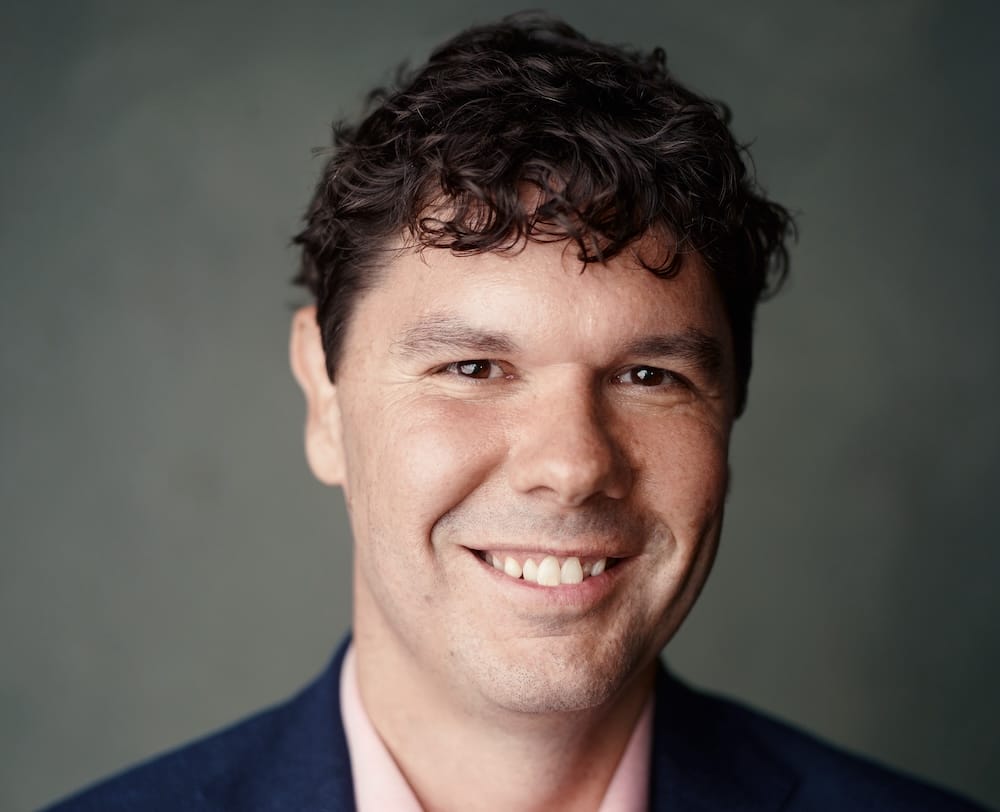
Ryan McCorvie is the founder and chief scientist of The Martingale Group, a boutique firm that offers tailored statistical consulting. The Martingale Group helps clients make sense of their data and draw evidence-based conclusions. McCorvie’s decades of experience in statistical modeling and data analysis form the backbone of the company’s approach, which combines fresh expertise with personalized solutions.|
A mathematician who’s spent over 25 years applying his skills in finance, academia, and public health, McCorvie is driven by a simple goal: using math to solve real-world problems.
Right now, McCorvie is knee-deep in a project to verify mathematical proofs using computers. He started this work in late 2023, using the LEAN programming language to formalize complex mathematical ideas in a way computers can understand and check.
When COVID-19 hit in 2020, McCorvie stepped up to help. For three years, he worked as a consulting statistician for the California Department of Public Health. He ran simulations to test different policy options, like how to safely reopen schools. He also created disease forecasts for state officials and built software to combine different COVID models. His work helped California’s leaders make informed decisions during a critical time.
Before the pandemic, McCorvie was hitting the books at UC Berkeley. From 2014 to early 2020, he pursued a Ph.D., diving into areas like machine learning, probability, and partial differential equations. His research shed new light on how we understand certain mathematical processes and analyze high-dimensional data.
McCorvie’s career kicked off at Goldman Sachs, where he spent nearly 15 years climbing the ranks to become a Managing Director. As a quantitative analyst and financial engineer, he was the go-to guy for risk management. He led the team that kept an eye on Goldman’s corporate bond trading, developed models to predict market changes, and stress-tested the company’s risk exposure.
During the late 2000s credit crisis, McCorvie’s expertise was crucial. He conducted detailed analyses of potential bankruptcy scenarios, helping Goldman navigate uncertain waters. He also built a team of Ph.D.-level experts to improve trading strategies and automate processes.
McCorvie’s foundation in math was laid at the California Institute of Technology, where he earned his bachelor’s degree. While there, he interned on the Mars rover project at the Jet Propulsion Laboratory and worked in Caltech’s supercomputing center. These experiences sparked his love for high-stakes math and science projects.
Outside of work, McCorvie is a man of varied interests. He’s an enthusiastic cook who loves whipping up Japanese dishes. You might spot him cycling around northern California, where he lives with his family. He’s also into music and occasionally produces his own tracks. McCorvie is active in his local church, where he helps organize charitable activities.
From crunching numbers on Wall Street to modeling pandemic scenarios, Ryan McCorvie has shown how powerful mathematics can be when applied to real-world challenges. Now, as he works on verifying mathematical proofs with computers, he’s pushing the boundaries of what’s possible in his field. Through it all, he maintains a balance between his professional pursuits and his personal passions, proving that a life in mathematics can be both intellectually stimulating and deeply fulfilling.
What is your typical day, and how do you make it productive?
I start the mornings by responding to things, having meetings, and catching up on small outstanding issues. This helps get my brain in the flow and jogs my memory of all the bigger things I plan to accomplish.
Later in the day, I get bigger projects done. After lunch I get in a groove. During this time, I try to minimize distractions. However, my most creative ideas come in the evening, after being steeped in problem solving all day.
The most important thing is just starting; everything is easier once you get over the initial hump.
How do you bring ideas to life?
An underrated part of doing creative technical work is the role of the unconscious. Jacque Hadamard wrote about this in his book “The Mathematician’s Mind.” The first stage is getting steeped in all of the details of a technical problem, consciously chipping away on aspects of a problem and gaining insight. This hard work is essential, but the creative breakthrough might come sometime later, after the mind has turned its active attention to something else. A related experience is working on a problem to the point of frustration, then waking up in the morning to a fresh new insight. In both cases, an important part is to allow for a certain amount of unconscious incubation. Going deep is necessary to prime the subconscious, but the subconscious does its own work.
What’s one trend that excites you?
AI assistance, especially with coding, shows a lot of promise. When I started working in the early 2000s I was surprised people were essentially using the same tools as they did in the 1970s. Those tools have gotten better over time, but AI promises to be a big step forward if it can automate some of the more tedious parts and technical parts of creative work.
What is one habit that helps you be productive?
By nature, I’m very distractible, and I tend to want to jump to new tasks or projects as they occur to me. I have a mantra: Do One Thing and Only Handle It Once. That is, if I take up a task, I don’t take up other tasks until this one is taken to its conclusion.
What advice would you give your younger self?
You will always overestimate what you can accomplish in a year. But you will always underestimate what you can accomplish in five years. Keep at it, even though there are inevitable surprises, obstacles and setbacks.
Tell us something you believe almost nobody agrees with you.
Sometimes being very clear about the plans and goals that are not in scope can be more helpful than figuring out the plans and goals you are trying to accomplish.
What is the one thing you repeatedly do and recommend everyone else do?
I’m a big believer in the power of to-do lists. They let you see the scope of the work. They are a thing to return to in order to refocus on the next task. And they are especially great because checking items off a to-do list gives a unique satisfaction.
When you feel overwhelmed or unfocused, what do you do?
For me, any kind of deep concentration is an act of will, so when I get fatigued, I don’t always notice it. I push myself to keep going, even when my I’m feeling distracted or discouraged. Everyone knows that physical exercise and good sleep are the best cures for anxiety and lack of focus. The trick is to recognize when you need to take a break to focus on your physical self to be more productive and when you need to keep pushing to make progress.
When you are chasing a big goal, you should feel really good about it a third of the time, be okay about it a third of the time, and be discouraged or frustrated a third of the time. If you’re feeling bad all the time, you’re fatiguing and risk burning out. If you’re feeling good all the time, you’re not working hard enough.
What is one strategy that has helped you grow your business or advance in your career?
There are a lot of stakeholders in any project you work on. It can be easy to get pulled in many directions, but focus on delivering solutions to your client’s problems.
What is one failure in your career, how did you overcome it, and what lessons did you take away from it?
There’s a saying that “what got you here won’t get you there.” Early in my career, I was results-focused and a complete master of the minutia of my domain. I was promoted because I could get high-quality, detail-oriented work done. However, strengths and weaknesses can be two sides of the same coin. As I rose, it mattered less what I was personally delivering than how well I could create teams. What I knew mattered less than how I could leverage the expertise of others. I missed a promotion because I didn’t quickly enough realize the nature of my job had changed, and what had previously been strengths were limiting my further progress.
What is one business idea you’re willing to give away to our readers?
There’s a huge opportunity in using AI as an interface for experts to help explore and exploit large data sets. Existing data science tools like SQL are powerful, but can be quite technical, especially when trying to integrate different data sets. AI has the potential to create a natural langauge interface for experts to explore and synthesize data like never before. The organization that figures out how to do this will be very successful.
What is one piece of software that helps you be productive? How do you use it?
I use a simple text editor (sublime text) to write notes and to-do lists. There are fancier note-keeping software systems, but I love the direct simplicity of this one.
What is the best $100 you recently spent?
Rather than a basic barber shop trim, I recently got a really nice haircut from a stylist. It’s a small thing, but I think it’s an investment in a better first impression.
Do you have a favorite book or podcast from which you’ve received much value?
I really enjoy the BBC’s “In Our Time,” where each episode focuses on a scientific idea, a historical event, or an artistic work. Top experts summarize the important points in a rapid-fire and intellectually heady discussion. It’s a bite-sized way to engage with some of the greatest hits of Western Civilization.
What’s a movie or series you recently enjoyed and why?
I’m still dazzled by Liu Cixan’s “Three Body Problem,” recently adapated as a miniseries. It’s so dense with interesting new ideas about the nature of civilization, space exploration, and so much else.
Key learnings:
- Manage distractions by only working on one thing at a time and working on it to its natural conclusion
- A lot of creative work is unconsious. Give your unconsious brain the raw material and the time to work for you.
- Qualities that are strengths early in your career can become weaknesses as your career progresses.