
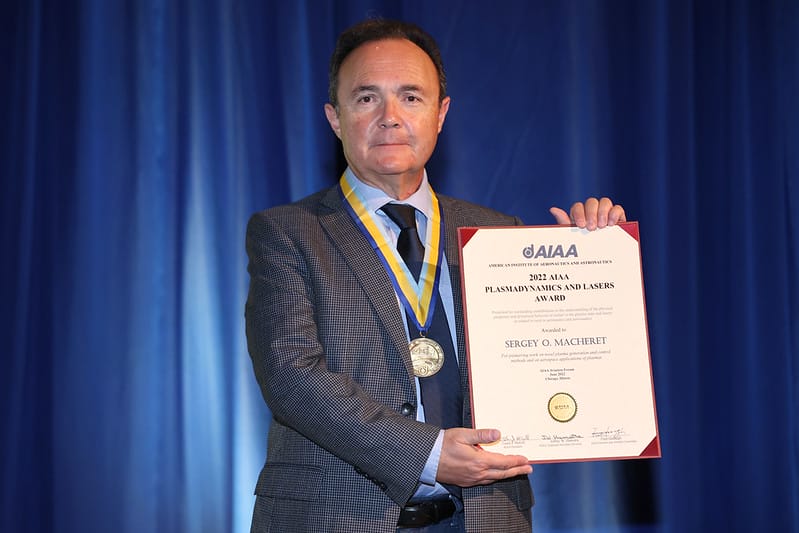
Dr. Sergey Macheret is a distinguished researcher and educator specializing in plasma science and aerospace engineering. Born in Kiev, Ukraine, he earned his M.S. in Physics from Moscow Institute of Physics and Technology and his Ph.D. in Plasma Physics and Plasma Chemistry from Kurchatov Institute of Atomic Energy. Macheret’s career spans both academia and industry, with positions at the Ohio State University, Princeton University, and Lockheed Martin’s Skunk Works, where he contributed to advanced aerospace programs. In 2014-2024, he served as a Professor of Aeronautics and Astronautics at Purdue University, also holding a concurrent appointment in Electrical and Computer Engineering in 2022-2024. In 2023, he founded US Plasma Engineering LLC, focusing on innovative plasma applications. A Fellow of the American Institute of Aeronautics and Astronautics, Dr. Macheret has been recognized for his pioneering work in plasma generation and control, receiving numerous awards including the 2022 AIAA Plasmadynamics and Lasers Award. His prolific career is documented in over 170 scholarly papers and a dozen patents, underscoring his significant contributions to science and technology.
What is your typical day, and how do you make it productive?
I try to structure my day to maximize productivity and to prioritize tasks based on urgency and importance. I am not good at multitasking and try to dedicate specific blocks of time for deep-focus research. Regular breaks during which I do something unrelated, or seemingly unrelated, to the main tasks are essential for maintaining long-term focus.
How do you bring ideas to life?
I believe in a collaborative approach to innovation. My ideas often come to life through a combination of intuition, rigorous scientific methods, and teamwork. I engage with colleagues to discuss, test and refine concepts. Since our field is highly interdisciplinary, it is essential to engage with experts in different areas. This iterative process from theoretical exploration to practical application ensures that ideas are both innovative and applicable.
What’s one trend that excites you?
Our field is highly interdisciplinary and is becoming even more so. The integration of plasmas with other fields of science and with other technologies excites me. In aerospace applications, plasma science has to be integrated with aerodynamics, propulsion, materials, etc. In another emerging field of plasmas for control of electromagnetic interactions, plasma physics has to be integrated with electromagnetics in general and metamaterials and photonics in particular. It is such cross-disciplinary integration that could lead to significant advancements in both industry and academia.
What is one habit that helps you be productive?
Always be patient.
What advice would you give your younger self?
I would advise my younger self to be more patient (with myself and others) and to embrace failure as an essential part of learning.
Tell us something you believe almost nobody agrees with you on?
IT-based tools are increasingly being used in education. Many of these tools are wonderful, and many educators think that such tools change the very nature of the educational process. However, I believe that the expansion of the educational toolbox does not alter the very core of teaching and learning. There is no substitute for personal face-to-face interaction of teachers and students.
What is the one thing you repeatedly do and recommend everyone else do?
Continuously learn and adapt. The fields of science and technology are fast-evolving; staying updated with the latest research and technological advancements, not only in your field but also in other fields, is crucial.
When you feel overwhelmed or unfocused, what do you do?
I take a step back and engage in a different activity, either physical or mental. This break helps to reset my focus and often provides a new perspective on whatever challenge is causing the feeling of being overwhelmed.
What is one strategy that has helped you grow your business or advance in your career?
Instead of following the latest trend and trying to be the best of many doing the same thing, I always tried to work on problems and ideas that very few, if any, other researchers are pursuing. Additionally, I like sharing ideas, getting others excited about a particular idea, and sharing the authorship of a research paper or an invention.
What is one failure in your career, how did you overcome it, and what lessons did you take away from it?
When working on a government-sponsored program, I had an idea which, I thought, would enable us to reach the goal. Two of my colleagues then did the tests and found that the idea apparently did not work. I was quite discouraged by this failure but then decided to involve a few more colleagues in this work. They did a wonderful job, and their meticulous work and some improvements they came up with resulted in success. The obvious lessons are: (1) do not give up, (2) share your ideas and get others involved, and (3) be open to changes to your original idea.
What is one business idea you’re willing to give away to our readers?
There is a wealth of potential practical applications of low temperature plasmas. In my opinion, plasma synthesis of nanoparticles or nanostructures, as well as plasma chemical synthesis with nanostructured catalyst would be especially promising and can be developed into a successful business.
What is one piece of software that helps you be productive? How do you use it?
In everyday work, I just use the standard MS Office software. But when teaching aerodynamics, I became a big fan of the XFLR5 free software based on the XFOIL software originally developed at MIT. XFLR5 computes and analyzes aerodynamics and is particularly useful as an educational tool, but it can also be used in professional R&D.
Do you have a favorite book or podcast you’ve gotten a ton of value from and why?
“Gas Discharge Physics” by Yuri P. Raizer is a book that has greatly influenced my work and my thinking. One of the unique features of this book is the emphasis on physical insight and order-of-magnitude estimates rather than on a formal approach with a lot of long equations. Regretfully, the English-language edition is too abridged, but fortunately, I can read the full Russian version of the book.
What’s a movie or series you recently enjoyed and why?
I recently enjoyed several French, German, and Swedish mystery series on MHz Choice. I like following the logic of investigations complemented by forensic science.
Key learnings
- Collaboration is key
- Be Unique
- Always Be Learning