
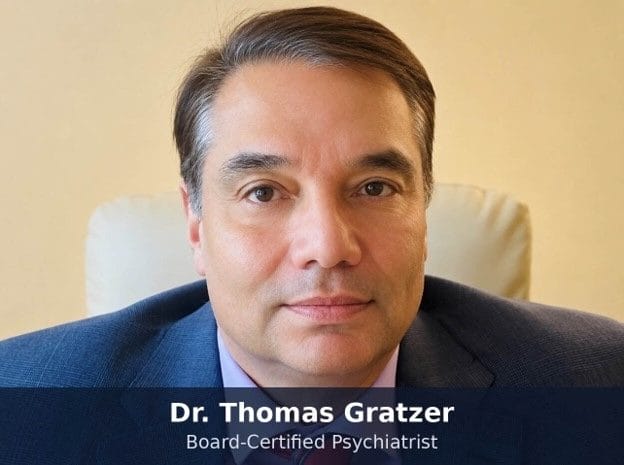
Dr. Thomas Gratzer is a board-certified psychiatrist and forensic psychiatrist based in Minnesota who is affiliated with Psych Recovery Inc. in St. Paul. Over the course of his career in both general and forensic psychiatry, he has built a reputation for combining clinical expertise with rigorous, evidence-based analysis. He has also served as an expert witness in landmark cases, including In re Linehan, a decision that helped shape how courts interpret sexually dangerous person statutes.
After extensive training in general psychiatry, Dr. Gratzer developed a specialized forensic practice focused on the intersection of mental health and the legal system. His work includes competency evaluations, violence risk assessments, and expert testimony in cases that require careful psychiatric judgment.
Today, Dr. Gratzer is re-establishing his general psychiatry practice while continuing his commitment to evidence-based medicine and long-term patient outcomes.
After spending an extended period away from clinical practice, he is returning with renewed focus, completing credentialing across commercial and government payers while rebuilding his practice at Psych Recovery Inc. He lives in Eden Prairie, Minnesota, with his wife, Denise.
What is your typical day, and how do you make it productive?
Right now, my days are divided between rebuilding my practice and preparing for a full return to both clinical and forensic work. That includes credentialing, administrative responsibilities, continuing education, and staying current with developments in psychiatry.
I try to schedule my most demanding work during the hours when my concentration is strongest and leave administrative tasks and correspondence for later in the day. I’ve learned that productivity isn’t really about managing every minute — it’s about matching the work to the level of focus you have available.
How do you bring ideas to life?
I usually start by testing an idea against both the available evidence and the practical realities surrounding it. That’s the same approach I take in clinical medicine. An idea may sound compelling in theory, but it still has to stand up to considerations like patient needs, licensing requirements, liability, and logistics.
If it still makes sense after that process, I move forward deliberately, building it in stages and adjusting as new information becomes available. In my experience, the strongest ideas aren’t the ones that arrive fully formed — they’re the ones that continue to hold up after repeated questioning.
What’s one trend that excites you?
Artificial intelligence, particularly its growing role in medicine and psychiatry.
Many clinicians worry that AI will weaken the physician-patient relationship, but I see the opposite happening. Used thoughtfully, it can reduce the administrative and analytical work that often competes with patient care, giving physicians more time for meaningful human interaction.
Clinicians who learn to use these tools effectively won’t spend less time with patients — they’ll have more opportunity to focus on the parts of medicine that only people can provide.
What is one habit that helps you be productive?
Staying current.
Psychiatry continues to evolve, and I’ve always viewed continuing education as a lifelong responsibility rather than something that ended after residency. Returning to foundational material while remaining open to new research, technologies, and approaches has served me well throughout my career, especially during periods when I needed to rebuild momentum.
What advice would you give your younger self?
I’d remind myself that setbacks don’t define you — your response to them does.
I would also encourage my younger self not to fear difficult periods. Those experiences often build resilience and perspective in ways that success alone never can. Finally, I’d say to trust the value of doing things methodically, even when progress feels slower than you’d like.
Tell us something you believe almost nobody agrees with you on?
Many people believe a major setback permanently defines a person’s future.
I believe the opposite. How someone responds to adversity often says far more about their character than the adversity itself, and I’ve seen many second acts become stronger than the first.
What is the one thing you repeatedly do and recommend everyone else do?
Ground every important decision in evidence before acting.
Whether I’m forming a clinical opinion, preparing forensic testimony, or making a professional decision, I’ve found that carefully gathering and weighing evidence before reaching conclusions consistently leads to better outcomes. It’s a habit that’s served me throughout my career, and I think it applies well beyond medicine.
When you feel overwhelmed or unfocused, what do you do?
I like to simply step away from the problem for a time and collect my thoughts.
What is one strategy that has helped you grow your business or advance in your career?
One of the best decisions I made was affiliating with Psych Recovery Inc. instead of trying to rebuild everything independently.
Working with a practice that shares my values allows me to concentrate on patient care and forensic work while relying on an established infrastructure to help manage credentialing and many of the administrative challenges involved in returning to practice.
What is one failure in your career, how did you overcome it, and what lessons did you take away from it?
I spent an extended period away from clinical practice while resolving a personal matter that ultimately took much longer than I expected.
Rather than viewing that chapter as the end of my career, I focused on preparing for my return. I sought the right professional support, stayed current in psychiatry, and approached the process one step at a time.
It required patience, but it also reinforced something important: persistence matters. What ultimately brought me back was my love for medicine. Psychiatry has always been the work I was meant to do.
What is one business idea you’re willing to give away to our readers?
I think there’s a real need for a credentialing and re-entry navigation service for physicians and other licensed professionals returning to practice after time away.
Whether someone has stepped away because of retirement, family responsibilities, or other life circumstances, returning to practice involves licensing boards, DEA registration, malpractice coverage, payer credentialing, and numerous administrative hurdles. Most physicians don’t realize how complex the process is until they’re in the middle of it.
A service that helps professionals navigate that process efficiently would fill a genuine need.
What is one piece of software that helps you be productive? How do you use it?
ChatGPT and Claude.
As I’ve rebuilt my practice, stayed current with research, and managed the administrative responsibilities that come with returning to medicine, I’ve found AI tools extremely useful for organizing information, drafting documents, summarizing research, and helping me think through complex problems before investing significant time in them.
What is the best $100 you recently spent? What and why?/
A new pair of running shoes.
It’s a simple purchase, but staying consistent with running helps clear my mind and keeps me mentally sharp for the more demanding parts of my work.
Do you have a favorite book or podcast you’ve gotten a ton of value from and why?
Kaplan & Sadock’s Comprehensive Textbook of Psychiatry.
It was an essential resource during my residency, and decades later I still return to it. Psychiatry changes rapidly, and the book has evolved alongside the field. It’s a good reminder that staying current is a lifelong responsibility rather than something you finish during training.
What’s a movie or series you recently enjoyed and why?
I don’t really know, but I would like to mention a quote that has brought me wisdom over the years:
“Never give up. Remain positive. Find meaning in helping others.”
Over the years, that has become something of a personal motto, and it’s helped guide me through some of the more challenging periods in both my career and my life.
Key learnings
- A setback doesn’t have to define a career — how someone responds to it often matters more than the setback itself.
- Grounding decisions in evidence, whether clinical, forensic, or professional, builds habits that translate across every stage of a career.
- Joining the right team can allow professionals to focus on excellence in their core work instead of rebuilding every piece of infrastructure alone.
- Staying current in a rapidly evolving field requires an ongoing commitment to learning.
AI is most valuable when it creates more time for meaningful human connection rather than replacing it.