
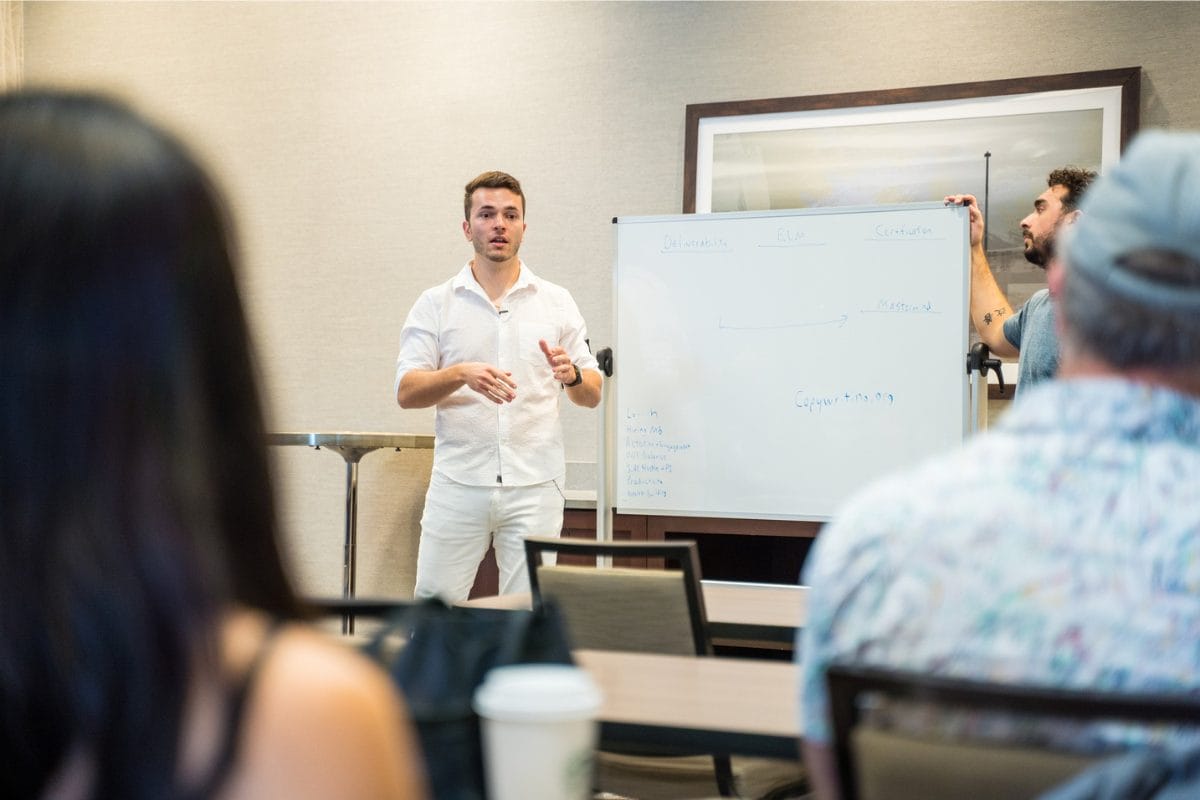
Troy Ericson is the founder of MailGenius. Since 2020, Troy and his team have generated over $200,000,000 for their clients. He has been recognized as the #20 copywriter in the world by Peter Tzemis of Traffic & Funnels. Troy’s expertise spans social media, direct response marketing, salesmanship, and copywriting, which he sees as the “holy grail” for driving revenue.
Troy’s journey began after a failed college baseball career. He initially started running Facebook Ads for clients before discovering that many businesses struggled to reach their new leads due to problems with email deliverability. Recognizing this problem, Troy transitioned to email marketing & deliverability, where he developed the concept of Email List Management. This approach allows companies to hire Troy & his
team for copywriting, email deliverability, and strategic list management — in the past, companies would have to hire 3 separate people for this. This innovative solution maximizes email results while minimizing cost.
What is your typical day, and how do you make it productive?
First off, I’m not a huge fan of waking up super early. I’m more productive when I’ve had enough sleep & wake up naturally, so I usually get up around 7 or 8 am. I try not to check my phone right away because it can be a huge time suck, and it gets my head spinning in a million different directions. Instead, I like to take a little time to get my mind right with some reflection as I get ready for the day.
Then, I dive into work pretty quickly on the goal list that I made the night before. As the owner of e-mailMarketing.com and several other ventures, I wear a lot of hats from time to time, but I always start with the most urgent stuff first. Here’s my typical order of things:
• Deep Work: This happens first thing in the morning. Whatever the key objective is for that day/week/month happens here. Right now I’m migrating CRMs & setting up ads. But this time of day depends what will help us achieve our #1 goal at any given time.
• Client Communication: After deep work, I take a break to work with our management team to ensure client success. This could involve helping them with anything from crafting email copy and managing lists to solving deliverability issues or deep strategic ideas. I’m still very involved in making sure my clients are seeing the results they deserve. In the afternoon, I focus on software development: I’m constantly working on my “Reverse Cold Email” software and service. This involves everything from brainstorming to beta testing and gathering feedback. I also own and am improving MailGenius with my team, a free online email spam testing tool.
• Content Creation: This is a big one for me. Whether it’s recording a video, writing an email to my list, or posting on social media, I make sure I’m putting out valuable content toward the end of each day. I try to be very personable and share stories that will connect with people on a human level. I have learned that personal stories are much more engaging than purely business-related content. Learning and adapting: I try to stay on top of the latest trends in email marketing and software by taking a quick walk at the end of each day. I’m always testing new strategies and seeing what works best. I use AI to help me learn new things and find solutions to specific problems, but I don’t allow it to interact with potential leads. I am constantly adjusting the campaigns based on feedback from the market. I will sometimes ask AI for help with idea generation, especially for affiliate swipes, but very few of the emails that
my team and I write are 100% AI. After that I will spend some time doing things I personally enjoy.
I make sure that I do my most important tasks first, before I get distracted by less important things. I have learned to be gracious with myself in the moment, and to accept that sometimes it’s okay to be upset if that day wasn’t hyper-productive, but then you have to move on and figure out the next thing. I also try to avoid working late at night, since I find it hard to focus after I’ve gotten out of work mode. I’ve found that it’s better to just close my laptop and go to bed rather than trying to reopen it.
How do you bring ideas to life?
It’s not a straight path, and it’s definitely been a journey of figuring things out, but I think that’s how the best ideas are born. No one comes up with a great idea without months or years of being curious & mentally innovating their own life.
Next, I’m a big believer in taking action. I don’t wait for the perfect moment or try to plan out every single detail in advance. I’ve learned that sometimes you just have to start and adjust as you go. It’s like one of my favorite Metallica songs says: “Advantages are taken, not handed out”. That quote really resonates with me. I’ve always been that way, and it’s served me well. I’ve always had a bias toward action. I also believe in a growth mindset, and that with hard work and determination, anything is possible.
I’m also an idea generating machine. So many things excite me, and I get ideas all the time. I have to say no to myself a lot. I’ve learned to prioritize the ideas that are closest to cash for me, my team, and my clients. I focus on one thing at a time. I have a “now,” a “next,” and a “later”. I have learned the hard way not to spread myself too thin and try to build multiple bridges at once. It’s better to build one bridge at a time, focus on getting it right, and then move on to the next.
Here are some of the things that I do to bring ideas to life:
• I look for problems that need solutions. I started e-mailMarketing.com (formerly Email Paramedic) because I saw so many businesses struggling with their email lists & deliverability. So I would experiment with different ideas I had & treated the list like a science experiment. This way I could get paid to come up with ideas, test them,
and double down on the ones that worked.
• I test and iterate. I don’t get too attached to my ideas. I put them out there, see what works, and adjust accordingly. If it doesn’t work, I’m one step closer (and smarter) to finding what will work.
• I try to be contrarian. I like to go against the grain and do what other people aren’t doing. If everyone is doing one thing, I’ll try something completely different to get to a solution faster. And kill the idea if it doesn’t work out.
• I’m always learning and adapting. I stay on top of the latest trends and technologies in email marketing, and I’m not afraid to try new things. I use AI to help me brainstorm, but I don’t rely on it too much for pure writing. I really believe in human connection.
• I rely on my team. I’ve built a team of people who compliment my strengths & weaknesses. My Email List Managers are fantastic at making sure all the little things get done, and they’re also really creative. I want them to have a positive and productive work environment. So, what got me into email marketing? It wasn’t something I planned. Like most of my life, it was an organic evolution. It was born out of struggle. I’ve learned that the best way to do something is to just try it.
• I wanted to be a professional baseball player, but that didn’t work out. I had a Tommy John surgery, which is a pretty serious surgery for a pitcher, and then I lost my ability to throw accurately. I had to figure out a new path, and it was kind of a dark time. I started dabbling in business while I was still in college, and it was the first time I had an idea of what it was like to be free to do what I wanted. I started by running Facebook ads for an agency. That’s where I got a taste of marketing. I saw how powerful it could be for businesses.
• I met some really awesome people who showed me what was possible. My first client, Greg, was selling t-shirts outside of Yankee Stadium, and he showed me that you don’t have to do business in a corporation. I learned a lot from him. He taught me the value of hustling.
• I got some experience with funnels and email marketing when I worked on a project called Hustle Island. We sold 24,000 t-shirts and built an email list of 147,000 people. That experience was invaluable. I realized how powerful email could be for building relationships and driving sales. I had found my love in business.
• I went all in on email marketing when an ads client wanted to fire me, I asked them why, and they told me it was due to their emails going to spam. It wasn’t my fault, but I decided to figure it out anyway. I did, they nearly 4x’d their email revenue, my name got a lot of traction, and the rest is history.
What’s one trend that excites you?
There’s a lot happening, but one thing in particular has really grabbed my attention. It’s the idea of “Reverse Cold Email,” and it’s something I’m all in on. It’s not just a little tweak, it’s a total flip on how we usually think about cold outreach.
Here’s why it’s so exciting to me:
• It’s about leading with value. Instead of blasting people with unsolicited emails, you’re joining their email list first by subscribing on their website. You’re saying, “Hey, I’m interested in what you’re doing,” which immediately puts you on a higher status point… “But I noticed XYZ”. That’s where you smoothly show your experience & offer a call to help.”
• You’re entering their world. You’re not hitting them cold. You’re replying to an email they sent you because you opted into their list. This puts you in a setting where they don’t get a lot of messages like that. It’s like you’re already part of their community.
• It cuts through the noise. Let’s be real, people are getting bombarded with DMs and cold emails, and a lot of that is going straight to spam. When you reply to their email, you’re showing that you’ve actually taken the time to pay attention to their world. That makes you stand out.
• It’s a way to get a more even playing field. When you send a regular cold email, you’re naturally at a lower status because you’re asking for something. With reverse cold email, you’re still lower than them because it’s their business, but it’s more evened out.
I first started doing this by recording a quick Loom video for people, pointing out a problem in their funnel or ad copy, and offering a solution. It worked really well and I was closing clients like that. I wanted to figure out how to scale this with cold email.
So, I built an entire software around this idea. I call it “Reverse Cold Email” because I’m technically not sending any cold emails. Instead, I’m replying to emails that they send me. It kind of flipped it on its head. With it, there’s no warm-up time. I can start sending emails today, and I’m not limited to 40 emails per inbox. I can send up to 100 per day per inbox, which is a big deal.
I really believe this is the next big thing. I think it’s a strategy that can work for a lot of businesses, especially B2B and online businesses. It’s a way to connect with people authentically, offer value, and build relationships WHILE making sales.
Also, I think I should mention that I am not saying that traditional cold email is not effective. It can be, but I think there’s a much better way that many people have not been using or even thinking about.
What is one habit that helps you be productive?
If I had to pick just one, it would be prioritizing my day by tackling the most important tasks first. It’s a game changer for me, and it’s something that has really helped me get more done and stay focused on my goals.
It’s really easy to get caught up in the day-to-day stuff. If I’m not intentional, I can easily spend hours on things that aren’t really moving the needle. So, I start my day with the most important stuff. It’s not always easy, but it’s definitely worth it.
Here’s how I think about it:
• I treat my day like I’m filling a jar. If I start with the little things — the sand — the big things — the rocks — won’t fit. If I put the big rocks in first, I can pour the sand in around them, and everything will fit. I try to do the most important things first.
• I structure my day around my big priorities. I do my most important work before I check emails or social media. If I have a big project that needs my full attention, I tackle it first thing, before anything else has a chance to distract me. It’s so easy to get distracted, so I try to put myself in a position to succeed.
• I know when to quit. It’s really important to know when to close the laptop for the day. It can be tempting to keep working late into the night, but I’ve found that I get burned out quickly when I do that. When I try to go back to work after dinner, I’m only operating at 25% brain power and am just scrolling on my phone. It’s much more effective for me to just stop, relax, and go to bed so I can start fresh the next day.
I’ve also learned that it’s really important to be in motion and to keep things moving. This is why I make it a habit to prioritize tasks. I can easily get caught up in analysis paralysis and let perfection be the enemy of progress. But, I believe that anything is possible with hard work and determination, and I try to reflect that in my actions.
Prioritizing tasks isn’t just about getting more done, it’s also about making sure I’m working on the things that matter most. It’s about being intentional with my time and energy. I find that this one habit helps me stay focused, and it makes a big difference in my overall productivity and my overall sense of well-being.
What advice would you give your younger self?
I’d probably focus on mental state because everything else stems from that – including your habits, beliefs, and eventual success.
• First off, I’d tell myself, “You are not your success.” Back in college, I was so wrapped up in baseball that my entire identity was tied to it. When I got injured and my baseball career ended, I felt like I lost everything. So I would go back & tell myself that it’s okay to be upset, but not to let it define me. I’d say, “Your worth isn’t tied to what you do, but who you are”. It’s important to find value in yourself outside of your accomplishments.
• I’d also say, “Love yourself and love other people.” I really believe in the importance of building genuine connections. I would tell my younger self that it’s not just about achieving success, it’s about the relationships you build along the way. My mentor Joel Marion has a cool hat that says “Rich in Relationships”. Pretty powerful for a guy who built & sold BioTrust for well over 9 figures.
I’d also tell myself to embrace stories. When I first started out in business, I thought that writing was lame and that I needed to be more firm and factual. I didn’t realize the power of a good story and how it could connect with people. I’d tell myself that stories are not weak; they’re one of the most powerful tools available. And they’re actually cool too because people are drawn to stories and they use them to make
sense of the world.
Tell us something you believe almost nobody agrees with you.
I believe that most people are overly focused on “best practices” rather than on what actually works.
Here’s what I mean:
• So many people get caught up in following the rules or “best practices” that they forget to experiment and find their own unique approach. This is true in email marketing as well as in other aspects of business. I see so many people who get stuck following a formula, or who are afraid to break from the mold because they think that the “experts” know best. In my experience, I’ve found that following the crowd isn’t always the best way to succeed.
• Many people think that there is a “best time” to send an email, a “best way” to write an email, or a “best” email platform to use. I don’t believe it. I’ve found that the key is to experiment, test, and find what works best for you and your audience, rather than relying on what other people say is the “best practice”.
• I believe that “best practices” are often just a collection of ideas that have worked for some people in some situations, but that doesn’t necessarily mean that they will work for you. As I’ve said before, switching platforms and expecting different results is like switching gyms and expecting to get stronger. It’s all about preference, and what works best for you. If you are not getting the results that you want, don’t assume that the platform is the problem. It’s more likely that you need to adjust your strategy.
For example, there are a lot of people who believe that the key to a good email is to include a huge picture. But I’ve found that simple emails with a personal story and a clear message work much better. People like to feel that they are connecting with you, not some generic corporation. People want to know the person behind the message. This is why I emphasize the importance of story.
I think people get so caught up in what they should be doing that they forget to ask themselves what they could be doing, and to try those things. And I understand the temptation to look for “best practices”; it’s often easier to copy what other people are doing than to try to come up with something new. It’s less risky, too. If you fail, you can always say, “Well, that’s what everyone else is doing. It must be something else!”
But I think that the real opportunity lies in challenging the status quo and thinking outside the box.
Ultimately, I think it’s essential to approach everything with a spirit of experimentation and to have a willingness to challenge conventional wisdom. That’s how you find your unique path, create something special, and make a real impact.
What is the one thing you repeatedly do and recommend everyone else do?
Okay, so if there’s one thing I repeatedly do and recommend everyone else do, it would be to prioritize storytelling in ALL your communication. And I don’t just mean in your emails but across all platforms. I’ve found that stories are incredibly powerful tools for building connections, making your message memorable, and driving results.
Here’s why I believe this is so important and why I do it in my own business:
I use stories in my business all the time. I share my personal story of how I got into email marketing after my baseball career ended. I talk about the challenges I’ve faced and how I overcame them. I also share stories from my clients to show people what’s possible. All of this makes my message more engaging and relatable. People can’t relate to you outside of the story frame. It’s just too hard for them to put yourself in your shoes unless they’ve gone through something similar.
When you feel overwhelmed or unfocused, what do you do?
Okay, this is a great question, and it’s something I think about a lot, because as an entrepreneur, it’s easy to feel overwhelmed and unfocused. Over the years, I’ve developed a few strategies to get myself out of a funk, and I hope that they might be helpful to you, too.
Here’s what I do:
• I get everything out of my head and onto a whiteboard. I literally write down everything that’s bugging me or that I’m trying to accomplish. It doesn’t have to be organized at first, it’s just about getting it all out. This helps me to see all the different things that are weighing me down, and it’s the first step in getting back on track.
• Then, I organize those ideas into categories. I prioritize the different things that I need to do, and I organize them into a “now, next, and later” framework. I focus on the one to three things that are most important and that need to happen right away, the “nows,” and I put everything else into “next” and “later” categories. This helps me to focus on the most important tasks and to avoid getting bogged down by everything else. Some people use sticky notes to move things around. I often erase some things entirely because they just don’t matter and were taking up too much mental real estate.
• I make sure that I’m getting enough sleep. When I’m not getting enough sleep, I get easily overwhelmed, and I have a really hard time focusing. If I try to go back to work late at night, I know that I’m just running on low brain power. I have learned to close the laptop at night and to get back to it the next day. I know it’s time to stop working for the day when I go out to eat or go for a walk.
• I understand that nothing can ever be completely finished. There will always be something else to do, and that’s okay. I’ve learned to let go of the idea that I have to do it all, and I focus on the one thing that matters most. This helps me to avoid the feeling that I’m falling behind because I’m not doing everything at once.
• I focus on my strengths and bring in people who can help me with my weaknesses. I know I’m not great at everything, and I’ve learned to bring in people to help me. For example, I know I’m good at writing, but I need people who are good at technical stuff. This allows me to do what I’m good at and to bring in other people who can help me with the rest.
Ultimately, I think it’s important to remember that overwhelm is a skill that you can learn to manage. It’s something that everyone deals with at some point or another, and the more you learn to deal with it, the better you get at it. It’s like anything else in life: the more you practice it, the better you get. When you have a good system, you can recognize when something is wrong, and you can get back on track quickly.
What is one strategy that has helped you grow your business or advance in your career?
Okay, so if I had to pick just one strategy that’s been a game-changer for growing my business and advancing my career, it would be niching down and becoming the go-to expert in a specific area.
Here’s how I did it and why it’s been so effective:
• Finding my Blue Ocean: Back in 2019, I was doing Facebook Ads for an agency, but I realized the market was super saturated. It felt like a red ocean, with a lot of competition, and I knew I couldn’t stand out that way. So, I decided to go all-in on email marketing, which at the time felt like a blue ocean. Instead of trying to be good at everything, I decided to become an expert in one specific thing.
• Focusing on a Specific Problem: I niched down even further by focusing on email list
management. I realized that many businesses had neglected their email lists, or they didn’t know how to make the most of them. So, I created a system that combined email copywriting with deliverability, and that was a game changer. I made sure emails landed in the primary inbox, which was a huge need for businesses.
• Becoming the Go-To Guy: By focusing on this very specific area, I quickly became known as the “Email Paramedic,” a term that highlights my focus on reviving dead email lists. I also became known as the guy who could get emails into the primary inbox, and not the promotions or spam folders. Because I was the only Email List Manager in the room at various in-person events, I grew super quickly because no one else really did this AND posted about it online.
• Creating a Unique Offer: My offer was simple: I would increase my clients’ open rates and sales or they wouldn’t pay. That was very different from other agencies who just “wrote emails” and it made it easy for clients to say yes. This allowed me to stand out from the competition and attract a lot of clients.
• Building a Brand Around It: I created a brand around the concept of Email List Management, with websites like EmailListManagement.com and EmailMarketing.com. This helped me to solidify my position as the expert in this niche.
What is one failure in your career, how did you overcome it, and what lessons did you take away from it?
One time one of my team members got a positive comment from Alex Hormozi in Slack on the emails we wrote for a company of his. So I used the screenshot in my ads. The ads started to do better, but I got a message from Alex a few days later asking for that to be taken down. So I did.
I was super bummed at first because it made the ads do better, but it wasn’t the right move for me to post it without asking first. Eventually I realized that the campaign was doomed from the start anyway because I was selling a bundle of email templates that people viewed as a “toolbelt” kind of offer rather than one that made them curious about hiring us for done-for-you services.
It was the wakeup call I needed to focus on things that actually give value and increase curiosity rather than tactics & clout.
What is one business idea you’re willing to give away to our readers?
Okay, I’m happy to share a business idea that I’ve thought about but don’t have the time to do…
A service where you can upload pictures of junk mail that you get & the service makes sure that you never get junk mail from that sender ever again!
I know, it sounds ironic. But we’re talking about physical mail that you never signed up for — annoying!
What is one piece of software that helps you be productive? How do you use it?
I’ve used ActiveCampaign for over 5 years of running my business and it’s my go-to for email marketing, but it does so much more than just sending emails.
Here’s how I use it:
• Email Marketing Automation: Obviously, this is a core function of the software, but it’s more than just sending out newsletters. I use ActiveCampaign to create automated sequences that nurture my leads, onboard new clients, and follow up with people who have engaged with my content. I make sure to create welcome series, abandoned cart sequences, and more, making sure that every point of contact with my audience feels personal. It’s really helped me to streamline my communication and keep me top-of-mind with my audience.
• Segmentation: I use ActiveCampaign’s segmentation features to make sure I’m sending the right message to the right people. For example, if I have business owners, and also people who are just starting out, I make sure to send them different content that’s relevant to them. I don’t want to send a high-ticket offer to someone who’s just starting out, and I don’t want to send a beginner’s guide to a seasoned business owner. Segmentation helps me to personalize my message and build a stronger relationship with my subscribers.
• Deliverability: The platform has good quality IP addresses that help with deliverability. I can monitor my open rates, click-through rates, and spam complaints to make sure my emails are performing well.
• CRM: It’s not just for email, it helps with customer relationship management, too. I use it to keep track of all my contacts, their interactions with my business, and their engagement with my emails. It also helps me to keep track of where people are in my funnel.
• Testing and Optimization: ActiveCampaign also helps me test different subject lines, email copy, and calls-to-action to see what works best. It lets me analyze the performance of my campaigns to continuously improve my messaging. This process is essential because what works today might not work tomorrow. I have to be willing to constantly test and tweak.
• Automations: This is where ActiveCampaign really shines. I can set up automations that are triggered by different events, like a subscriber joining my list, clicking on a link, or abandoning a cart. I use this feature to create custom follow-up sequences that are tailored to each individual’s behavior and preferences. This has really helped me to personalize the experience of people on my list, which is key.
I know there are other platforms out there, like Klaviyo for e-commerce businesses, or instantly for cold email outreach, but ActiveCampaign is the one that works best for me. It’s flexible, it’s powerful, and it helps me stay connected with my audience. I’m always looking for tools that can help me be more efficient, and ActiveCampaign has really helped me with that. I highly recommend it to anyone who’s serious about growing their business through email marketing.
What is the best $100 you recently spent?
TSA Pre-check! I’m still shocked by how many people wait in exponentially longer lines at the airport.
Do you have a favorite book or podcast from which you’ve received much value?
10x Is Easier Than 2x is the book that has recently helped me shift my mindset toward taking bigger leaps.
The whole premise is that it’s easier to change your model or offer completely than it is to constantly make little tweaks. The bigger the change, the bigger the return (if it works of course – that’s the tricky, err, fun part)!
What’s a movie or series you recently enjoyed and why?
I don’t tend to watch TV unless there’s a big sporting event. But my favorite movie is Hacksaw Ridge.
Key learnings:
• Prioritizing tasks by tackling the most important ones first is a game-changer for productivity. This involves focusing on the key objectives and using a “now, next, and later” framework.
• Storytelling is a powerful tool for building connections, making a message memorable, and driving results. It should be prioritized in all communication, not just in emails. Personal stories are much more engaging than purely business-related content.
• Niching down and becoming the go-to expert in a specific area is a key strategy for growing a business. It involves focusing on a specific problem and creating a unique offer. For example, focusing on email list management and deliverability proved effective.
• Experimentation and a willingness to challenge conventional wisdom is essential for finding a unique path and making a real impact. Many people focus too much on “best practices” rather than on what actually works for them.
• It is important to focus on the value you bring and increase curiosity rather than focusing on tactics or clout.
The most valuable information from the interview centers on the importance of combining strategic thinking with a focus on human connection. The advice about prioritizing tasks, focusing on a niche, using storytelling, and experimenting to find what works best emphasizes a practical, action-oriented approach. Also, the idea of “Reverse Cold Email” suggests a creative, contrarian approach to marketing that is about leading with value. Overall, the interview highlights the value of adapting and learning as a means to success.