
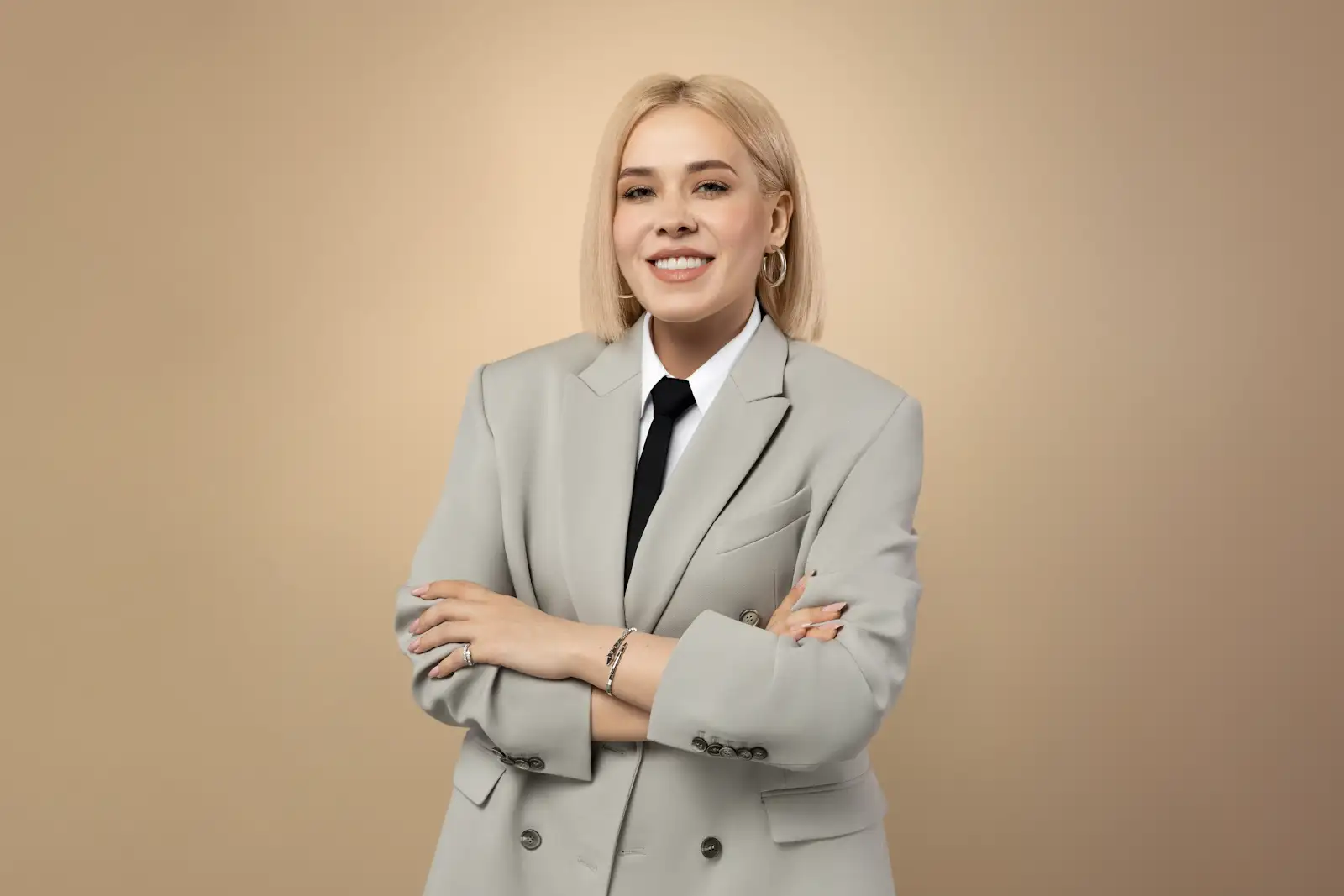
Victoria Repa is the CEO and founder of BetterMe, a global wellness platform that has been chosen by users worldwide. She was the first Ukrainian to be selected for Apple Entrepreneur Camp and was named to Forbes’ “30 Under 30” Europe, Technology category. She has performed on stages at Web Summit, Google for Startups, and London Tech Week, etc.
Driven by personal pain, Victoria founded BetterMe in 2017. In 8 years, BetterMe has grown from a niche Facebook community with three teammates into a global company with 500+ employees, which offers two supportive apps BetterMe: Health Coaching and BetterMe: Mental Health, to empower millions. Launched in 2021, the BetterMe Store promotes inclusivity with its range of activewear, equipment, and smart devices. Victoria’s mission is clear: to make health affordable to everyone, regardless of gender, shape, or background.
What is your typical day, and how do you make it productive?
Over the years of developing the company, balancing productivity and personal life, my routine as an entrepreneur has formed into stable habits that support me throughout the day. The basis of everything is sleep, which lasts at least 7–8 hours. My morning rituals include a cold shower for physical and emotional awakening, no caffeine and breakfast, and diving into strategic tasks. This helps me stay focused throughout the day.
In addition, I exercise for at least 60 minutes every day. Exercises such as Pilates or yoga help me develop not only physical health but also discipline and mental strength. Spiritual practices are also part of my routine. I practice 40 minutes of meditation and mantras, as well as breathing techniques such as Pranayama. They help me maintain balance no matter what the day brings.
It took me years of searching and understanding what I needed to create this routine. When I started my business journey and while studying at Stanford Executive Program in 2019, my priorities shifted more toward hustle and proactivity than my own wellness. However, over time, I began to appreciate the benefits of sleep and exercise rather than coffee and working late into the night.
How do you bring ideas to life?
For me, bringing ideas to life always starts with personal truth, not just market analysis. More than eight years ago, I was working in media analytics at a technology company. I sat at my desk, ate poorly, and constantly felt physically and mentally exhausted. And I wasn’t alone: on social media, people around the world were seeking simple answers to a complex question: “How can I get healthier quickly?” This realization struck me deeply because I was one of those people.
That’s when I decided to take a bold step. I left my stable job to create a product that didn’t exist yet, one that would turn chaotic health advice into something clear, accessible, and practical. Not for “perfect” fitness users, but for real people — people like me.
We started small: a Facebook community, followed by an MVP that included video workouts and meal plans all in one scroll. In ten days, we reached 100,000 downloads, and just one year later, in 2018, BetterMe took first place in terms of downloads in the United States. It was proof — people were ready for simplified health. Today, BetterMe is used by millions of people worldwide. However, our mission has remained unchanged over the years. Every product we release still starts with the same question I once asked myself: “How can I make life easier for people who are tired, busy, and just want to feel better?”. This is how I bring ideas to life, creating what I myself lacked.
What’s one trend that excites you?
One trend that really excites me is “thinking like an athlete.” It’s a way of thinking that goes far beyond physical training. It’s about maintaining a constant presence, building resilience, and recognizing that progress is not linear. Athletes train by overcoming discomfort, failure, and stagnation. And it is precisely this mental discipline that translates directly into business.
Today, I approach business in the same way as I approach sports. For example, I treat failures in the same way as I do mistakes in sports: I analyze, adjust, and try again. This helps me grow as a leader, recognized by the Stevie Award and TITAN Women In Business Awards, and stay mindful and focus daily. I am glad to see that more and more people are adopting this mindset, which prioritizes the athlete. It is resilient, empowering, and extremely relevant in today’s fast-paced world.
What is one habit that helps you be productive?
My most powerful habit that contributes to productivity is prioritizing my internal state, encompassing physical, mental, and emotional well-being. I workout for at least one hour every day without fail. It’s a powerful practice not only for my body but also for my brain. Activities like Pilates, yoga, tennis, or golf give me focus, clarity, and endurance for everything else. I combine physical movement with mental and spiritual practices. This combination resets my nervous system and sharpens my thinking. Without this routine, I would be lost in chaos and unable to remain stable in the unpredictable circumstances that entrepreneurial life often presents. So a reliable mind-body connection creates the foundation for my leadership.
What advice would you give your younger self?
I would recommend that she rely on a mantra that has been my guiding principle for years: “Act and don’t react; time spent reacting can be spent on positive action.” Having graduated in 2015 from the Kyiv School of Economics, I quickly learned that nothing works except experience. As a result, I started my own company without any business experience or technological background.
As I developed and grew my business, I realized that leaders don’t need to know all the answers, but they do need to keep the team energized. Today, I see my role as founder and CEO not only through an operational lens. As a “Chief Energy Officer,” I take responsibility for the emotional climate I create for the people around me: my team, partners, and users.
When I was younger, I thought success meant speed — always doing something, always proving something. But over time, I realized that real progress comes when you are calm enough to make thoughtful decisions. It is impossible to lead when you are burned out.
Tell us something you believe almost nobody agrees with you.
I believe that the CEO should personally test the company’s product. Most leaders believe that reviewing technical specifications or data is enough, but I am convinced that nothing can replace real experience.
Like any product company, we conduct user testing before each launch. However, we have found that users are not always able to clearly articulate their requests. So I go one step further and immerse myself in their context. I use the product the way they do, paying attention not only to whether it “works,” but also to whether it is intuitive, motivating, and enjoyable. I ask questions like: “Can a beginner do this?” or “Will this feature help someone feel more confident or, on the contrary, cause frustration?” To achieve this, I became a certified Health Coach (Institute for Integrative Nutrition) and Pilates instructor (APPI) in 2022. That knowledge helps me understand the real-life challenges faced by people, from motivation and mindset to physical limitations.
Testing enables me to identify shortcomings in advance, provide feedback to the team, and ensure that each feature aligns with our mission: health that works in real life. After all, today’s users expect more than just functionality. They want a genuine experience that supports them for who they are, not who we imagine them to be.
What is the one thing you repeatedly do and recommend everyone else do?
I recommend reconnecting with your body every day. It doesn’t have to be a full workout; sometimes it’s 10 minutes of stretching, mindful breathing, or a short walk in nature. Our bodies accumulate emotions, stress, and tension long before our minds are aware of them. Movement clears this space. This allows you to reset your attention, calm your thoughts, and return to balance.
I tell my team the same thing: don’t wait until you burn out to start listening to yourself. The “Move a little every day” approach, recognized with the Corporate Excellence Award, is the simplest and most effective way to recharge your energy and creativity.
When you feel overwhelmed or unfocused, what do you do?
I return to my breathing. When I am overwhelmed, I do not attempt to “push through.” I slow down, reset, and then move forward again—with greater awareness and improved energy.
I always carry mala beads with me, which guide me in moments when I need to stop and ground myself. While speaking at events such as Web Summit Lisbon, Web Summit Rio, and London Tech Week in 2023, I have spent many stressful hours on planes and in airports. So, I repeated mantras, breathed, and brought my attention back to the present. This is a practice I have been using for many years — not to avoid stress, but to meet it with clarity and purpose.
What is one strategy that has helped you grow your business or advance in your career?
One strategy that helped grow BetterMe was turning virality into a system, rather than relying on a lucky break. We began with traditional marketing, including paid ads, user acquisition, and product testing. All of this worked, but we saw that if something performed well organically, it could be scaled further.
So we began treating virality as a deliberate process. Instead of chasing attention, we created content that met real emotional or practical needs—something people genuinely wanted to share. By tracking trends, behavior, and timing, we built a formula: trends + timing + analytics.
This strategy has enabled us to reach millions of people from diverse demographics and cultures. We don’t just create health content, we make it shareable, meaningful, and memorable. That’s what drives real growth.
What is one failure in your career, how did you overcome it, and what lessons did you take away from it?
One of my biggest mistakes in the beginning was trying to do everything at once. In the first two years of BetterMe’s existence, we released 12 separate apps, each dedicated to a specific aspect of health and wellness. Sleep, running, meditation, training — we created everything imaginable. It was our way of figuring out what would catch on, but it was accompanied by chaos and a lack of understanding of the next steps. It took time to simplify the process. We have combined everything into a single, cohesive ecosystem. Today, BetterMe is a single, integrated platform, not a collection of disparate ideas. All of our products, including the BetterMe: Health Coaching app, BetterMe: Mental Health app, and BetterMe Store, are united by a shared mission and vision.
What is one business idea you’re willing to give away to our readers?
Stop building products for the ideal user, and start creating for real ones. When I founded BetterMe in 2017, we made the same mistake that most product development teams make: we created processes for the most motivated and disciplined users. Those who never miss a workout, never put things off until later, and never lose focus. But real people aren’t like that at all. So we changed our approach and started creating a product for real behavior. We developed tools that adapt to users, not the other way around.
My advice is simple: meet users where they are. Don’t try to “fix” them, support them. Test relentlessly, listen constantly, and remain humble enough to admit that you don’t truly understand your audience until you’ve lived their experience. That’s how great products are born.
What is one piece of software that helps you be productive? How do you use it?
I use many apps and software every day that are necessary for building my workflow. However, I also use BetterMe: Health Coaching not only as its founder, but also as a user who needs structure in a world that constantly distracts my attention in different directions.
We live in an age of distractions. Our minds constantly jump between messages, tasks, and an endless stream of information. I’ve learned that staying productive doesn’t require more time — it requires discipline. And discipline isn’t something you’re born with; it’s something you train, like a muscle. That’s why I rely on our app. It helps me maintain a daily rhythm that keeps my brain in shape — movement, mindful breaks, and reflection. It reminds me that consistency is what builds focus.
At BetterMe, we view health as a tool for mental clarity and collective productivity. When everyone sticks to small daily routines that strengthen both body and mind, we work smarter, stay calmer, and think more creatively. That’s why, for me, this app is not just about health and fitness. It is a compilation and embodiment of my mission, which is crucial for me to demonstrate to the world: making health affordable to everyone, regardless of gender, shape, or background.
What is the best $100 you recently spent?
I consider every dollar I spend an investment in my development, whether it’s in knowledge or physical well-being. For example, I can spend $100 on researching a new Pilates technique, testing wellness products, or investing that amount in leadership development training materials.
I believe that the best investment is always one that improves how you think, move, or feel.
Do you have a favorite book or podcast from which you’ve received much value?
Over the years, I have read hundreds of business books, but only a few have truly resonated with me and offered advice that has helped change my way of thinking, providing valuable leadership tips.
One of the books that had a big impact on me early on was “Blitzscaling” by Reid Hoffman and Chris Yue. I read it during BetterMe’s first year and asked my entire team to read it as well. It gave me a framework for scaling quickly, even in moments of uncertainty. It helped me understand that speed matters and that you can’t wait for everything to be perfect.
I also find Mel Robbins’ “The 5 Second Rule” extremely useful as a daily tool. I still refer back to it when I feel hesitant or overthink. This book is easy to understand, but powerful in its essence.
Each of these books taught me something specific that I could apply immediately, and for me, that’s the most valuable kind of reading.
What’s a movie or series you recently enjoyed and why?
I don’t really watch TV shows or movies. For me, free time is learning time. I prefer to invest my free time in learning about business or leadership — something that broadens my horizons or helps me grow. I find it more interesting to study how people make decisions, cope with pressure, or create new systems.
Key learnings:
- Think like an athlete. Mental endurance, consistent training, and recovery are as essential in leadership and entrepreneurship as they are in physical fitness.
- Build for real people. Products grow when they meet users where they are, especially when motivation is low or routines are inconsistent.
- Viral growth can be systematic, not accidental. The combination of trends, timing, and analytics creates campaigns that evoke an emotional response and spread organically.