
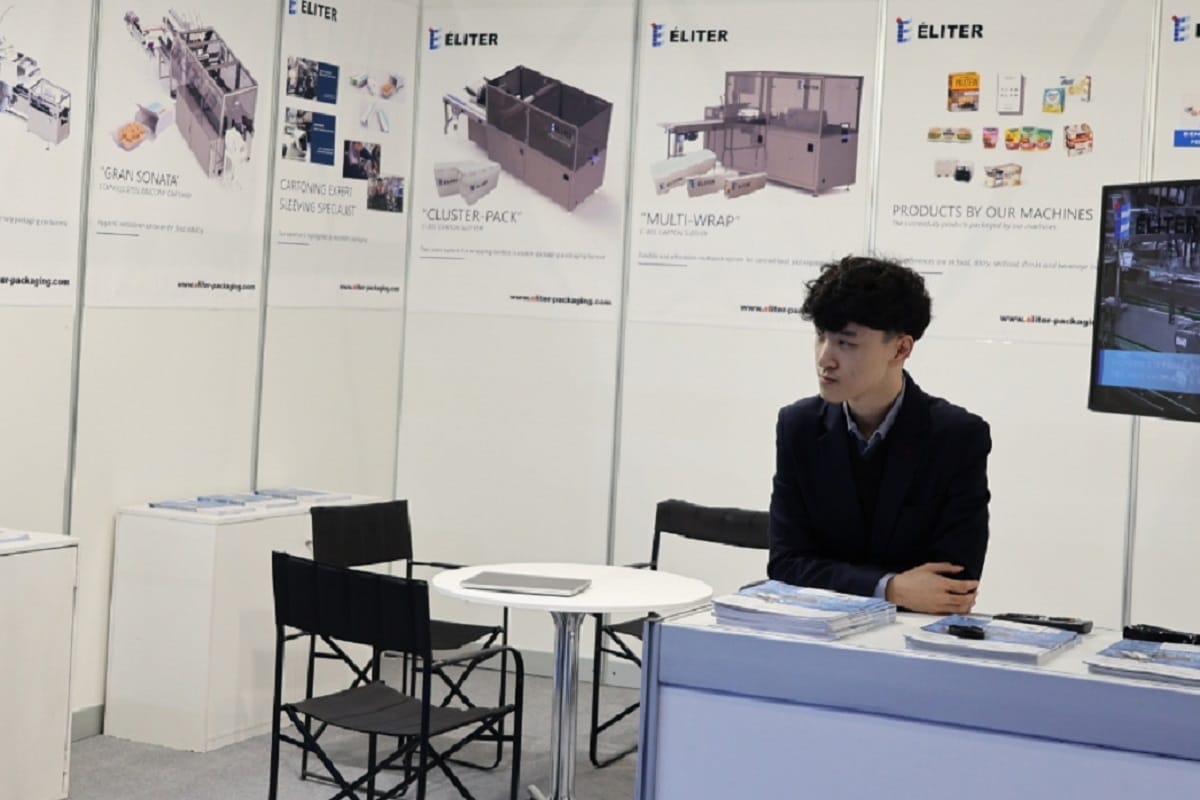
Zhiwei Bao (鲍智威) is a Chinese business executive and mechanical engineer holding more than 20 machine design patents. He is the owner of ÉLITER Packaging Machinery, a third-generation family-owned manufacturing business and a renowned brand in the carton sleeving market. Apart from his own business, he serves meanwhile as the Head of Digital and Product Marketing at Xi’an ActionPower Electric Co., Ltd., a publicly listed Chinese power electronics company and two-time recipient of the State Science and Technology Progress Award.
This dual identity sets Bao apart from other young entrepreneurs in China. Returning from Spain in 2021, he successfully rebranded his family’s business before joining ActionPower in March 2025. Today, he draws on that hands-on success to drive ActionPower’s international growth, building unparalleled competitive edge for the company through digital marketing and engineering-driven product strategies to establish it as a globally recognized power electronics brand.
As a contributor to Entrepreneur, Bao regularly shares his expertise on business building, product marketing, and entrepreneurial strategy.
Beyond his engagements in business and engineering, he is an accomplished classical guitarist with a deep love for Spanish music—a passion that originally drew him to study and work in Spain. Notably, he performed the famous classical guitar piece Recuerdos de la Alhambra at the University of Granada during a book launch event for his professor.
What is your typical day, and how do you make it productive?
I commute between two cities – Wenzhou and Xi’an, roughly 1,600 kilometers apart – due to the dual roles I hold: running my own packaging machinery manufacturing business while simultaneously serving as the Head of Digital Marketing for a publicly listed company. How I start my morning depends entirely on which side of the table I am sitting at that day.
When I am at ÉLITER Packaging Machinery in Wenzhou, I start early in the morning reviewing technical inquiries and project updates from clients across Europe and North America, a primary target market of my company’s focus of solutions which is carton sleeving. By mid-morning, I head onto the workshop and engineering floor to follow up on every ongoing project in our facility, from checking whether the mechanical design aligns with a customer’s specific product and packaging features, to monitoring the assembly and commissioning status of cartoning and sleeving machines scheduled for delivery.
A day at ActionPower in Xi’an, where I lead corporate branding, digital strategy, and product marketing, looks completely different. I dedicate a large block of my day to researching growth strategies – studying our latest product features, market positioning, and competitive edges – followed by deep, uninterrupted brainstorming on how to integrate them with SEO and technical product marketing.
To keep this dual-city rhythm productive without burning out, I rely on strict context-switching and a clear evening boundary. Once I wrap up work for the day, I spend time practicing classical guitar – Spanish music has always been my passion. Stepping away from industrial specifications and marketing analytics to focus on music resets my mind for the next day. It has been always my routine jobs ever since I returned from Spain in 2021.
How do you bring ideas to life?
Industrial manufacturing and B2B growth rely heavily on a hybrid mindset that combines engineering expertise with business acumen. In today’s market, no one can excel by relying on either one in isolation.
Industrial automation and machinery development fundamentally begin by working backward from the end application. For a packaging machinery project at ÉLITER Packaging Machinery, bringing an idea to life starts with a thorough technical review of the client’s actual product and packaging samples – whether trays, cups, or bottles. From there, we research how the secondary packaging, such as a carton or sleeve, should be structurally designed around those dimensions while ensuring seamless mechanical feasibility and machine efficiency.
This exact same research logic applies to my work at ActionPower. Wearing my product marketing hat, I study deep into the real-world pain points of the industries where our testing equipment is deployed. For instance, in grid interconnection validation, engineers face a classic trade-off that high-power testing scenarios inevitably generate massive energy consumption and thermal stress. Understanding that core technical contradiction allows us to shape our product positioning around how our solutions solve it.
Ultimately, I apply this identical iterative framework to both engineering and marketing initiatives: identifying the exact gaps where our technology offers a clear solution, gathering both qualitative feedback and quantitative data from the market, and refining relentlessly.
What’s one trend that excites you?
Smart manufacturing, Industry 4.0, IIOT and enhanced human-machine interaction are promising trends that bring industrial world to another level.
Machines and equipment are no longer a set of hardware whose value and ROI are counted by the initial setup capital expense, continued investment and final outputs. They are now designed to further support management, production and measurements within a company for facilitating their day-to-day operation.
A packaging machine nowadays may have an integrated IIOT and analytical interface to provide insights into production efficiency through data-collection along the production by coordinating with upstream and downstream equipment. Users and operations look into the real-time OEE and process capability to report to management who in turn optimize their production sequence.
Similarly, in the power electronics testing space at ActionPower, testbeds and programmable power systems are becoming increasingly software-defined. Rather than forcing test engineers to spend weeks manually coding complex, stepped power profiles from scratch to meet strict IEEE or IEC standards, modern systems can now be pre-configured with automated testing sequences tailored to the client’s exact validation requirements before the unit even leaves our facility.
What excites me most about this trend is how it shifts the burden of complexity from the user onto the equipment itself.
What is one habit that helps you be productive?
Dedicating the first 30 minutes of my day to uninterrupted industry reading is an essential part of my daily routine. It keeps me abreast of technological advancements and allows me to learn insights from key opinion leaders before the day’s operational demands take over.
Fostering an interdisciplinary skill set that combines engineering, R&D, and product marketing is what truly allows me to stand out – especially when balancing my roles at ÉLITER Packaging Machinery and ActionPower.
My daily reading list adheres to my belief of cross-disciplinary learning: I regularly turn to Entrepreneur, where I also serve as a contributor, for broader business and leadership insights; Search Engine Journal to stay sharp on strategic SEO, digital marketing, and brand growth; and Packaging Europe to track the latest innovations, material shifts, and automation breakthroughs in the packaging sector.
What advice would you give your younger self?
Don’t panic. Trust that every decision you make, even the ones that feel like detours at the time, will eventually guide you onto the right path.
For a long time, I second-guessed my decision to return from Spain in 2021. Prior to that, I had built a solid career in the international shipping industry, working with global giants like Hapag-Lloyd. Having the career path in an established industry at halt and transiting to manufacturing seemed to be a step that I gave up all of the efforts spent by then.
However, but for the visions and firsthand understanding I had acquired about international supply, cross-border trade frictions and business patterns, I would have had rebranded our family business into an international trademark.
Similarly, without the cross-cultural foundation and my successful experience with rebranding ÉLITER Packaging Machinery, I would have had the opportunity to shape the global digital and brand strategies for ActionPower.
Don’t worry about whether a career move looks like on paper or not. Your skills are transferable and the dots will eventually connect.
Tell us something you believe that almost nobody agrees with you on.
In the industrial B2B world, your target buyers care far less about the initial price tag than most manufacturers believe.
Bear in mind, a product is designed to attach value and foster customer success, rather than for saving capital budget while satisfying the applications with bare-minimum specifications.
A real “product” goes far beyond tangible and physical equipment. It is a holistic ecosystem that has engineering consultation before the sale, machine’s reliable operation on the floor, the functional add-ons for production, and the technical support contained to achieve customer-success throughout its lifecycle.
Unfortunately, the race-to-the-bottom price wars sparked in recent years have dragged both domestic manufacturers and Western competitors onto the wrong battlefield.
That is why I firmly believe that engineering, R&D, solution design, and ultimately closing the deal must be customer-success-driven rather than purely sales-driven. To escape the price trap, companies have to embed a product marketing mindset across the entire organization – uniting R&D, production, and business development around a single question: How do we make the customer’s operation measurably more successful?
What is the one thing you repeatedly do and recommend everyone else do?
Step outside of your own office and hear from the voices from different departments and even from outside of the company. Be part of every scenario that happens in your business’s workflow.
The best decision is never made in isolation based on your own perception. Make a potin sitting down with R&D teams, application engineers and even end-users to understand how your products and offers perform in the field.
Whether you are an executive or an employee, don’t stay in your comfort zone. Learning from what people do in different departments and functions help you acquire a holistic understanding of your business, your organization and your industry.
When you feel overwhelmed or unfocused, what do you do?
I often pick up my classical guitar to shift my mind and stress away from machines and business. Leaving the piling-up work aside for a while is never a bad option to refresh my mindset before I prepare myself for new innovations. I own two guitars built by José Oribe, a Californian luthier – one made in 1979 and the other in 1997, both of them the Calidad Suprema model.
Spanish music and the traditional Spanish repertoire for classical guitar are what I grew deeply attached to during my years living in Spain. Playing the steady tremolo on a piece like Recuerdos de la Alhambra by Francisco Tárrega always reminds me of my life in Granada, which feels like a true pilgrimage site for a classical guitarist. This was also the piece I played in 2019 at the book launch of Granada en Siete Paseos, written by my professor María Del Carmen Alonso Morales. I don’t need to worry about any project deadlines or marketing strategies for upcoming go-to-market (GTM) plans.
An hour of focused practice is sufficient for clearing the mental clutter, helping me return to my desk with a calm mind and renewed focus.
What is one strategy that has helped you grow your business or advance in your career?
Translating subtle engineering context into transparent, buyer-centric product marketing. In traditional industrial sectors, companies often separate technical R&D from commercial communication – leaving engineers lost in specifications while marketing teams rely on generic propaganda.
By connecting those two worlds, I turned technical transparency into our strongest growth engine. At ÉLITER Packaging Machinery, breaking down complex mechanical design choices and packaging feasibility directly for overseas engineers helped elevate us from a regional manufacturer into a trusted international brand. Drawing on that same methodology to ActionPower, I align our R&D breakthroughs in high-power testing directly with the real-world compliance challenges our global buyers search for online – building trust and authority long before a sales conversation even begins.
What is one failure in your career, how did you overcome it, and what lessons did you take away from it?
I once bypassed my supervisor – Maggie Mei Zhi Gui – while working at Hapag-Lloyd to push through an urgent solution for a shipper client facing documentation issues while their cargo was pending loading at the berth.
I escalated my proposal directly to a higher-level stakeholder without aligning with her first. While my intentions were customer-focused, skipping the chain of command created unnecessary internal friction and exposed a critical blind spot.
I had always taken Hapag-Lloyd’s motto, “Your Cargo – Our Passion,” to heart. She was initially furious about the operational bypass I had made. Yet because we shared the same commitment to customer success, we were able to talk it through openly and realign. From that experience, I learned that maintaining uncompromised internal protocols while prioritizing problem-solving efficiency is a far more advanced professional skill – one I needed to master.
What is one business idea you’re willing to give away to our readers?
As an entity-based SEO expert, I would say a great business idea would be a specialized approach helping entrepreneurs engineer their personal digital footprints – a concept rooted in entity-based SEO and the E-E-A-T mindset. While this idea is closely tied to search engine optimization, the methodology behind it is vital for any business leader looking to build lasting digital authority and trustworthiness.
Search engines like Google recognize individuals with verifiable real-world achievements as distinct Person Entities. When content is properly attributed to such an entity, that authorship serves as a powerful trust signal and ranking factor for the pages associated with them.
When authoritative pages across the search ecosystem consistently mention a founder’s real-world accomplishments, Google connects the dots and formally recognizes them. The takeaway from this algorithmic mechanism is clear: entrepreneurs must actively synchronize their offline achievements into a structured digital footprint so search engines -and AI models – can verify and recognize them.
What is one piece of software that helps you be productive? How do you use it?
As a mechanical engineer myself, I rely heavily on SolidWorks. I use it not only in my core engineering workflows to develop end-of-line automation proposals, but also alongside AutoCAD to create structural packaging designs and optimize packaging specifically for automated machinery.
What is the best $100 you recently spent? What and why?
I spent $100 fir the air ticket travelling from Xi’an to Shenzhen for attending Shenzhen SEO Conference 2026 for which I was invited as an VIP.
The highlight of the trip was meeting Eli Schwartz, the author of Product-Led SEO, in person. I am myself a practitioner for product-let SEO and I always hold the conviction that placing user-helpfulness and delivering genuine utility to users as the prioritized strategies for digital marketing overrides the common stereotype that SEO is search-engine oriented task. User-first is always the pivotal principle for my works at ActionPower and ÉLITER Packaging Machinery.
Do you have a favorite book or podcast you’ve gotten a ton of value from and why?
Product-Led SEO by Eli Schwartz has been one of the most influential books on my approach to digital growth.
Product-Led SEO argues against that mindset entirely by addressing that sustainable search growth must be grounded on deep user empathy and real product value rather than reverse-engineering algorithms.
That philosophy aligns completely with how I build digital visibility for both ActionPower and ÉLITER Packaging Machinery. Rather than churning out patterned content following surface-level metrics, we analyze potential user needs according to certain industrial application scenarios where our equipment is purposed and for which users come to the search ecosystem with a question or problem to solve, developing dedicated engineering documentation, application notes, and real-world technical problem-solving as the core “product” of our web presence.
People come to search engine with a question. And with the question answered in alignment with customer success, you win the client.
What’s a movie or series you recently enjoyed and why?
I recently rewatched Andrés Segovia: The Song of the Guitar, Christopher Nupen’s classic documentary filmed at the Palace of Alhambra in Granada.
Watching Segovia perform and reflect on his lifelong mission to elevate the classical guitar to the global concert stage never gets old. Beyond my personal love for the instrument, it is a timeless reminder of what true mastery requires – decades of quiet, uncompromising discipline behind every effortless note, a standard I strive to bring into both engineering and business.
Key learnings
- Compete on customer success, not initial price. An industrial product is an ecosystem of reliability and support, not just hardware; uniting R&D, production, and sales around buyer outcomes eliminates the need for price wars.
- Treat technical expertise as a marketing product. Answering real, application-specific buyer questions through transparent documentation builds lasting authority with both customers and search engines far better than chasing vanity keyword metrics.
- Balance customer urgency with internal alignment. Listening directly to frontline engineers and end-users uncovers hidden bottlenecks, but moving fast to solve client issues without aligning internal stakeholders creates unnecessary operational risk.
- Turn cross-disciplinary experience into a strategic edge. Non-linear backgrounds bridging logistics, engineering, and marketing provide a holistic view of supply chains and buyer psychology that narrow specialization cannot replicate.