
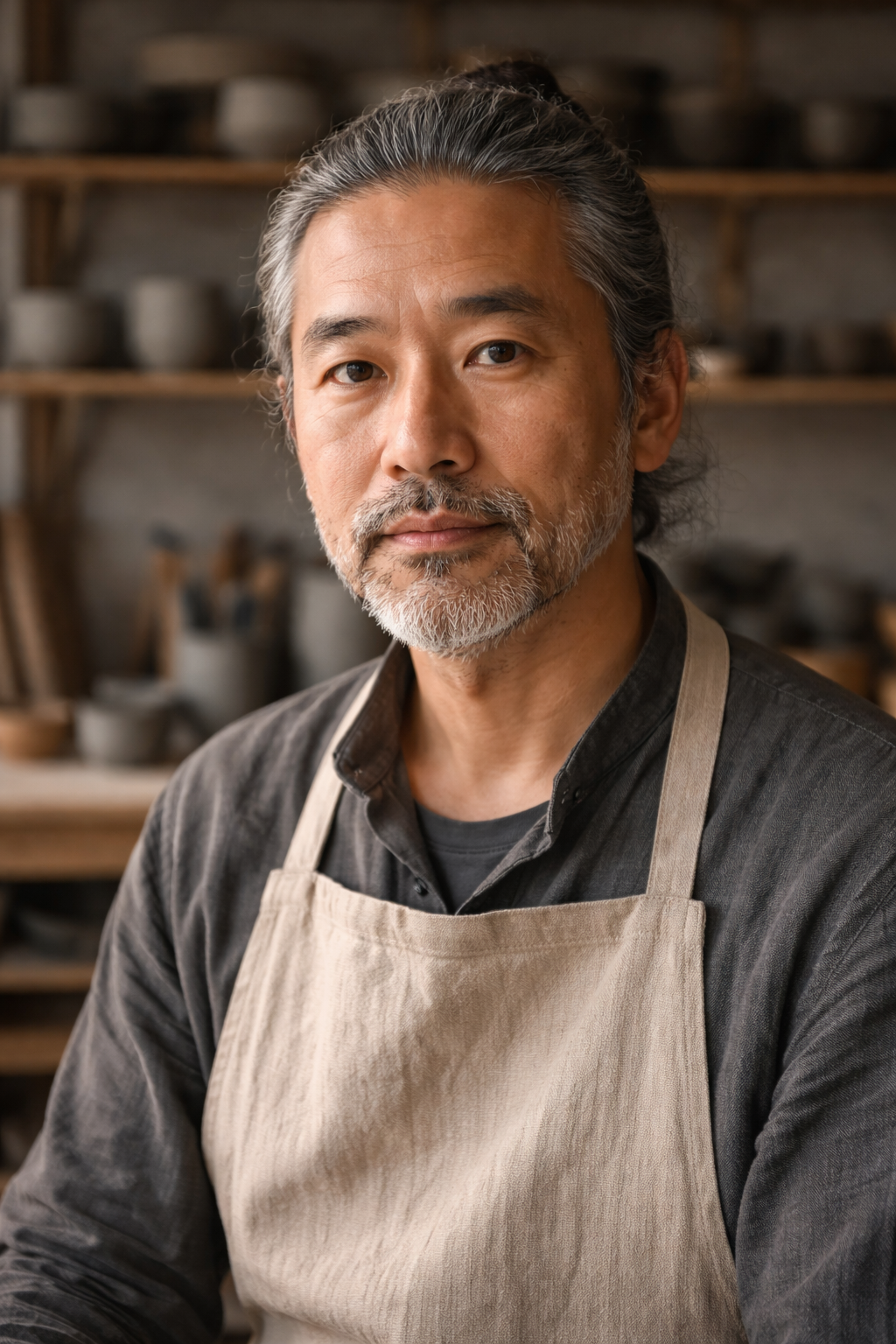
Hector Konomi is a Toronto-based ceramic artist whose work blends tradition, patience, and quiet purpose. Known for handcrafted teapots and functional vessels, his practice is rooted in Japanese Tokoname teaware and shaped by a life spent listening closely to materials.
Born near the Bohai Sea, Konomi grew up surrounded by natural clay and everyday handmade objects. As a child, he spent time along riverbanks, touching mud and shaping it by hand. Those early moments left a lasting impression. They taught him that useful objects can also hold memory and meaning.
As a young adult, Konomi moved to Japan to study fine arts in Tokyo. While there, he discovered Japanese ceramics and tea culture. He was drawn to Tokoname ware for its balance, restraint, and deep respect for function. What began as curiosity turned into commitment.
Konomi later trained in Tokoname City, one of Japan’s Six Ancient Kilns. He worked within a traditional kiln community and became associated with the Daikōji kiln. Through years of disciplined practice, he learned hand-forming techniques that value patience, repetition, and quiet refinement.
After his training, Konomi established his studio in Toronto. There, he continues to make kyusu teapots, tea bowls, and everyday vessels that feel calm and grounded in the hand. He works with iron-rich clays and embraces the natural influence of fire.
Alongside his studio work, Konomi shares practical writing on ceramics, offering clear guidance shaped by experience. Today, his work reflects a steady belief: when made with care, simple objects can carry history, culture, and human touch forward.
What is your typical day, and how do you make it productive?
I check the studio before anything else. Clay tells you quickly what needs attention. A pot left uncovered or drying too fast can ruin a week of work. I plan my day around the stage the pieces are in—forming, trimming, drying, or firing. Productivity for me is not speed. It’s keeping the process moving without interruption. I write a short list the night before and try to finish one physical task completely before starting another.
How do you bring ideas to life?
Ideas usually come from use, not imagination. I watch how a lid sits, how tea pours, how a handle feels after repeated use. If something feels slightly off, I remake it. Many of my forms come from remaking the same teapot dozens of times. Small changes add up. I rarely sketch. I learn through repetition.
What’s one trend that excites you?
I’m encouraged by people caring more about durability. Fewer objects, used longer. In ceramics, that means fewer decorative pieces and more functional ware meant for daily life. That shift matters.
What is one habit that helps you be productive?
Slow drying. It sounds simple, but it applies to everything. Rushing clay leads to cracks. Rushing decisions leads to mistakes. I build time into the process on purpose.
What advice would you give your younger self?
I would say that uncertainty is not a problem to solve. It’s part of learning. I spent years worrying about whether I was doing the “right” thing. The work improves when you stay with it.
Tell us something you believe almost nobody agrees with you on?
I think limitations improve creativity. Fewer tools, fewer glazes, fewer forms. Most people want more options. I’ve learned more by removing choices than adding them.
What is the one thing you repeatedly do and recommend everyone else do?
Make the same thing again. Mastery doesn’t come from novelty. It comes from repetition with attention.
When you feel overwhelmed or unfocused, what do you do?
I clean the studio. Not as avoidance, but as reset. Order in the space brings order in the mind. Clay dust everywhere means I’ve lost focus.
What is one strategy that has helped you grow your business or advance in your career?
Staying rooted in a specific tradition. Training in Tokoname gave me a clear framework. I didn’t try to do everything. I focused deeply on one lineage and translated it honestly into my current environment.
What is one failure in your career, how did you overcome it, and what lessons did you take away from it?
Early on, I rushed a kiln load before winter. Several pieces cracked because they weren’t dry enough. It cost time and materials. The lesson was simple: fire doesn’t forgive shortcuts.
What is one business idea you’re willing to give away to our readers?
Open studios that focus on use, not sales. Invite people to brew tea with the work. Let objects explain themselves.
What is one piece of software that helps you be productive? How do you use it?
A basic notes app. I log clay bodies, firing results, and glaze tests. No automation. Just clear records.
Do you have a favorite book or podcast you’ve gotten a ton of value from and why?
I often return to books on anthropology. They remind me that objects are cultural records, not trends.
What’s a movie or series you recently enjoyed and why?
Documentaries about food or craft. They show patience without dramatizing it.
Key learnings
- Long-term growth often comes from focusing deeply on one tradition or system rather than chasing variety.
- Repetition and restraint can lead to stronger results than constant innovation.
- Sustainable practices often emerge naturally from traditional methods.