
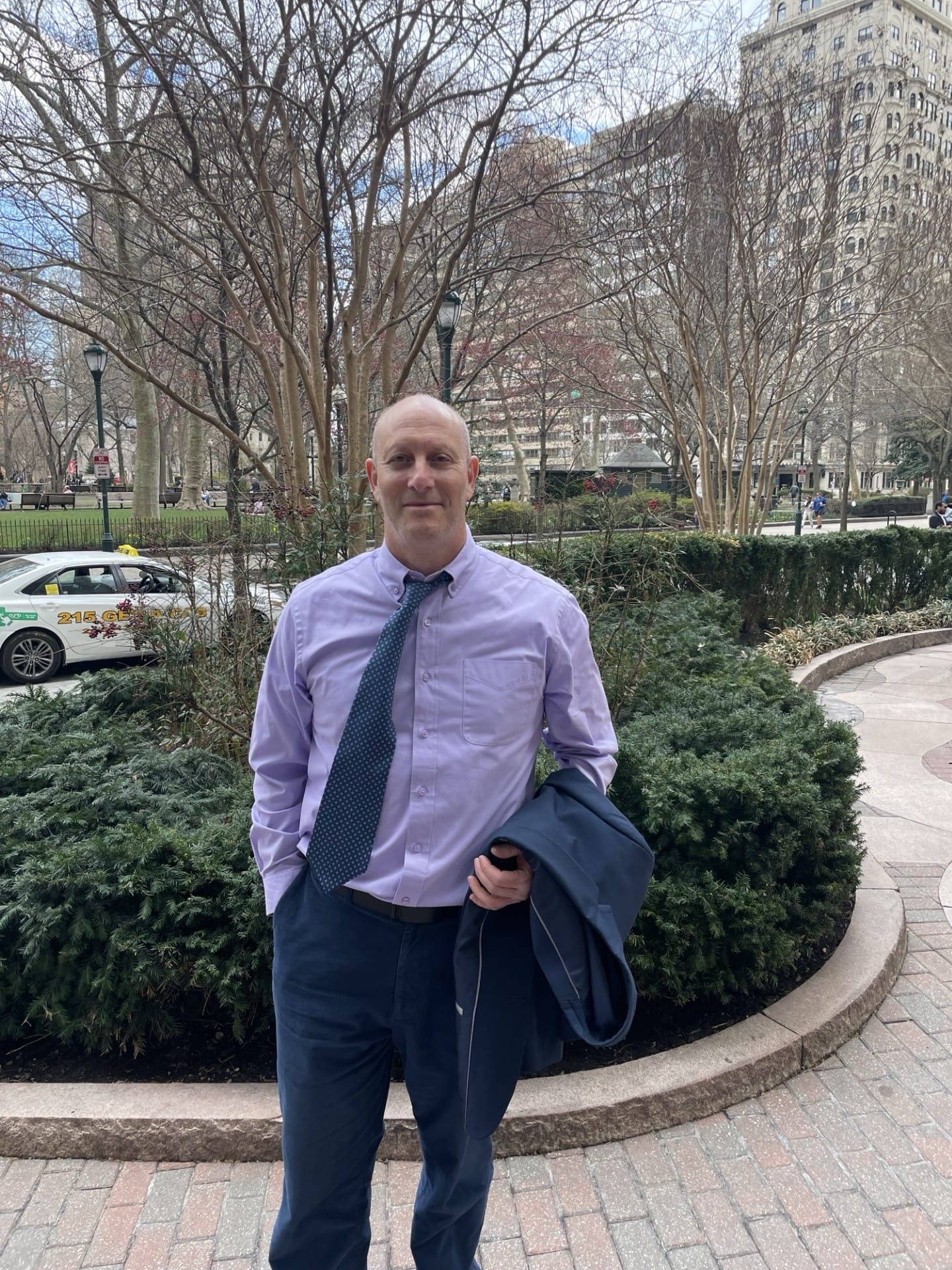
Dr. Andre Posner, DO was born in Dakar, Senegal, while his parents were volunteering with the Peace Corps. His dad was a doctor helping fight smallpox in Africa. That early exposure to global health stayed with him.
He grew up in Merion Station, Pennsylvania, in a home filled with family—his parents, grandparents, and six siblings. It was a busy, loving house where he learned the value of community and care.
Andre studied pharmacology at the Philadelphia College of Pharmacy and Sciences. Then he went on to earn his medical degree at Nova Southeastern University’s College of Osteopathic Medicine. From the start, he was drawn to treating the whole patient, not just their illness.
Over the years, he worked as a hospitalist at Frankford Hospital, Main Line Health, and now Penn Medicine. Along the way, he became known for teaching. He’s won several awards from hospitals and students who say he explains things clearly and makes them feel confident.
In 2021, he was named a 5-star physician by Suburban Life Magazine. He’s also received awards like the Faculty Award for Resident Teaching and the D. Stratton Woodruff Award for Excellence in Teaching.
Outside the hospital, Dr. Posner enjoys chess, meditation, and being in nature. He lives a life that’s thoughtful, calm, and rooted in purpose.
What is your typical day, and how do you make it productive?
I usually wake up early, before the sun rises. I like having quiet time to meditate and prepare mentally for the day ahead. On hospital days, I start rounds early—checking on patients, coordinating with other doctors, and helping residents understand each case. I break the day into sections: patient care, teaching, and administrative work. That structure helps me stay focused. I also set small goals for each shift, like improving a resident’s understanding of a diagnosis or getting all my notes done before I leave.
How do you bring ideas to life?
I believe ideas need to be tested in the real world to matter. For example, I noticed years ago that residents were overwhelmed by how to present patient cases. So I came up with a simple four-question framework to help them organize their thinking. I tried it out on a few students during rounds, and it worked. They kept using it—and started sharing it with others. That’s how I know something has legs.
What’s one trend that excites you?
I’m really encouraged by how mindfulness is becoming more accepted in medicine. For a long time, it was seen as a fringe idea. Now, more physicians are using it to manage stress and avoid burnout. I’ve practiced meditation for years, and it’s helped me remain centered in a very intense job.
What is one habit that helps you be productive?
Chess puzzles. I’ve been playing since I was a kid. Every morning I do a puzzle to get my brain firing. It’s a way of sharpening my thinking without being on a screen. That kind of mental exercise carries over into clinical reasoning and decision-making.
What advice would you give your younger self?
Slow down. When I was in medical school, I was always rushing—trying to finish the next thing, move on to the next goal. If I could go back, I’d remind myself to really enjoy the process of learning. Some of the best lessons happen in between the big milestones.
Tell us something you believe almost nobody agrees with you on?
I think boredom is useful. Most people avoid it at all costs, but I think those moments—like waiting for labs to come back or walking between rooms—are when your mind can really process things. That’s when insights show up.
What is the one thing you repeatedly do and recommend everyone else do?
Take walks in nature without your phone. No music, no podcast, just walking and observing. It’s how I reset my thoughts. Some of my best ideas come during those walks.
When you feel overwhelmed or unfocused, what do you do?
I open my meditation app and do three minutes of breathing. Just enough to calm the noise. Sometimes I’ll step outside between rounds and breathe fresh air, even for a minute. It helps me start fresh.
What is one strategy that has helped you grow your business or advance in your career?
Mentorship. I actively sought mentors when I started out, and I still lean on them. But mentoring others has probably taught me more than I expected. I’ve learned how to listen better and explain things in ways that really land. That’s probably why I’ve been fortunate to receive several teaching awards—I treat each teaching moment like it matters.
What is one failure in your career, how did you overcome it, and what lessons did you take away from it?
Early in my teaching, I was too focused on being the smartest person in the room. I thought I had to have all the answers. A senior colleague pulled me aside and told me that teaching wasn’t about showing off—it was about making space for others to grow. That shifted everything for me. I started asking more questions and letting students take the lead. It made me a better doctor, too.
What is one business idea you’re willing to give away to our readers?
A simple mobile app for residents to track “teaching moments” from their shifts. Just short notes they can review later. Like, “remember to ask about travel history in fever cases” or “don’t forget to recheck EKGs after electrolyte correction.” It could be private, or sharable across residency cohorts.
What is one piece of software that helps you be productive? How do you use it?
A basic notes app. I use it to keep track of interesting cases, reflections, or even things I want to look up later. Sometimes those notes become the start of a teaching session. It’s nothing fancy, but it keeps everything in one place.
Do you have a favorite book or podcast you’ve gotten a ton of value from and why?
The Art of Learning by Josh Waitzkin. It’s part memoir, part mental training manual. It resonates with me because it focuses on how people get better over time—whether in chess, sports, or medicine. It reminds me that learning never stops.
What’s a movie or series you recently enjoyed and why?
The Queen’s Gambit. Besides the obvious connection to chess, I appreciated how it showed the value of quiet focus and mentorship. It’s rare to see someone’s internal life portrayed so clearly.
Key learnings
- Building repeatable, simple frameworks can help others grow and improve performance under pressure.
- Strategic downtime—through walking or boredom—can unlock deep insight and clarity.
- Teaching is more powerful when it’s collaborative, not performative.
- Quiet daily rituals like chess, meditation, and note-taking provide focus and resilience in high-stress work.
- Mentorship is a cycle—giving and receiving both create meaningful professional development.