
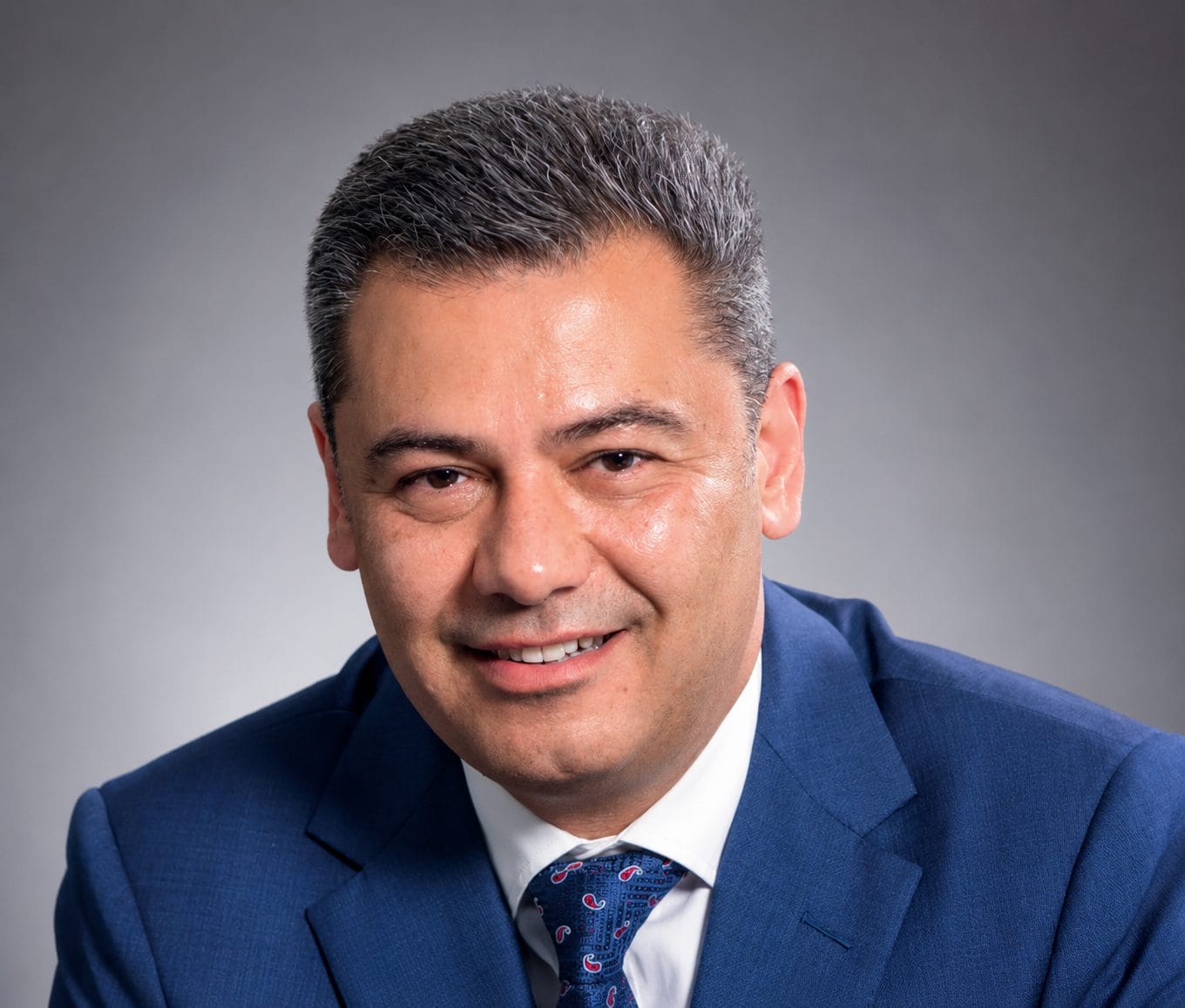
Burak Basel is a Cypriot entrepreneur and investor with nearly three decades of experience building and backing technology companies. As founder and Chairman of Basel Holding, he leads a global investment firm with portfolio companies spanning fintech, smart city infrastructure, and enterprise software across the United States, the United Arab Emirates, and Europe.
Basel began his career in 1996 developing CRM software for the tourism industry before pivoting to financial technology, working with financial services firms worldwide on home banking, payment systems, and revenue management. It was through that experience that he identified the role fintech could play in powering the next generation of smart cities, and Basel Holding was born from that insight.
Through Basel Holding, he provides strategic capital and operational support to companies building citizen-facing infrastructure, from Citizen-to-Government payment platforms and digital public services to smart kiosk networks. Portfolio highlights include Jova Digital, whose Smart Teller kiosks transformed access to government services across the UAE, and CorPayss, a payment technology platform built by veterans of the card industry.
Basel was named Tech Venture Finance Officer of the Year at the 2019 Global CFO Excellence Awards, and Basel Holding was recognised by CIO Review as one of the 20 Most Promising Smart City Solution Providers globally in 2020. Away from the boardroom, he is the founder of the Denkay Basel Social Development Foundation – established in memory of his late father – which has funded a fully equipped rehabilitation centre for children with disabilities in Kyrenia and sponsored the FIRST LEGO League Junior competition in Northern Cyprus. He is based in London.
What is your typical day, and how do you make it productive?
My week is built around three distinct modes of focus rather than a single daily routine. About 40 percent of my time goes to what I call strategic stewardship: the high-level direction of Basel Holding, capital allocation decisions, and working with our leadership team on where we are heading next. Another 30 percent is high-touch portfolio work, sitting in the engine room with our portfolio companies on growth, financial performance, and operational scaling. The final 30 percent I protect for horizon scanning: reading across sectors, cross-border networking, deepening my technical knowledge in areas I do not yet understand well enough.
What makes it productive is the separation. If I let portfolio firefighting bleed into strategic thinking time, I end up doing both badly. The discipline of keeping those modes distinct is the most important productivity habit I have.
How do you bring ideas to life?
By compressing the distance between insight and action. Most organizations let good ideas die in the gap between observation and decision. They analyze, then they consult, then they convene a meeting about the meeting. My approach is to collapse that cycle from weeks to hours wherever possible.
The critical caveat is that speed without accuracy manufactures mistakes faster. So the compression has to happen at the decision-making layer, not the thinking layer. I think carefully and then I move quickly. Slowing down the action without slowing down the analysis is the discipline that separates good execution from reckless execution.
What’s one trend that excites you?
By compressing the distance between insight and action. Most organizations let good ideas die in the gap between observation and decision. They analyze, then they consult, then they convene a meeting about the meeting. My approach is to collapse that cycle from weeks to hours wherever possible.
The critical caveat is that speed without accuracy manufactures mistakes faster. So the compression has to happen at the decision-making layer, not the thinking layer. I think carefully and then I move quickly. Slowing down the action without slowing down the analysis is the discipline that separates good execution from reckless execution.
What is one habit that helps you be productive?
Deliberate silence before decisions. I am, by nature, a listener rather than a talker. In most rooms, I will say relatively little until I have absorbed enough to have a view worth expressing. That habit gets misread sometimes as disengagement, but it is the opposite. I am processing. Every significant decision I have made at Basel Holding has been preceded by a period of listening that other people in the room might have found uncomfortably long.
The productive habit underneath that is simply this: I do not speak to fill space. When I do speak, it means I have decided something. That compression of signal-to-noise has saved me from more bad decisions than any analytical framework.
What advice would you give your younger self?
Choose your capital partner as carefully as you choose your co-founder. I learned this the hard way in the early years: not all money is created equal, and the wrong investor creates a cage around your business that no amount of operational excellence can escape. The right investor brings network, patience, and genuine understanding of your market. The wrong one brings urgency that is structurally incompatible with what you are trying to build.
The second piece of advice is less dramatic but more consistently useful: stop selling a story and start selling proof. The earlier you build the habit of grounding every claim in evidence, the faster you will earn the trust that actually matters.
Tell us something you believe almost nobody agrees with you on?
That silence is a competitive advantage in business. Most professional environments reward visible activity: the person who speaks most in meetings, who sends the most emails, who is most visibly busy. I think that preference systematically misidentifies who is actually doing the important work. The most consequential decisions in any organization are made by people who are thinking carefully in the background, not performing productivity for an audience.
I have built Basel Holding on a version of this principle. We move deliberately, we commit for five to seven years, and we make fewer but better decisions than firms that treat activity as a proxy for intelligence. The market periodically validates this and then forgets it again.
What is the one thing you repeatedly do and recommend everyone else do?
Interrogate your investment thesis at the point where it is most likely to be wrong. Every investor, every founder, every operator has a story they tell themselves about why their approach is correct. The productive habit is to identify the single assumption that, if false, would invalidate the entire thesis, and then to actively look for evidence that it is false.
At Basel Holding, the assumption we interrogate most often is the management quality of our portfolio companies. We believe management is the primary determinant of outcome. That belief should make us the most rigorous evaluators of management quality in any deal we consider, not the most charitable. The habit of stress-testing your own convictions is what keeps them honest.
When you feel overwhelmed or unfocused, what do you do?
I go back to first principles. When things feel overwhelming, it is almost always because I have allowed the immediate to crowd out the important. The antidote is not to work harder on the immediate. It is to step back and ask what actually matters here, and whether what I am doing right now is the highest-value use of my attention.
Practically, this means I will often stop what I am doing, leave the building if I can, and spend an hour on nothing but thinking. No email, no calls, no ambient noise. Just the question: what is the one thing that, if I resolved it, would make everything else easier or irrelevant? That question has never failed to reorient me.
What is one strategy that has helped you grow your business or advance in your career?
Treating management quality as the primary investment screen, above market size, above technology differentiation, above financial metrics. This sounds obvious but almost nobody actually does it. Most investment frameworks treat management as one factor among several. We treat it as the factor, and everything else as context.
The practical effect is that we pass on technically impressive businesses with weak leadership and back less glamorous businesses with exceptional operators. Over a five-to-seven-year horizon, that bet almost always pays off. Great operators find a way. Weak operators find a way to fail, regardless of how good the product is.
The Jova Digital deployment in the UAE is the clearest example. The technology in the Smart Teller kiosks was not unique in every component. What was exceptional was the team’s ability to navigate a complex government deployment, maintain relationships across multiple municipal clients, and execute a rollout to over 1,000 units without the wheels coming off. That is a management achievement, not a technology achievement.
What is one failure in your career, how did you overcome it, and what lessons did you take away from it?
Early in my career, I confused product quality with business viability. I built software that genuinely solved the problems it was designed to solve, and I assumed that quality would translate naturally into commercial success. It did not, at least not at the speed or scale I had assumed.
The lesson was that a great product without a clear path to the customer is not a business. It is an experiment. I had to learn, relatively late for someone in my position, that distribution is as important as the product itself, and that the skills required to build something excellent are entirely different from the skills required to take it to market.
I overcame it by being honest about the gap and finding the people who had the skills I lacked. That is also where my appreciation for management diversity came from: I learned from personal experience that the founder’s strengths are rarely the business’s limiting constraint. The constraint is almost always in the capabilities the founding team does not have.
What is one business idea you’re willing to give away to our readers?
A compliance-as-a-service layer specifically designed for fintech companies entering emerging markets. The single biggest barrier for good fintech products expanding into the Middle East, Eastern Europe, or Southeast Asia is not product quality and it is not market demand. It is the complexity and variability of regulatory environments that no small team has the bandwidth to navigate alone.
A firm that built deep regulatory expertise across ten to fifteen high-growth markets, packaged it as a service layer that fintech companies could plug into, and maintained it as regulations evolved would be solving a genuine and expensive problem. The market is large, the switching costs once embedded are high, and the problem gets harder to solve as more fintech companies try to expand internationally at the same time.
What is one piece of software that helps you be productive? How do you use it?
A well-structured data dashboard that consolidates portfolio performance metrics across our investments. I am not religious about which platform it runs on, but the discipline of having a single source of truth for the numbers that matter, updated in real time, and accessible anywhere, is what allows me to move between the strategic and operational modes of my week without losing the thread.
The most important feature is not sophistication. It is honesty. A dashboard that shows you what you want to see is worse than useless. The one I rely on is built to surface the metrics most likely to indicate a problem before the problem becomes visible in the headline numbers. Early warning over comfort.
What is the best $100 you recently spent? What and why?
A book I had been meaning to read for years and kept deferring. I will not name it because the specific title matters less than the habit. The most consistent return I get on any discretionary spending is on reading that has no immediate practical application. The ideas that end up changing how I think about an investment or a leadership decision are almost never the ones I was looking for. They arrive sideways, from a book I picked up for reasons that seemed tangential at the time.
Do you have a favorite book or podcast you’ve gotten a ton of value from and why?
I return often to case studies of companies that faced genuine crises and had to choose between short-term survival and long-term reputation. The Johnson & Johnson Tylenol case of 1982 is one I have referenced more times than I can count. When faced with a crisis that was not technically their fault, they chose a voluntary recall that cost them enormously in the short term and built the kind of trust that no marketing campaign could replicate.
The lesson I take from it is the same one I try to apply at Basel Holding: trust is the most valuable asset on your balance sheet, and it is built in moments of adversity, not in moments of comfort. Any book or case study that illustrates that principle clearly is one I consider worth the time.
What’s a movie or series you recently enjoyed and why?
I am drawn to stories about people who build things under constraints, whether those constraints are financial, institutional, or geographical. The narrative arc of a founder or leader who identifies a gap, builds something to fill it, and navigates the resistance that good ideas inevitably attract is the story I find most compelling, in fiction and in life. It is also, not coincidentally, the story I have spent thirty years trying to live.
Key learnings
- I built my investment philosophy around a single conviction: management quality determines a company’s outcome above market size, technology, or financial metrics. Every decision Basel Holding makes runs through that filter first.
- My career started with CRM software for the tourism industry in Cyprus in 1996. Three decades later we are deploying government service kiosks across the UAE. The through-line has never changed. Technology only matters if it removes friction from someone’s actual experience.
- Our five-to-seven-year investment lock-up is not a limitation. It is the point. Patient capital changes the decisions a portfolio company makes. It lets them build for genuine health instead of for the optics of the next funding round.
- The Denkay Basel Social Development Foundation runs on the same discipline I apply to investing. Good intentions are not enough. Sustainable impact means funding rehabilitation, education, and employment, not charity that ends when the attention does.
- The shift I am most convinced of is what I call the Delegated Economy. AI agents will manage personal finances autonomously within parameters you set, and money will simply stop being something you have to think about day to day.