
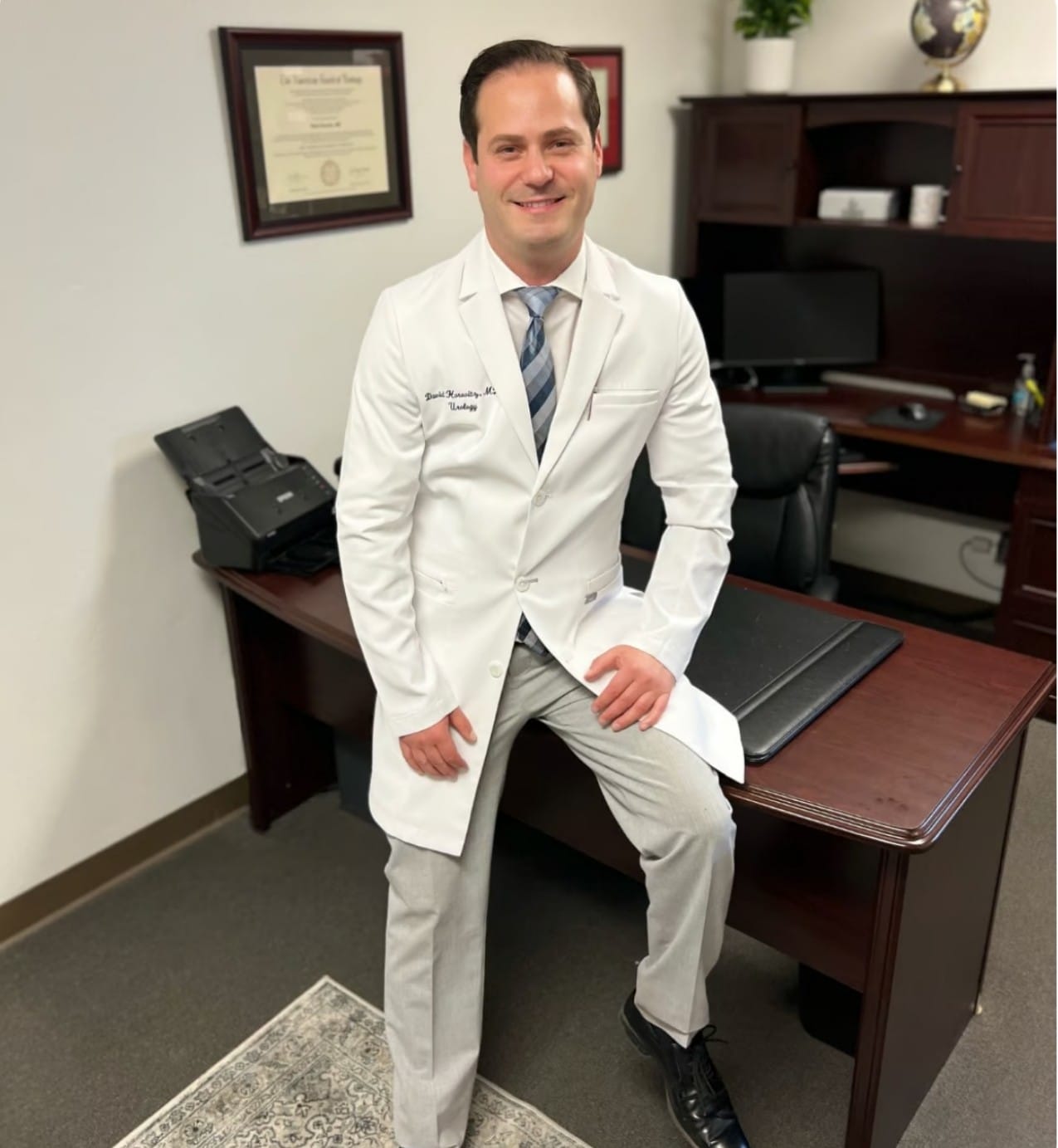
Dr. David Horovitz, MD completed his undergraduate degree in biology, first class with distinction, at York University in Toronto, Ontario, Canada. While studying there, he earned numerous accolades, including The Governor General’s Academic Medal, the prestigious award granted to an individual who obtains the highest academic standing in a bachelor’s degree program at the university upon graduation. He then went on to pursue his undergraduate medical education at the University of Western Ontario in London, Ontario, Canada.
Thereafter, he returned to Toronto to complete his urology internship and residency at the University of Toronto, Canada’s #1 academic institution and home to one of the largest departments of surgery in North America. While there, he trained with world-class surgeons at internationally renowned hospitals, including the Princess Margaret Cancer Center, Toronto General Hospital, Toronto Western Hospital, St. Michael’s Hospital, the Hospital for Sick Children, Sunnybrook Health Sciences Centre, and Mt. Sinai Hospital. After his residency, Dr. Horovitz completed a two-year Endourological Society-accredited clinical fellowship at the University of Rochester in Rochester, New York, in laparoscopic, robotic, and minimally-invasive surgery and endourology. Dr. Horovitz is a Diplomate of the American Board of Urology and a Fellow of the Royal College of Physicians and Surgeons of Canada, rendering him fully board-certified in urology in both Canada and the United States. He has published 12 peer-reviewed scientific journal articles and two textbook chapters, he and has given numerous presentations at international forums.
Dr. Horovitz has been serving the population of Kern County since opening his private practice in Bakersfield in 2019. His utmost priority is to deliver the highest quality of medical and surgical care to his patients. He takes great pride in staying current with the latest scientific and technological advancements so that he can incorporate new techniques and developments into his practice. As a physician, Dr. Horovitz believes in open communication to foster the development of strong interpersonal relationships with his patients. His philosophy of care is to always adhere to the values of empathy, compassion, and altruism when helping and supporting his patients throughout their clinical experience. He always includes them in shared decision-making by recognizing their individual views and unique perspectives.
What is your typical day, and how do you make it productive?
My typical day begins with an early morning wakeup, eating a nutritious breakfast, and then commuting to my office. On days where I have clinic, I begin by reviewing laboratory, imaging, and pathology results that have become available for patients that I saw in prior visits and are now available for viewing in my electronic medical record. I then look at my patient roster for the day and carefully review their chart, including all documentation provided by referring physicians for my new patients and all tests results that have become available for my follow-up patients. When my clinic begins, my wonderful team helps with checking patients in, taking their vital signs, and asking any pertinent information about their health. When I see patients in clinic, I try to get a full understanding of their particular issue by letting them speak and listening to their concerns. We formulate a plan together, taking into account their own individual goals, beliefs, and value system while ensuring that they receive the most up to date, evidence-based diagnostic and treatment strategies. In addition to these types of visits, my team and I also perform office-based procedures such as cystoscopy, transrectal ultrasound-guided prostate biopsy, urodynamic studies, Urocuff, renal/bladder ultrasound, circumcision, and vasectomy.
On surgical days, I would have reviewed all pertinent studies, including reviewing diagnostic imaging studies several days before. I meet with patients and their families in the pre-operative area alongside my surgical team, which consists of operating room nurses, scrub technicians, and anesthesia providers. All necessary paperwork is filled out and all final questions are answered. Once the patient is brought to the operating room and placed under anesthesia, a surgical pause is performed and I then lead the team by performing the operation – either open, endoscopic, laparoscopic, or robotic-assisted. After the procedure has concluded and the patient is woken up, they are brought to the Post-Anesthesia Care Unit and handover is given to the new team. I then contact the patient’s family members, either in person or over the phone, and update them on the details of the operation and next steps. If the procedure was performed on an outpatient basis, the patient is sent home with instructions regarding what to expect during the ensuing days and weeks. If they will be admitted to hospital for recovery, I will contact one of my hospitalist colleagues to facilitate admission, and we work together to ensure that the patient has a smooth, multidisciplinary, patient-centered recovery. Upon discharge, outpatient follow-up appointments are made so that I can see the patient back in clinic to answer any questions about their post-operative course and develop further care plans for them.
How do you bring ideas to life?
This is usually a process with multiple steps that begins with brainstorming, research, and real-world analytics. I gather ideas from several different places, including my staff members, patient feedback, colleagues, research articles, and professional forums and conferences. When an idea is solidified, I secure capital and determine if the project will be one that I should undertake alone or in conjunction with partner(s). Any concerns or objections are discussed in group meetings and action plans are created. This usually involves clear communication regarding the value of the idea and communication with any relevant consultants or other professionals. Roles, responsibilities, and timelines of all team members are created here and by the end of this step, it crucial that everyone has a clear understanding of their individual role, as well as how said role fits with everyone else’s. Execution of the idea is a complex step, but by this time, many hours would have already been spent preparing for a smooth delivery. Thereafter, it is essential to have continuous monitoring and malleability to ensure that any pitfalls are uncovered in a timely fashion and early adaptability is implemented. Sometimes, it is necessary to refine an approach to achieve the desired outcome.
What’s one trend that excites you?
A trend that I find very exciting is the widespread adoption of artificial intelligence. Once thought of as science fiction, this new technology has the potential to completely redefine our entire society and culture. It seems that the only comparable advancement seen over the current generation was the implementation and widespread use of the internet in the 1990s. The different realms that AI has the potential to influence are vast, and it will likely fundamentally change the way that procedures are performed in medicine, business, politics, and education, amongst others. Of course, with this new evolution also comes an entirely new set of ethical considerations, which have only now begun to surface, and new ideas and policy will surely be required to manage them safely and appropriately.
What is one habit that helps you be productive?
One habit that helps me be productive is maintaining a healthy lifestyle through diet and exercise. These are widely known to be beneficial not only for cardiovascular health but also for overall health in general. Staying physically fit is also beneficial for cognitive health and allows me to remain sharp in my thinking, allowing me to remain focused and disciplined. Being physically fit is very important when juggling many tasks at once, which often take place at various locations. Cognitively, it enables me to think with more clarity and make the best possible clinical decisions for my patients. I would always advocate for climbing the stairs over taking the elevator, playing sports over video games, and choosing a salad over an unhealthy side dish.
What advice would you give your younger self?
I would tell my younger self that when it comes to conquering challenges, obtaining goals, and progressing in business ladders and entrepreneurial activity, having strong communication and interpersonal skills is often as important as possessing knowledge and technical skills. Most people will assume that a person possesses the latter based on one’s credentials. However, to truly advance and convince others to want to help, they must first genuinely like you. No one person can do everything alone. The importance of this cannot be underestimated.
Tell us something you believe almost nobody agrees with you on?
The main purpose of a watch lies not in telling time.
What is the one thing you repeatedly do and recommend everyone else do?
One important practice is to trust others but to always verify yourself. This applies to all aspects of life. In my own medical practice, I am constantly double-checking that things are done properly whenever tasks are delegated to others. This holds true in business endeavors too. Not only does this practice help clarify that one particular issue at hand is performed correctly but it also helps identify system errors that may be able to be corrected early.
When you feel overwhelmed or unfocused, what do you do?
At my core, I’m an optimist. Thus, it takes a lot for me to feel overwhelmed or unfocused. I think that part of the reason people feel this way is that they are perpetually living in the past or in the future. I try to make a point to live in the present as much as possible. The Japanese word for “crisis” is “opportunity,” which I find very interesting and intriguing. I like to envision challenging times as periods of growth – that way, I come out the other side stronger and more resilient than I was upon entering into them.
What is one strategy that has helped you grow your business or advance in your career?
Surrounding myself with expert, hard-working people has helped me tremendously in advancing my career. Being a complete jack of all trades and carrying out operations perfectly on one’s own is simply not a reasonable or realistic goal for most. One must first decipher what tasks need to be accomplished and then find people with specific expertise in various areas to carry out the tasks. Networking is very important in doing this, as you can often find really great people and get really good ideas from others with whom you know who have navigated similar waters.
What is one failure in your career, how did you overcome it, and what lessons did you take away from it?
At one point, I, along with several other surgeons in town, decided to invest in a surgery center. This seemed like a great opportunity at the time, and we were all quite excited. We hired an outside consultant company to manage the logistical aspects and, unfortunately, the project never came to fruition. The management company ended up completely mismanaging the project, and before we all realized the problem, it was too late and we were in too deep. From this, I learned that while it is important to delegate tasks to experts, one must remain vigilant and have many checks and balances in place to ensure that what people promise is what ends up being performed.
What is one business idea you’re willing to give away to our readers?
I think that a product to help golfers locate lost balls would be a real winner – not that I would ever need something like that.
What is one piece of software that helps you be productive? How do you use it?
My electronic medical record is an absolutely essential part of my day-to-day practice. It allows me to store my patient notes, laboratory results, imaging studies, and pathology on a cloud, so that I can access it anytime and from anywhere. This software also allows me to schedule patients, send notes to other physicians, and make referrals. Plus, I never have to worry about theft of sensitive patient information, as was the case with old paper charts. One downside is that the software glitches from time-to-time, which occasionally means that I can’t access the charts temporarily. This can be a real problem if it occurs during clinic hours.
Do you have a favorite book or podcast you’ve gotten a ton of value from and why?
I really enjoy watching Rick Beato’s “Everything Music” channel on YouTube. His breakdown of famous songs and explanations of how the various parts relate to the music theory behind them are extremely interesting and inspiring. He also has great interviews with other musicians and producers, and this gives fantastic insight into how some of my favorite albums were created. I haven’t seen any other channel which goes into this amount of depth and still is palatable to the average music hobbyist.
What’s a movie or series you recently enjoyed and why?
I really enjoy watching documentaries related to various cultural events that have shaped our society.
Key learnings
- Wake up early, eat a nutritious breakfast, and prepare well in advance for the challenges of a busy day.
- Begin projects by brainstorming, researching, and gathering real-world analytics.
- Having strong communication and interpersonal skills is often as important as possessing knowledge and technical skills.
- Trust others but always conduct verifications yourself.
- Surround yourself with expert, hard-working people.