
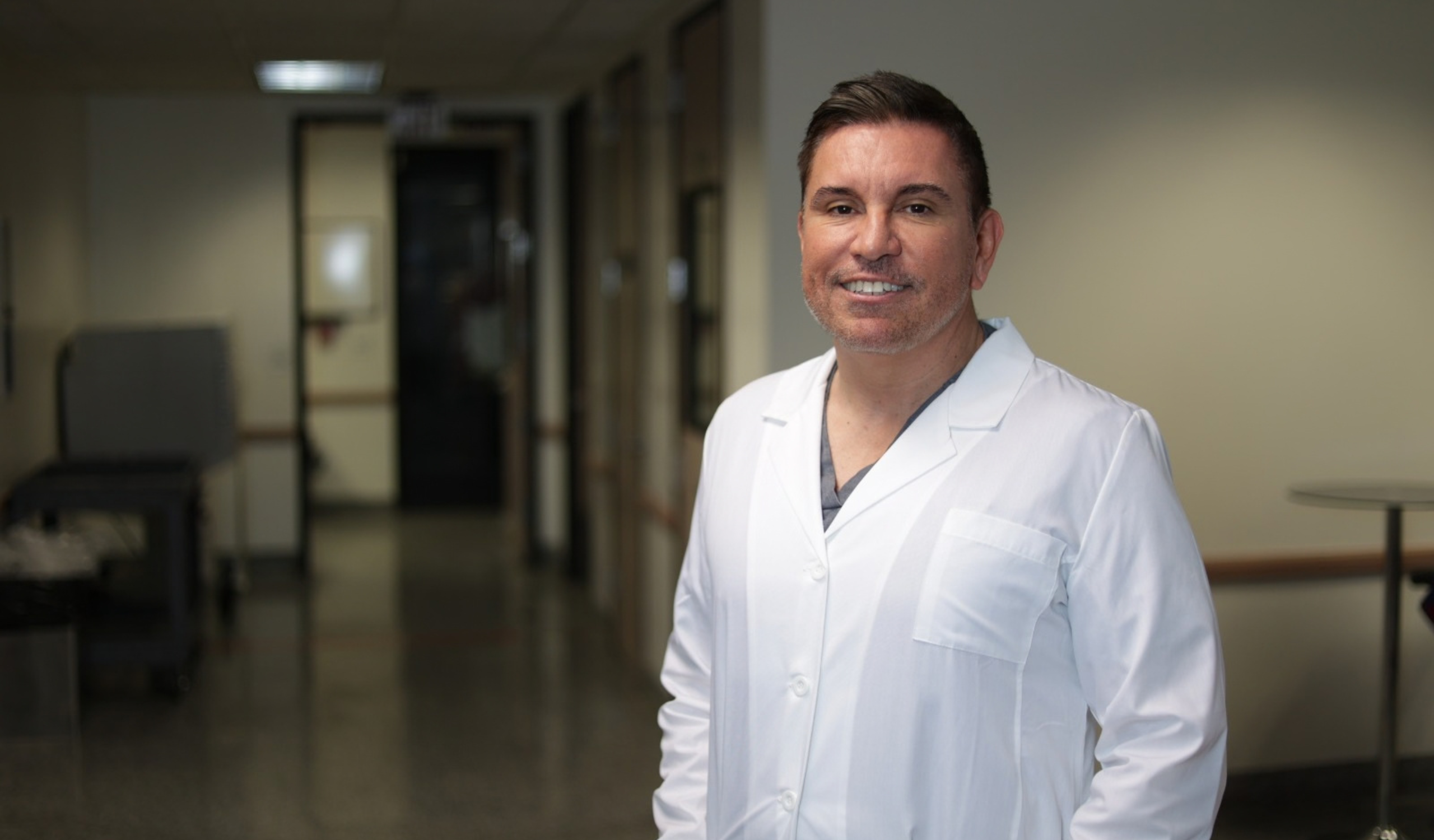
Feliciano Serrano, M.D., is a Los Angeles physician whose career has combined nephrology, interventional medicine, research, teaching, and community service. A native Angeleno, he grew up understanding both the diversity of Los Angeles and the challenges faced by families with limited resources. His parents taught him early to help people who had less, an idea that later became central to his work in medicine.
Serrano earned a Bachelor of Science in Biological Sciences from the University of Southern California before completing graduate studies in biological technology and genetics at California State University, Dominguez Hills. He later earned his medical degree from the Keck School of Medicine of USC and completed his internal medicine residency at White Memorial Medical Center in Los Angeles.
Wanting more tools to help patients with complex illnesses, Serrano pursued fellowship training in nephrology and hypertension at the University of Vermont School of Medicine. He also completed NIH-supported research examining thrombosis and platelet dysfunction in kidney disease and spent time lecturing and conducting research connected with Brigham and Women’s Hospital and Harvard.
He later completed specialised fellowship training in interventional nephrology and vascular procedures at the University of Arizona College of Medicine. His career has since focused on kidney and vascular care while continuing to reflect his interest in research, new methods, and underserved communities.
Serrano measures progress less by titles than by whether a method can be made better. His approach is rooted in empathy, perseverance, curiosity, and the belief that patient well-being should remain the priority.
What is your typical day, and how do you make it productive?
My days can change quickly because medicine does not always respect your calendar. I try to start by deciding what truly has to happen that day. Patient care comes first. After that, I make room for administrative work, reviewing cases, reading, and communicating with colleagues.
One thing I learned through research is that being busy and being productive are not the same thing. A laboratory can be busy all day and still produce poor data if the process is wrong. I try to apply the same thinking to my schedule. I focus on the work that actually changes the outcome rather than simply completing the largest number of tasks.
How do you bring ideas to life?
I start by asking whether the idea solves a real problem. Then I look closely at the mechanism behind it. In medicine, you cannot simply say that something sounds better. You have to understand why it should work, what could go wrong, and how you will measure it.
I have been criticised in the past for approaching dialysis differently from what was considered normal at the time. Years later, elements of that approach became much more accepted. That experience taught me not to abandon an idea just because it makes people uncomfortable. At the same time, you need evidence, patience, and a willingness to change your own thinking when the facts tell you to.
What’s one trend that excites you?
I am interested in the continued overlap between specialties. Medicine has historically divided the body into departments, but patients do not arrive divided into departments. Kidney disease can involve cardiovascular health, blood vessels, hypertension, clotting, and many other systems.
That is one reason interventional nephrology interested me. It requires you to think beyond one narrow area and understand how several systems interact.
What is one habit that helps you be productive?
I review my own methods. If something takes too long or repeatedly creates the same problem, I ask whether the process needs to change. I believe success is often measured by improving the mechanism rather than staring only at the outcome.
What advice would you give your younger self?
I would tell myself that hardship can become useful information. Growing up with economic limitations taught me things about people and communities that I could never have learned from a textbook.
I would also tell myself not to confuse disagreement with failure. Sometimes people question your direction because it is wrong, but sometimes they question it because it is unfamiliar. Learning the difference is important.
Tell us something you believe almost nobody agrees with you on?
I believe the process can sometimes matter more than the immediate result. People naturally want to judge everything by outcomes, but outcomes can be influenced by many factors outside your control.
If you build the right mechanism, study it carefully, and keep improving it, better outcomes usually follow. That mindset came from research and has stayed with me throughout clinical medicine.
What is the one thing you repeatedly do and recommend everyone else do?
Talk to people outside your immediate circle. Some of my most useful learning has come from working with people in different specialties, institutions, and communities. Collaboration can expose assumptions you did not even realise you were making.
When you feel overwhelmed or unfocused, what do you do?
I simplify the problem. Medicine teaches you very quickly that panic does not improve decision-making. I identify what is most important, deal with that first, and then move outward from there.
Outside work, I also value balance. Hiking and being outdoors can help clear my mind because there is no monitor, chart, research paper, or meeting competing for attention.
What is one strategy that has helped you grow your business or advance in your career?
I kept putting myself in environments where I had something new to learn. I went from biological sciences into genetics, medicine, internal medicine, nephrology, research, and eventually interventional and vascular procedures.
Each stage expanded my understanding of the previous one. I think careers become stronger when learning is cumulative rather than disconnected.
What is one failure in your career, how did you overcome it, and what lessons did you take away from it?
One difficult period came when I was scrutinised for supporting a different way of approaching dialysis. At the time, challenging an established method could easily be interpreted as challenging the people who had built it.
I kept focusing on the reasoning, the mechanism, and the patients. Over time, the approach became more widely accepted. The lesson was not that every unconventional idea is correct. It was that criticism alone is not enough reason to abandon an idea that has a sound basis.
What is one business idea you’re willing to give away to our readers?
I would create a bilingual health navigation service focused on explaining complex medical information in plain language before patients undergo major procedures or begin long-term treatment plans.
Many people do not need more information. They need someone to translate the information they already have into something they can understand well enough to make useful decisions.
What is one piece of software that helps you be productive? How do you use it?
I use digital calendar and note tools heavily. The important part for me is not the specific software but having one place where commitments, follow-ups, and ideas are captured. Medicine creates a tremendous amount of information, so anything that reduces the need to keep everything in your head is useful.
Do you have a favorite book or podcast you’ve gotten a ton of value from and why?
I tend to get the most value from medical and scientific reading rather than one particular book. Research trained me to enjoy following an idea across several sources and comparing how different people interpret the same evidence. I think that habit is more useful than attaching yourself too strongly to one author or school of thought.
What’s a movie or series you recently enjoyed and why?
I enjoy documentaries, especially ones about science, history, or people who had to persist through long periods when their ideas were not understood. I like seeing the years behind an achievement rather than only the final moment when everyone recognises it.
Key learnings
- Improving the process behind a result can be more valuable than focusing only on the result itself.
- Disagreement does not automatically mean an unconventional idea is wrong, but new ideas still require evidence, testing, and patience.
- Moving between different fields and specialties can create a broader understanding of complicated problems.
- Difficult personal experiences can provide insight that formal education cannot always teach.
- When work becomes overwhelming, identify the highest-priority problem first and simplify from there.