
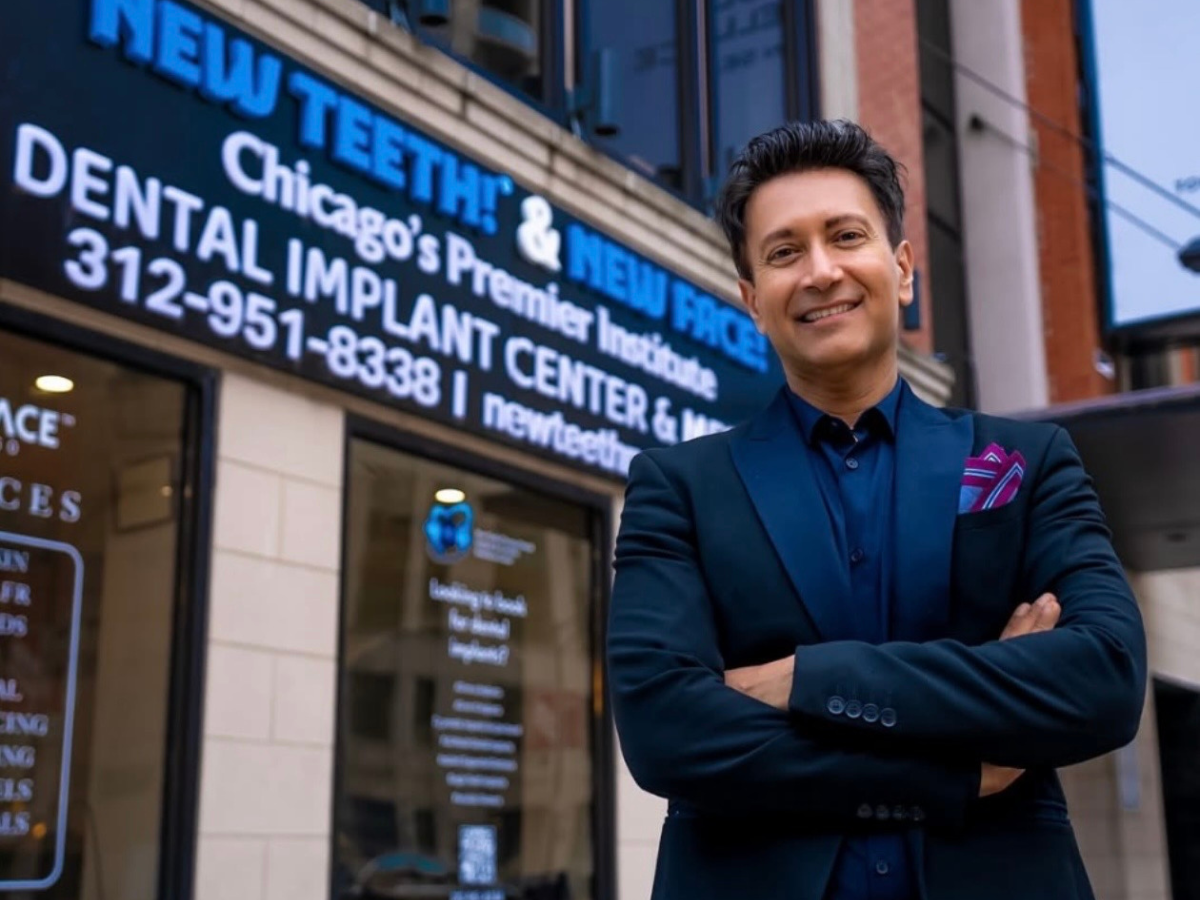
Dr. Irfan Atcha was raised in Chicago in a family with deep roots in medicine and dentistry. Surrounded by healthcare professionals from an early age, he developed an interest in science and patient care that eventually led him to pursue dentistry as a profession.
He earned a Bachelor of Science in Biochemistry from the University of Illinois before completing his Doctor of Dental Surgery degree at the University of Illinois College of Dentistry in 1996. As he gained experience, he became increasingly interested in dental implants and full-mouth rehabilitation, particularly helping patients with complex dental conditions who often believed they had few treatment options.
Over nearly three decades, Dr. Atcha has grown New Teeth Chicago into a practice dedicated to advanced implant dentistry, digital treatment planning, and full-mouth reconstruction. His commitment to continual education led him to earn Fellowship and Diplomate status with both the International Congress of Oral Implantologists and the International Dental Implant Association.
Dr. Atcha also serves as Chief Faculty at the Implant Efficiency Institute, where he teaches advanced implant techniques and full-arch rehabilitation to experienced dentists. In recent years, he has expanded his work through partnerships with providers in Florida and California while investing in healthcare-focused real estate that supports long-term access to care.
Outside the office, he enjoys running, fitness, and travel. He continues to seek new ways to improve patient care while sharing his experience with other clinicians and helping advance the field of implant dentistry.
What is your typical day, and how do you make it productive?
I rarely think about my day in terms of appointments. I think about it in terms of decisions. Every patient arrives with a different history, different expectations, and a different problem to solve. My job is to slow everything down, study the details, and make the right decisions before treatment ever begins. That mindset keeps me focused because every day presents a new puzzle rather than another item on a schedule.
How do you bring ideas to life?
I like to challenge my own ideas before anyone else does. If something sounds exciting right away, I’ll usually spend time looking for reasons it won’t work. I’ll ask colleagues for their opinions, think through different scenarios, and let the idea sit for a while. If it still makes sense after all of that, it’s usually worth pursuing.
What’s one trend that excites you?
I’m excited about how digital planning and artificial intelligence are improving implant dentistry. They’re making treatment more precise and helping us visualize procedures in ways we couldn’t years ago. At the same time, I don’t think technology replaces experience. It works best when it’s paired with good judgment and careful decision-making.
What is one habit that helps you be productive?
I review every complex case more than once. The first review is about the clinical plan. The second is about the patient. I ask myself if there’s anything I might be overlooking because every person has different concerns, expectations, and goals. That habit has probably prevented more mistakes than anything else I’ve done in my career.
What advice would you give your younger self?
I’d tell myself that confidence comes from preparation, not from pretending you have all the answers. Early in my career, I thought experience meant becoming faster and more decisive. Over time, I realized the opposite is often true. The more experienced you become, the more willing you are to slow down, ask another question, and look at a problem from a different angle. Patients benefit much more from thoughtful decisions than quick ones.
Tell us something you believe almost nobody agrees with you on?
I think patients sometimes receive too much information and not enough perspective. People can spend hours researching procedures online, but what they really need is someone who can explain how all of that information applies to their specific situation. Context is just as valuable as information.
What is the one thing you repeatedly do and recommend everyone else do?
Keep learning from people outside your own field. Some of the best ideas I’ve applied in dentistry came from studying leadership, business, and communication rather than dentistry itself. Good ideas rarely stay in one profession.
When you feel overwhelmed or unfocused, what do you do?
I change my environment completely. Sometimes that means going for a run, and sometimes it means taking a short drive without thinking about work. I’ve learned that forcing an answer usually doesn’t help. Stepping away for a little while often brings more clarity than sitting at my desk.
What is one strategy that has helped you grow your business or advance in your career?
I’ve always focused on becoming known for solving difficult problems instead of trying to do everything. Over time, patients and colleagues began referring complex cases because they knew that was where my passion was. Specializing gave me opportunities to keep learning, teach other dentists, and build relationships based on trust.
What is one failure in your career, how did you overcome it, and what lessons did you take away from it?
Early in my career, I believed technical skill was the most important part of being a dentist. Eventually, I realized communication is just as important. You can have the best treatment plan in the world, but if a patient doesn’t fully understand it or feel confident moving forward, you haven’t really succeeded. That lesson changed the way I approach every consultation.
What is one business idea you’re willing to give away to our readers?
I’d love to see a mentorship platform where experienced healthcare professionals regularly discuss real patient cases with younger clinicians. Some of the most valuable lessons I’ve learned came from conversations that never appeared in a textbook.
What is one piece of software that helps you be productive? How do you use it?
Our digital treatment planning software is something I rely on every day. It allows me to study complex cases from multiple angles before treatment begins and collaborate with my team so everyone is working from the same plan.
Do you have a favorite book or podcast you’ve gotten a ton of value from and why?
One book I’ve returned to several times is The Checklist Manifesto by Atul Gawande. It reminds me that consistency matters just as much as expertise. Small details repeated every day often make the biggest difference over time.
What’s a movie or series you recently enjoyed and why?
I tend to enjoy travel documentaries more than scripted shows. I like seeing different places and learning about how people live and work in other parts of the world. It’s a good way to unwind and often gives me ideas for places I’d like to visit.
Key learnings
- Expertise grows through curiosity, careful planning, and a willingness to question your own assumptions.
- Technology is most effective when it’s supported by experience and thoughtful clinical judgment.
- Mentorship and continuous learning create better professionals and better outcomes.
- Communication is just as important as technical skill when helping people make important decisions.
- Looking beyond your own industry can provide valuable ideas and fresh perspectives.