
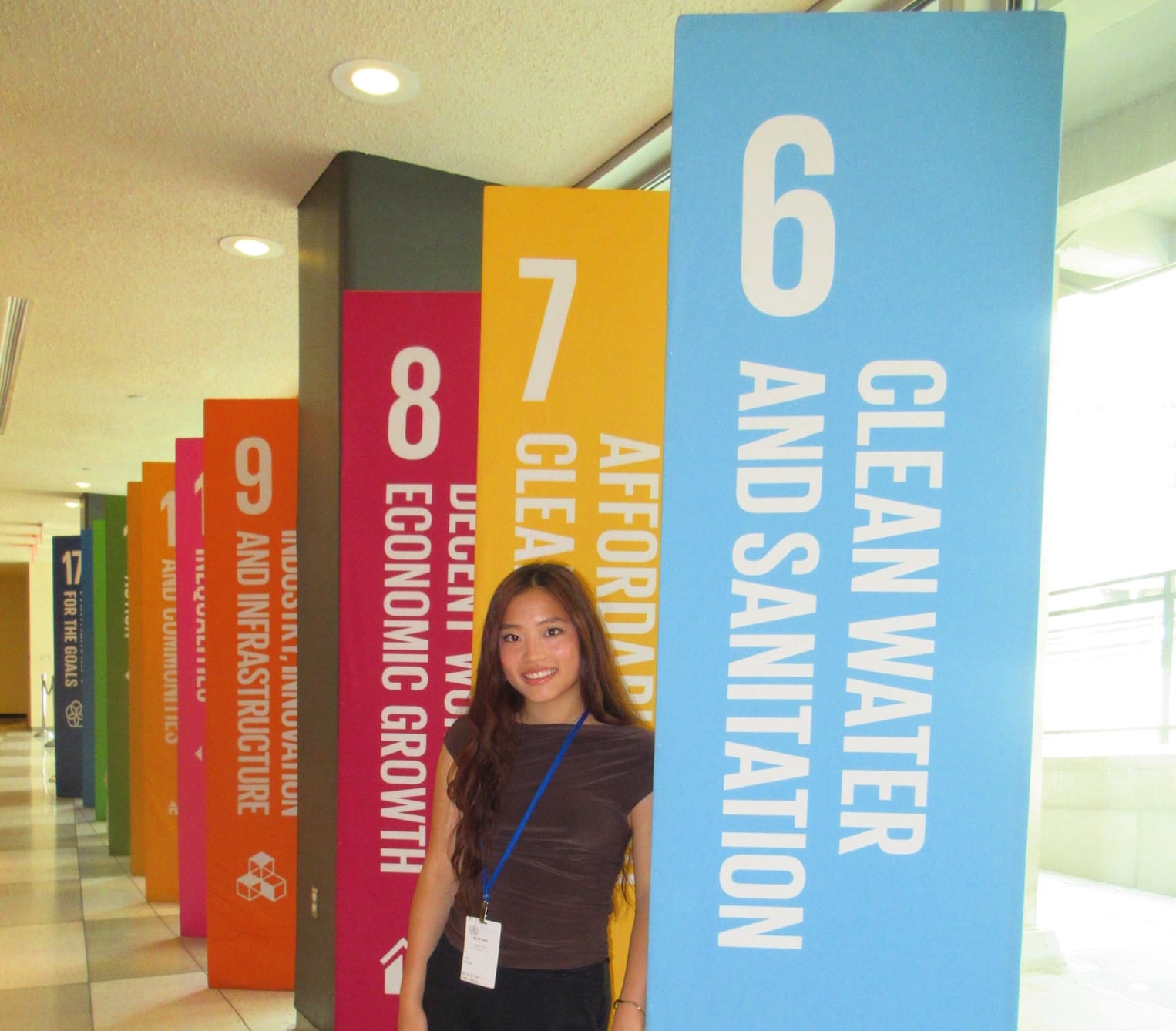
Vivian H. Liu’s goal is to inspire the next generation of science researchers through creative, accessible education. She believes creativity is what makes science stick, whether that means folding paper in a classroom or building lab-grade tools on a budget.
She is the co-founder of Origami For Good, a 501(c)(3) nonprofit that uses origami to promote mental wellness, sustainability, and hands-on learning through 300+ student-led chapters that have distributed over 820,000 folded pieces worldwide. She also co-founded Future Female Scholars, a free STEM tutoring platform connecting more than 1,700 teen tutors with students from underserved communities.
As a researcher, Vivian develops low-cost sensors for detecting waterborne toxins. Her project DiscSPR earned Grand and Special Awards at the 2026 Regeneron International Science and Engineering Fair, Best of Fair at the Fort Worth Regional Science and Engineering Fair, and a Stockholm Junior Water Prize state medal. She is a Simons Research Fellow at Stony Brook University, an American Junior Academy of Science Fellow, and a student at the Texas Academy of Mathematics and Science. Her work has been recognized with the Gloria Barron Prize for Young Heroes, the Princeton Prize in Race Relations, a TEDx talk, and a role as a UN Youth Delegate.
What is your typical day, and how do you make it productive?
This summer I’m at Stony Brook studying how urease breaks down urea inside cellulose nanofiber sponges, so my day starts in the lab around 9. Mornings are pipetting, running kinetics trials, and asking the PhD student I work with a ton of questions. I eat lunch outside if the weather cooperates, usually with a bag of shrimp chips involved. Afternoons I answer Origami For Good (origamiforgood.org) chapter emails and match tutors for Future Female Scholars (@future.female.scholars), which takes about an hour if I’m honest with myself and three if I’m not. After dinner I take a walk around the campus pond, then do the day’s write-up. The system that works for me is pretty simple!
How do you bring ideas to life?
I make a bad first version quickly. Origami For Good started locally with a batch of paper hearts we handed out at school to spread kindness and see if anyone cared. People did, so we made a folding guide, then a chapter kit, then it spread, using origami to teach science & policy! My science fair project DiscSPR worked the same way. Surface plasmon resonance instruments cost tens of thousands of dollars, so I tried to rebuild the sensing on a cheap spinning disc. The first prototype barely worked. It didn’t need to work well, it just needed to prove the idea deserved a second prototype.
What’s one trend that excites you?
Young people getting actual seats in policy rooms instead of photo ops. This July I attended the UN High-Level Political Forum in New York as a youth delegate with the UN Major Group for Children and Youth, in sessions where teenagers questioned member state representatives directly. The people who will live longest with decisions about water, climate, and education are starting to be in the room when those decisions get discussed, and institutions are slowly building permanent structures for it rather than one-off panels.
What is one habit that helps you be productive?
Walking without headphones! I loop the UNT campus in Denton, past the same heron and a log of squirrels, and at Stony Brook this summer it’s deer and an osprey nest. Stuck problems tend to sort themselves out by the end of a walk.
What advice would you give your younger self?
Please send the emails. In ninth grade I drafted a message to a professor asking about research, deleted it, and rewrote it for weeks before sending. The reply came in two days and led to my first lab internship, and paid (like whaaat)! Nothing about my qualifications changed in those weeks. Only the sending did.
Tell us something you believe almost nobody agrees with you.
Origami is a real science education tool, not just a traditional craft table activity. It teaches geometry, sequences, and precision with just a $0.20 sheet of paper, and engineers use folding patterns in solar arrays and heart stents. How cool is that?! I’ve taught workshops where kids who say they hate math follow a twenty-step fold perfectly. They can do the thinking. The teaching format was the problem.
What is the one thing you repeatedly do and recommend everyone else do?
Argue the other side. Before I defend a conclusion, I try to build the strongest case against it. The mathematician Carl Jacobi’s advice was “invert, always invert,” and it holds outside math. In the lab, I ask what would have to be true for my data to be wrong, which is how I’ve caught my own errors before a judge did. At the Institute for Youth in Policy, our whole curriculum is built on students steelmanning positions they disagree with. Most bad decisions I’ve watched people make came from never seriously visiting the other side.
When you feel overwhelmed or unfocused, what do you do?
I FaceTime my friends from back home and eat mint chocolate chip ice cream. We usually don’t talk about whatever’s stressing me, they just tell me what’s going on with them. An hour later I can look at my to-do list without wanting to close the laptop, so I pick one task and start there.
What is one strategy that has helped you grow your business or advance in your career?
Turning what we did in person into a curriculum anyone can teach. Origami For Good started as workshops I ran myself, which capped us at wherever I could physically be. So we wrote our environmental lessons down: folding pieces from recycled paper while learning why single-use waste matters, origami whales and sea turtles paired with short lessons on ocean plastic, that kind of pairing. Once a chapter lead in another city could run the same hour-long lesson from a doc, growth stopped depending on me. That curriculum is most of how we got past 300 chapters, and it’s what won us grants from the Awesome Foundation’s Conservation and Climate chapter ($1000), 2x Youth Service America ($2000), Gloria Barron Prize for Young Heroes ($10K) and more. The strategy in plain terms is to “write down the thing only you can do until it becomes a thing anyone can do.”
What is one failure in your career, how did you overcome it, and what lessons did you take away from it?
When we launched Future Female Scholars (futurefemalescholars.com), we had tutors signed up and almost no students showing up to sessions, because we were matching people by hand over email and half the sessions died in scheduling. We rebuilt around a proper signup and matching system and started posting on Instagram where students actually spend time, and the platform grew to over a thousand registered tutors and 140K+ followers. The lesson was that a service can be genuinely free and genuinely good and still fail if using it takes effort, so we now treat friction as seriously as the tutoring itself.
What is one business idea you’re willing to give away to our readers?
Operations software for youth-led nonprofits? Chapter agreements, volunteer hour verification, starter kit templates, and press contact lists are things every teen founder rebuilds by hand, and I built all of them in Google Docs for 100+ plus chapters. A twenty dollar a month product covering that paperwork would unlock thousands of student organizations currently stuck at one city because the founder is also the entire back office.
What is one piece of software that helps you be productive? How do you use it?
Google Sheets. When I helped run TAMS Fair, a mock presentation event where 25 plus research projects rehearsed before regional and international competitions, the entire event lived in one shared sheet, from judge schedules to project assignments to the valogram sales that funded it. One sheet let a whole officer team coordinate without meetings, and I’ve never found a fancier tool worth switching to.
What is the best $100 you recently spent?
Poster boards and presentation supplies for students in our ASPIRE program, which pairs TAMS students as one-on-one research mentors with kids in underserved Denton schools. Watching a middle schooler present a project on a board she designed herself was worth more than anything else that money could have gone to.
Do you have a favorite book or podcast from which you’ve received much value?
The Boy Who Harnessed the Wind by William Kamkwamba. He built a working windmill at fourteen from scrap parts and a library book, and I reread it before every science fair season as a reminder that equipment is rarely the real bottleneck to invention!
What’s a movie or series you recently enjoyed and why?
Lessons in Chemistry. A scientist gets pushed out of her lab and ends up teaching chemistry through a cooking show, and her audience learns real science without noticing. My work runs on the same bet, so it was satisfying to watch it succeed on screen.
Key learnings:
- A rough prototype built this week teaches more than a polished plan finished next month.
- Writing your process into a curriculum lets a project grow past the founder’s calendar. (And makes it accessible to others!)
- Arguing the opposite side of your own conclusion catches errors before judges and reviewers do. It is so, so important to consider every angle.
- A free service still fails if using it takes a ton of effort, so treat friction as a real cost.
- Cold emails have a low reply rate and an outsized return for people just starting out. Never be afraid to shoot your shot!