
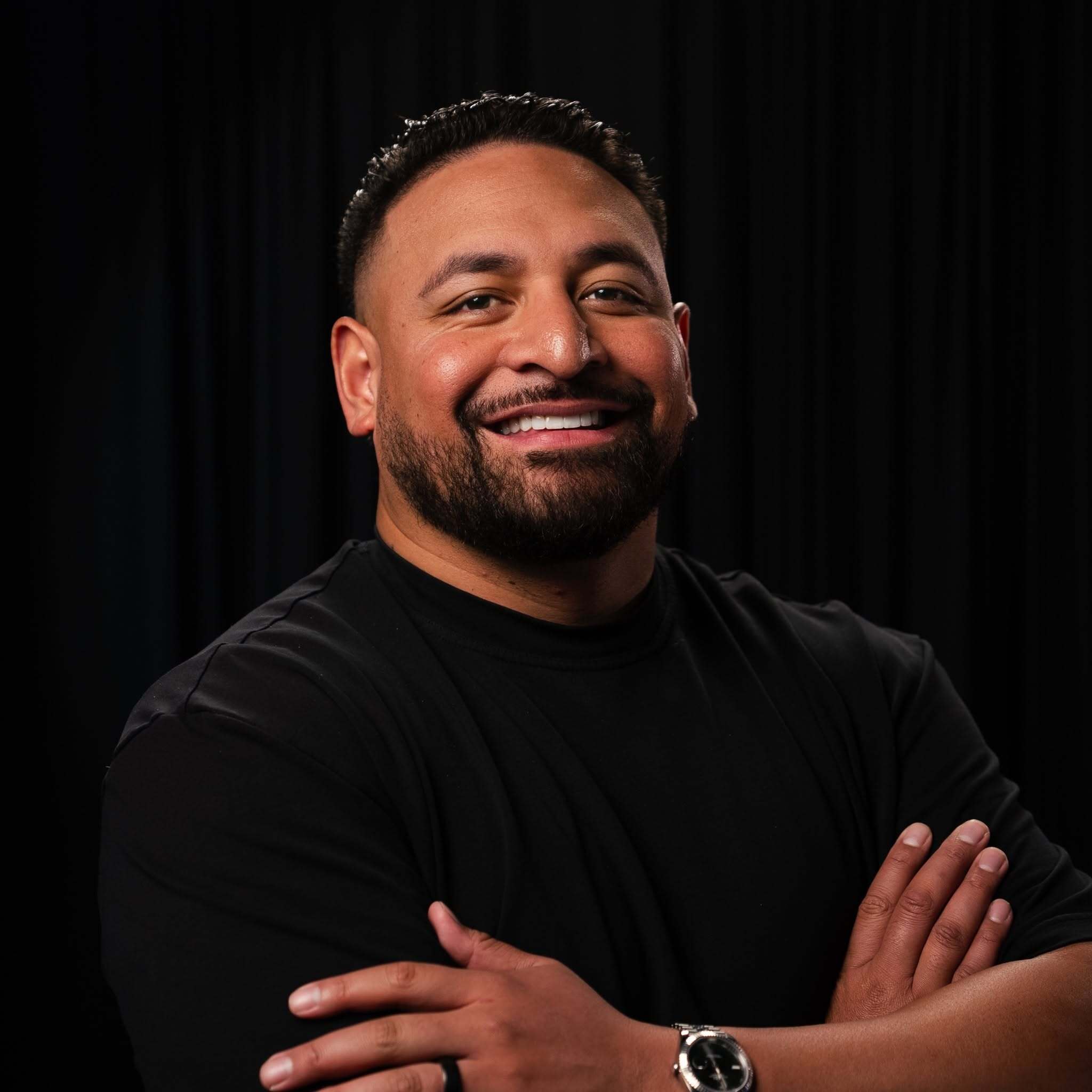
Lamè Kinikini grew up watching his father build a life from the ground up through grit, discipline, and faith. His dad never cut corners and never made excuses, but Lamè also saw the cost of that hard work: time away from family, sacrificed to make ends meet. That tension shaped how Lamè would come to think about success.
Raised to follow the traditional path of school, a good degree, and a safe career, he set out to become a doctor, drawn by the promise of stability and respect. Everything changed one summer when he earned over $100,000 in just a few months selling door-to-door. The number was so far outside what his family had ever seen that his own father struggled to believe it. For Lamè, it was a turning point. There were smarter, faster ways to build wealth than the grind he’d always been told to accept.
But that same opportunity carried a familiar cost. The work that gave him financial freedom pulled him away from his wife and kids, from the milestones, the family events, and the ordinary moments he could never get back. He refused to keep trading presence for income.
Real estate became the answer. Through creative financing and data-driven investing, Lamè built a portfolio that gave him back his time while creating real, long-term wealth. It was proof that providing for your family and being present with them don’t have to be mutually exclusive.
What started as a real estate strategy soon revealed something bigger. As Lamè dug deeper, he saw that short-term rentals weren’t only an income stream. They were one of the most powerful and legitimate tools available for people to keep more of what they earn. Through cost segregation, bonus depreciation, and material participation, STR investing offers a tax advantage that isn’t a loophole or a gray area, but a clear, intentional choice written into the tax code and protected by real estate. For earners watching a large share of their income disappear each year, it became a way to retain their income rather than surrender it.
He founded Elk Ridge Investments to make that same path available to everyone else. The company helps everyday people step into real estate without the stress of being a landlord or managing the chaos behind the scenes, focusing on deals that cash flow, appreciate in value, and deliver significant tax benefits. Through it all, family, faith, and service remain at the heart of everything the company builds.
What is your typical day, and how do you make it productive?
Honestly, my day doesn’t look like the “5am cold plunge, gratitude journal” thing everybody posts about. It starts early because I’ve got four kids, and mornings are non-negotiable family time before anything else touches my phone. That’s the one rule I don’t break. I spent too many years in door-to-door trading presence for income, and I promised myself I wasn’t doing that again once I had the choice not to.
Once I’m actually working, my day is really just triage between two things: where are the deals, and where are the fires. Mornings are usually deal flow: underwriting, looking at what’s come in from sellers, figuring out what actually pencils once you run the real numbers on a creative finance structure. Afternoons are operations and people: checking in with my team, capital partners, whatever’s actually on fire that day, because there’s always something on fire in this business. Short-term rentals are not passive, and I stopped pretending they were a long time ago.
The thing that actually makes it productive isn’t some system, it’s that I only let myself go deep on one problem at a time. I’d rather be really good at acquisitions and operations than mediocre at ten things. You can’t be a dog in five different fights at once.
And honestly, the biggest productivity unlock for me was just deciding what I wasn’t willing to sacrifice anymore. Once family time was off the table for negotiation, everything else in my day had to get more efficient to make room for it
How do you bring ideas to life?
For me, ideas don’t get brought to life in a boardroom, they get brought to life by taking action on whatever’s actually in front of me. I look back at my life and almost none of my big moves came from some grand vision. I broke my leg playing football and ended up auditioning for the school musical because it was the only thing available to me at the time. I got into Airbnb because I hated moving and didn’t want to get rid of furniture. I got into creative finance because I had a line of credit and needed a faster way to buy than 20% down on every deal. None of that was planned. What I’ve learned is you don’t get the big picture handed to you. You take the next right action, and the big picture reveals itself looking backward.
So when I have an idea now, I don’t sit on it and try to perfect it in my head. I test it against something real as fast as I can. Talk to an investor. Underwrite a deal. Make the call. You find out what’s actually true a lot faster by doing than by planning.
What’s one trend that excites you?
The trend that genuinely excites me is how the whole short-term rental space is finally maturing past the gold rush. During COVID, anybody could throw a bed in a house and call themselves an investor, and honestly that hurt the space more than it helped it, because now everyone thinks “Airbnb” and pictures oversaturation, algorithm fatigue, all that noise. What excites me is that the shakeout already happened. The people who got in for easy money left when it stopped being easy, and what’s left is a smaller pool of operators who actually understand the tax mechanics, the demand side, the ops side. That’s a much better environment to build in than the one I started in.
The bigger trend underneath that is how much more sophisticated high earners are getting about the tax code. Cost segregation, bonus depreciation, material participation. Five years ago almost nobody outside real estate professionals had heard of any of that. Now I’m having those conversations regularly with physicians, attorneys, people who just had a liquidity event, and increasingly their CPAs are the ones bringing it up first. That shift, from us having to educate the market to the market already showing up educated, is a big deal for where this goes next.
What is one habit that helps you be productive?
I’m intentional about what I let into my head every day. Specifically what I consume on social media. Most people just let the algorithm feed them whatever, but I actively curate mine. I unfollow anything that isn’t adding value and I follow the people who are playing at a higher level than me, so when I open my phone I’m looking at high-level content, not noise. That sounds small, but I learned a long time ago in door-to- door sales that your mental state is your most valuable asset in this game. When you’re dialed in and confident, you perform, and when you’re not, nothing else matters. So I treat what I put into my mind with the same discipline I’d put into anything else.
What advice would you give your younger self?
If I could talk to that version of me, sitting on a curb after a brutal rookie week in door-to-door ready to call it quits, I’d tell him the same thing I still remind myself now: you’re more capable than you’re telling yourself, you just haven’t done enough yet to prove it to yourself. The game was never about whether I was good enough. It was about whether I was willing to keep working long enough to find out.
Tell us something you believe almost nobody agrees with you.
That real estate is not passive income, and anyone selling you that idea is lying to you to sell something a course, a book, a deal. I say this constantly and it does not make me popular in this industry, because “passive income” is basically the whole marketing engine real estate investing runs on. Everybody wants to believe they can buy a property and have money show up while they sleep. I believed that too, for about five minutes, right up until my first Airbnb, which I genuinely thought would run itself. It does not run itself. None of it does. The people I know who are actually winning in this space are obsessive about it. They eat, sleep, and breathe their operations. The second you treat it as passive, you’ve basically just parked your money in a high-yield savings account with extra steps and extra risk.
The other one, related to that, is that I think money is the easy part of this business, and most people have that backwards. Everyone assumes capital is the hard part, and that if they could just find the money, they’d be able to do the deal. In my experience it’s the opposite. Money is everywhere if you know how to find a deal worth funding. The actual hard skill, the rare one, is knowing how to structure and underwrite a good deal in the first place. Most people spend all their energy chasing capital and none of it becoming someone worth handing capital to. That’s backwards, and I don’t think most people in this industry want to hear it because it means the excuse of “I just need investors” isn’t really the problem.
What is the one thing you repeatedly do and recommend everyone else do?
The one thing I do constantly, and tell anyone who’ll listen to do, is put myself in proximity to people who are already playing at the level I want to get to. Not people who make a little more than me, people who make me feel like a beginner again. I’ve done this my whole career. Early on it was other door-to-door guys crushing numbers I hadn’t hit yet. Now it’s operators and investors doing deals bigger than mine. Every jump I’ve made has come right after I got close enough to someone to watch how they actually think, not just what they post. You cannot think your way into a new level by yourself. You have to borrow it from someone who’s already there until it becomes yours.
When you feel overwhelmed or unfocused, what do you do?
The first thing I do is have an honest conversation with myself, out loud if I have to. I’ve had the moment sitting on a curb, calling my dad, telling him I was done, where I let myself feel exactly how hard something was instead of pretending I was fine. But then I have to walk myself back to something true: I’m not going to die. My family isn’t in jeopardy. I can do hard things, I’ve proven that to myself over and over. That reframe alone does most of the work. Most overwhelm is really just your emotional state getting ahead of reality, and I learned a long time ago in sales that your state is the asset you have to manage it on purpose or it manages you.
After that, I go back to something small and concrete I can actually take action on. When I’m spinning, it’s usually because I’m thinking too big picture and not doing anything. So I’ll just pick one thing in front of me, underwrite one deal, make one call, and get a win, even a small one, to break the loop. And I’m careful about what I let into my head during that stretch, too. I curate what I’m consuming, who I’m around, because when I’m already low, the wrong input makes it worse and the right one, a conversation with someone playing a level up from me, or just leaning on my wife and my faith, brings me back fast.
The last piece is just remembering why I’m doing any of this in the first place. When work starts to feel like it’s costing me the thing I built it for time with my family that’s usually the actual root of the funk, not the business problem I think is bothering me. Reconnecting with that fixes more than people expect.
What is one strategy that has helped you grow your business or advance in your career?
The one strategy that changed everything for me was learning to use other people’s money and other people’s leverage instead of my own. Early on I was trying to scale by saving up my own capital, and I remember doing the math and realizing at that rate I could maybe buy three or four properties a year. That’s not a business, that’s a hobby. Once I got good at creative finance, negotiating directly with sellers instead of going through a bank, and then flipped the model so I was the one finding and structuring the deals while capital partners brought the money, everything opened up. That’s really the difference between working for income and building equity. Most people stay stuck because they’re trying to do it entirely with what’s in their own bank account. The skill that actually scales is being good enough at finding and structuring deals that money finds you.
What is one failure in your career, how did you overcome it, and what lessons did you take away from it?
I was dead wrong about being able to run two businesses at once and treat one of them as this passive side engine. Around 2020 and 2021, I had a VA company going alongside my real estate. Cold calling, SMS, that whole world was booming because everyone was suddenly hiring remote. I was making real money off of it, tens of thousands a month, and barely putting any time into it. I convinced myself that was sustainable. I thought I’d found a way to diversify and build a second income stream without it costing me anything.
Then the market shifted and AI came into that space fast, and that business basically collapsed. But the bigger problem wasn’t even losing that income. It was realizing, once I looked honestly at it, that trying to keep both businesses alive at the same time had been quietly starving my real estate business of the attention it actually needed to get better. I wasn’t as diversified as I thought. I was just split.
I shut the VA business down completely. That was a hard call in the moment because it felt like giving up a working revenue stream, but it was the right one. The second I went all in on real estate as the only thing, my operations got sharper, my deal flow improved, everything about the core business got healthier almost immediately. That’s really where my whole “be a dog in one thing” philosophy came from, not as a slogan I picked up somewhere, but as a lesson I learned the hard way after finding out I wasn’t as good at two things as I thought I was at one.
What is one business idea you’re willing to give away to our readers?
Here’s one I’d genuinely hand somebody: go build a business that rescues underperforming Airbnb listings.
There’s a stat I talk about a lot. Something like 60 to 70% of the income made on that platform goes to the top 5% of operators. Which means there’s this massive middle of listings just sitting there, owned by people who bought during COVID, thought it would run itself, and have no idea their photos, their pricing, their amenities, or their SEO on the platform are actively costing them money every single night that place sits unbooked or underpriced. Most of those owners don’t have the time, the skill, or honestly the interest to go learn algorithm mechanics and design optimization. They just want the number to go up.
So the idea is simple: build a service that goes in, audits an existing short-term rental, fixes the stuff that’s actually fixable, better photos, smarter pricing, the right amenities for that specific market, tightened-up SEO on the listing, and either charges a flat fee for the overhaul or takes a cut of the lift in revenue afterward. You’re not buying real estate, you’re not raising capital, you’re not taking on debt. You’re selling expertise to people who already own the asset and are leaving money on the table because they don’t know what they don’t know.
The reason I’d hand this away freely is because it doesn’t compete with what we do. We’re focused on acquisitions and the tax side. But if someone wanted to go all in on becoming the best in the country at just the operations and optimization piece, there’s a real business sitting right there, and honestly, the market needs more people doing it well.
What is one piece of software that helps you be productive? How do you use it?
Honestly, the piece of software that’s made the biggest difference isn’t something I use personally to run my day, it’s something we built for our investors. One of the trickiest parts of the short-term rental tax strategy is the material participation requirement. The tax code gives you a real, legitimate benefit, but you actually have to do the work to qualify for it. You can’t just own the asset and expect the deduction to show up. So we built a system that helps our investors plan out their hours ahead of time, track them as the year goes on, and stay organized against what the IRS actually requires to substantiate that participation.
It sounds like a small thing, but it solves the exact problem that trips people up. Most investors don’t fail to get the deduction because the strategy doesn’t work, they fail because they didn’t document it properly, or they didn’t realize how much of the requirement was on them to actively fulfill. Having a tool that keeps that front and center throughout the year, instead of investors scrambling to reconstruct their hours at tax time, is honestly one of the most valuable things we offer beyond the deal itself. It protects the whole reason someone got into this in the first place.
What is the best $100 you recently spent?
It actually wasn’t anything business-related, it was something small I bought to do with my kids. It sounds almost too simple to be the answer, but that’s actually the point. I’ve spent a lot of years building a career specifically so I’d have the freedom to spend $100 and an afternoon on something with them without thinking twice about it. The return on that isn’t measured in ROI, it’s measured in whether they remember it. Every big financial decision I make is in service of being able to say yes to the small ones like that without hesitation.
Do you have a favorite book or podcast from which you’ve received much value?
I’m not a big reader, if I’m honest, I’m much more of a podcast guy, and even beyond that, a huge amount of what I consume day to day is curated content on social media, because I’m intentional about following people who make me think at a higher level.
But if I had to pick books, two stand out. Rich Dad Poor Dad, for the obvious reason: it completely reframed how I think about debt. Most people are taught debt is something to avoid at all costs, and that book was the first thing that showed me debt is actually a necessity if you want to scale anything real. That one paradigm shift alone changed the trajectory of how I built my portfolio.
The other one is The Science of Sales. I like it even more than most of the classic mindset books because it’s not conceptual. It gives you an actual logical, repeatable process for how sales works. It’s not “believe in yourself and it’ll happen,” it’s “if you do this specific thing, this is what happens.” That mattered to me because sales is in everything. It’s in how you negotiate a creative finance deal, how you talk to an investor, how you raise capital. Understanding it as a science instead of a talent you either have or don’t was a huge unlock.
What’s a movie or series you recently enjoyed and why?
Honestly, I’d be lying if I gave you some clever answer about a show I’ve been binging, because the truth is most of my free time isn’t going toward that at all. When I’m off the clock, it’s going to my wife and my kids, and that’s genuinely not me trying to sound like the right answer, it’s the whole reason I built my career the way I did.
Key learnings:
- Short-term hard leads to long-term easy. Every day you pick the easy option instead of the hard one is a day you’re quietly signing up for a harder life down the road. That trade runs in both directions, and most people don’t realize which one they’re making until years later.
- Real estate is not passive income, full stop. Anyone selling you that idea is selling you something else. The people actually winning in this space treat it like the demanding, hands-on business it is. The second you treat it as passive, you’ve basically parked your money in a high-yield savings account with extra risk.
- Money is the easy part. The deal is the hard part. Most people think capital is the bottleneck. It’s not. If you’re actually good at finding and structuring a deal, money finds you. The rare skill isn’t access to capital, it’s being worth handing capital to.
- Success was never the number for me. It’s whether I’m building wealth without sacrificing presence with my wife and kids. I left good money once because it was costing me their time, and everything I’ve built since has been in service of not making that trade again.