
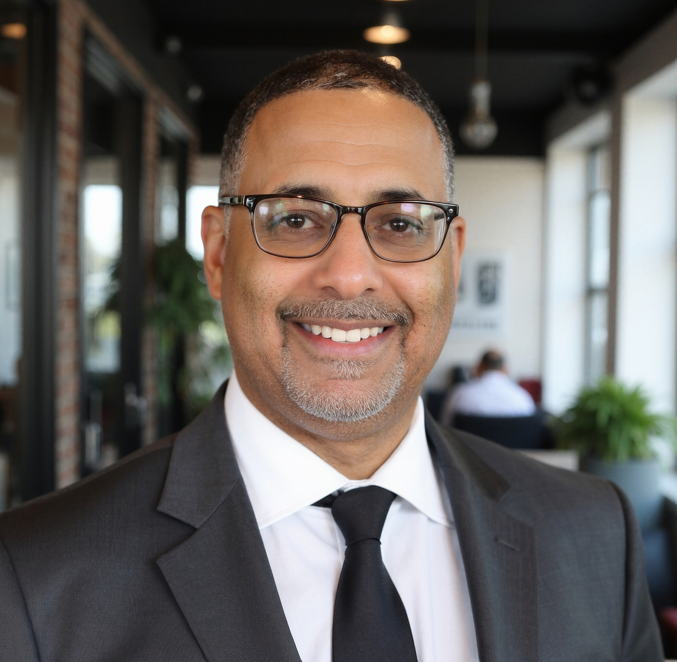
Omar Messado was born in Jamaica and came to the United States at age 10, growing up in Brooklyn, the Bronx, and New York City in a family where both parents had also come from Jamaica. His father worked as an electrical engineer for Con Edison, and his mother worked as a corporate secretary in the city. He attended Rice High School, graduating with first honors and a special award for business, then earned a BBA in Finance at Iona College. He later added coursework in financial planning at Pace University and, in 2012, an MS in Transportation Management from the Civil Engineering Division of Polytechnic Institute of New York University.
After several years in the Banking industry, his career took shape inside the procurement side of transportation, first at New York City Transit as an Associate Management Analyst supporting Car Equipment Engineering in the contract administration of its newest subway cars. After successfully managing four major subway contracts, his career progression in procurement transitioned to Kawasaki as a Contract Administration and Marketing manager, where he handled contract negotiations tied to rail equipment programs. From there he moved to the Metropolitan Transportation Authority, where he spent years directing procurement for Metro-North Railroad, covering rolling stock acquisitions, Positive Train Control initiatives, and equipment overhaul programs. He rose to Assistant Deputy Chief Procurement Officer, working directly with Metro-North leadership on operations, infrastructure, and design-build initiatives across the railroad. Today he works as a Procurement professional, applying the same discipline to sourcing, vendor management, and contract negotiation.
Outside of work, Omar rides with the Yonkers Bike Club and the Westchester Social Cyclist, swims mornings at the Ossining Recreation Center, and has volunteered as a Cub Master, Den Leader, and merit badge counselor for the Boy Scouts of America. He also gives time to the Ossining Food Bank and Pantry. Across roles, he has kept a habit of naming his next step in a career before he needs it.
What is your typical day, and how do you make it productive?
I start with a swim before anything else touches my morning. It clears the noise from the day before and gives me a blank page to work from. After that I go through open procurement items in order of what actually blocks other people’s work, not just what’s loudest in my inbox. I try to close small decisions fast so they don’t pile up into big ones.
How do you bring ideas to life?
I break an idea down into what it would take to actually execute it: cost, timeline, who has to agree, what could go wrong. Procurement operations as well as the acquisition of new trains, you have to think that way. An idea that can’t survive that kind of scrutiny probably needed more work anyway.
What’s one trend that excites you?
The shift toward design-build delivery on capital projects. It puts procurement people at the table earlier, when decisions are cheaper to change.
What is one habit that helps you be productive?
Writing down the next step before I close out a task, not after. It means I never open my day wondering where I left off.
What advice would you give your younger self?
Don’t wait for a title to start acting like the person you want to become. The habits come first.
Tell us something you believe almost nobody agrees with you on?
Most delays in big procurement programs aren’t caused by vendors. They’re caused by internal indecision that gets blamed on vendors because that’s easier to say out loud.
What is the one thing you repeatedly do and recommend everyone else do?
Read the contract again after it’s signed, not just before. People assume the work ends at signature. It doesn’t. It actually starts.
When you feel overwhelmed or unfocused, what do you do?
I swim. It’s not a metaphor for me, it’s a literal habit I picked up since I turned 50 and never stopped. I wished I did this earlier.
What is one strategy that has helped you grow your business or advance in your career?
I always identified the next role before I was fully settled into the current one. That meant I was building the skills for it early, instead of scrambling once the opportunity showed up.
What is one failure in your career, how did you overcome it, and what lessons did you take away from it?
Early on, I took a contract dispute personally instead of treating it as a negotiation problem to solve. I learned to separate the two. Once I did, resolving hard commercial disputes got a lot less stressful and a lot more effective. The idea is to maintain objectivity.
What is one business idea you’re willing to give away to our readers?
A subscription service that helps manufacturers, small and large track and compare supplier performance data, the kind of tooling large agencies build in-house but small shops can’t afford to.
What is one piece of software that helps you be productive? How do you use it?
A shared spreadsheet tracker for vendor deliverables against contract milestones. It’s unglamorous, but it catches slippage before it becomes a crisis. Lately, I have learned to embrace the use of artificial intelligence to do these and more.
Do you have a favorite book or podcast you’ve gotten a ton of value from and why?
‘The Great Bridge’ by David McCullough. This and a few other good ones remind you that a deal isn’t won by who talks loudest, it’s won by who understands the other side’s constraints better.
What’s a movie or series you recently enjoyed and why?
I like history and therefore I like a good documentary series on how things come to be. Watching how past generations innovated new ideas, built complex things and solved supply and materials problems with far less technology than we have today puts current challenges in perspective.
Key learnings
- Personal routines, like a morning swim, can be a reliable way to manage stress and refocus before high-stakes decisions.
- Planning the next career step early, rather than waiting for an opening, builds relevant skills ahead of time.
- Treating contract disputes as negotiation problems rather than personal conflicts leads to better outcomes.
- Reviewing signed contracts on an ongoing basis catches issues before they escalate.