
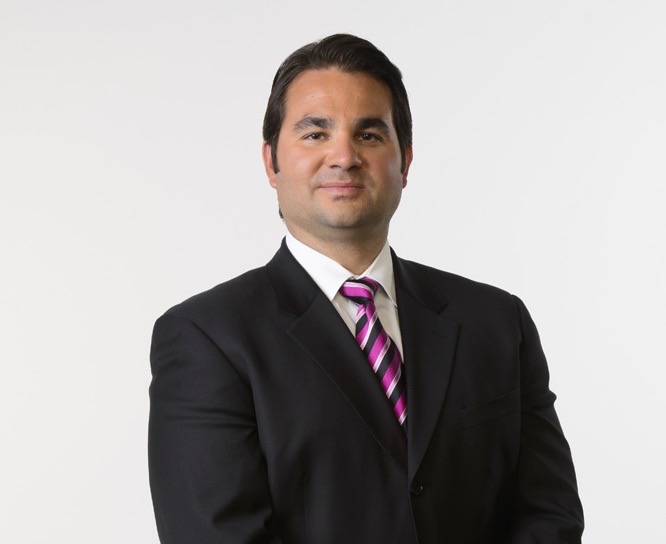
Growing up in New Jersey as the oldest of four brothers, Dr. Robert Guarino learned early that hard work and responsibility were part of everyday life. His parents worked blue-collar jobs and raised their children to value education, family, and keeping commitments.
Guarino took those lessons seriously. He graduated seventh in his class at Arthur L. Johnson Regional High School and earned a lacrosse scholarship to Rutgers University. There, he balanced college athletics with a demanding academic schedule and graduated with honors in biological sciences.
He continued his education at the University of Medicine and Dentistry of New Jersey–New Jersey Medical School, where he earned his medical degree. During his pathology residency at Saint Barnabas Medical Center, he served as chief resident before completing advanced fellowships in surgical pathology and breast pathology at The Mount Sinai Hospital in New York City.
Over the years, Guarino developed a career focused on breast pathology, medical education, and research. His work involves examining tissue, understanding disease, and contributing information that helps physicians make informed decisions. He has also taught medical students, sharing the knowledge and experience gained throughout his career.
Outside medicine, Guarino is a husband and father of three. He enjoys classic literature, golf, saltwater fishing, and European football. His enthusiasm for Inter Milan even led him to help establish a supporters club in New York City.
Despite the demands of his profession, Guarino continues to make room for family, personal interests, and learning. His life reflects a steady commitment to doing meaningful work while enjoying the experiences and relationships beyond it.
What is your typical day, and how do you make it productive?
My professional days involve reviewing pathology cases, evaluating microscopic findings, and communicating with other physicians when I need additional information. I try to begin with work that requires the most concentration. In pathology, rushing through something complicated rarely saves time. I would rather spend a few extra minutes understanding a finding than have to revisit it because I overlooked an important detail.
How do you bring ideas to life?
I start by identifying a specific problem. When I was involved in medical education, for example, I found it useful to think about what students were actually struggling to understand rather than simply presenting more information. If someone has difficulty recognizing a particular tissue pattern, the solution might be to compare several examples side by side. Small, practical changes often work better than complicated plans.
What’s one trend that excites you?
I’m interested in how digital pathology is developing. The ability to examine high-resolution tissue images digitally creates opportunities for consultation, education, and research. Artificial intelligence may eventually assist with certain repetitive tasks or help identify patterns worth closer examination. I find those possibilities interesting, although technology still needs careful validation and responsible use.
What is one habit that helps you be productive?
I keep notes about questions that deserve another look. They might concern an unusual pathology finding, a medical article, or something unrelated to work. Writing a question down prevents it from becoming another distraction. It also gives me something useful to return to when I have time to investigate it properly.
What advice would you give your younger self?
I would tell myself not to confuse being busy with making progress. At Rutgers, I balanced academics with lacrosse, so I got used to a demanding schedule. That discipline helped me, but I would remind my younger self that recovery and time away from responsibilities are important too. You can work seriously toward a goal without making every hour productive.
Tell us something you believe almost nobody agrees with you on?
I think people are sometimes too quick to treat uncertainty as a weakness. In medicine, saying that something needs further evaluation can be the most responsible answer. I would rather hear someone explain what they don’t yet know than offer a confident conclusion without enough evidence. That principle applies well beyond medicine.
What is the one thing you repeatedly do and recommend everyone else do?
Read something outside your usual interests. I enjoy classic literature because it lets me spend time with different ideas, personalities, and historical settings. Not everything you read needs to help your career. Sometimes reading something unfamiliar is valuable simply because it changes how you think.
When you feel overwhelmed or unfocused, what do you do?
I try to get away from whatever has been occupying my attention. Golf and saltwater fishing are two activities I enjoy because they take me into a different environment. Sometimes I also watch a football match. Following Inter Milan gives me something to enjoy that has nothing to do with medicine. I usually return to my responsibilities with a clearer perspective.
What is one strategy that has helped you grow your business or advance in your career?
I focused on developing specialized knowledge rather than pursuing every opportunity. After medical school, I completed a pathology residency at Saint Barnabas Medical Center and served as chief resident. I then pursued fellowships in surgical pathology and breast pathology at Mount Sinai. Each stage helped me build on what I had learned previously. Specialization gave my career direction while leaving plenty of room to continue learning.
What is one failure in your career, how did you overcome it, and what lessons did you take away from it?
One challenge I would point to is learning how to teach effectively. Early in my career, I sometimes assumed that explaining a subject thoroughly meant someone would understand it. That is not necessarily true. When a student remains confused, adding more detail may make things worse. I learned to ask where the confusion began and approach the subject differently. It taught me that communication is measured by what someone understands, not by how much information you provide.
What is one business idea you’re willing to give away to our readers?
I think there is room for a service that helps medical students practice explaining complicated medical concepts in plain language. Students could receive a clinical topic and practice explaining it to someone without a medical background. They would then receive feedback on clarity and accuracy. Understanding a subject and communicating it effectively are different skills, and both deserve attention.
What is one piece of software that helps you be productive? How do you use it?
A basic digital calendar is one of my most useful tools. I use it to organize commitments and make sure personal responsibilities receive attention alongside professional ones. With a family and a demanding career, it is easy for the week to fill up. Having everything visible in one place makes planning much simpler.
Do you have a favorite book or podcast you’ve gotten a ton of value from and why?
One book I would recommend is The Count of Monte Cristo by Alexandre Dumas. I enjoy its complex characters and how decisions made early in the story continue to affect people years later. It is entertaining, but it also raises interesting questions about ambition, justice, loyalty, and revenge. Those themes give you plenty to think about after finishing it.
What’s a movie or series you recently enjoyed and why?
One series I would choose is The Last Dance, the documentary about Michael Jordan and the Chicago Bulls. Having played competitive lacrosse at Rutgers, I find the dynamics of high-level team sports interesting. The series explores individual talent, personality, pressure, and the relationships between teammates. I particularly enjoyed seeing how differently people remembered the same events.
Key learnings
- Develop specialized knowledge through consistent learning and experience rather than pursuing every available opportunity.
- Recognize that uncertainty can be a reason for further investigation, not a sign of weakness.
- Make complicated information easier to understand by identifying where confusion begins.
- Maintain interests outside work to create opportunities for enjoyment, rest, and perspective.
- Read beyond familiar subjects to encounter different ideas and ways of thinking.