
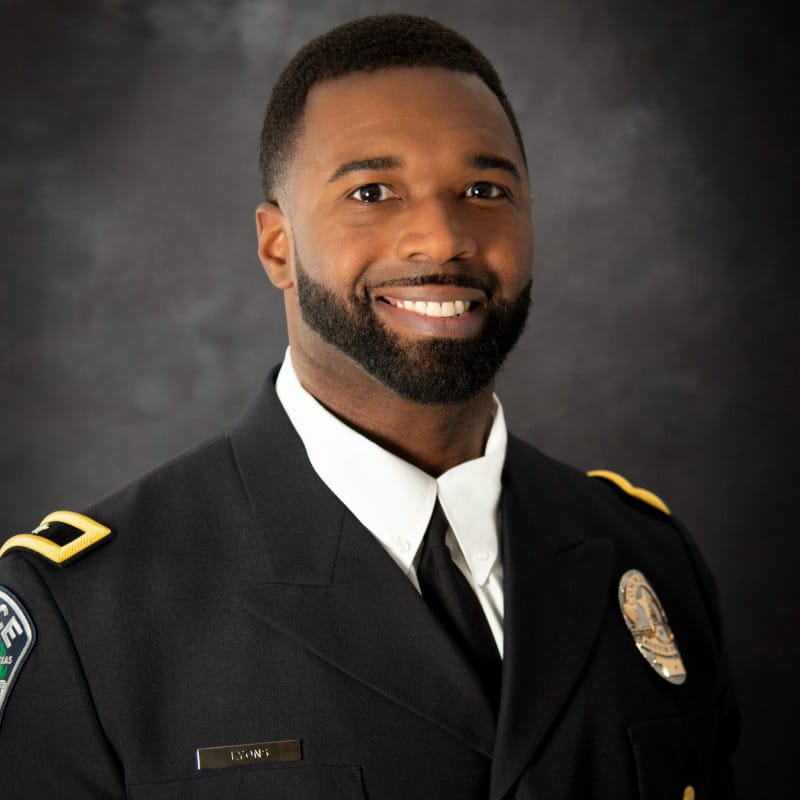
Wade Lyons is the Chief Executive Officer of Black Onyx Investigations, LLC, a private security and investigations firm he founded in 2024. He is currently leading the company’s expansion into executive protection services.
Wade began his public safety career in 2006 with the Austin Police Department, where he served in roles including Patrol, Investigations, Narcotics, Strategic Intelligence, Risk Management, and Recruiting. Rising through the ranks, he became Training Division Commander, overseeing training, recruiting, and hiring for more than 2,300 sworn and civilian employees. His leadership emphasized building trust, fostering connections, and strengthening collaboration across the department and the community.
He holds a B.S. in Community Health from Texas A&M University and an M.S. in Criminal Justice from Lamar University, where he is completing his MBA (expected 2025). Wade also graduated from the Harvard Kennedy School’s Senior Executives in State and Local Government Program and the FBI-LEEDA Command Leadership Institute, and holds a Lean Six Sigma Green Belt certification.
An advocate of servant leadership and mentorship, Wade is active in the International Association of Chiefs of Police (IACP), the National Organization of Black Law Enforcement Executives (NOBLE), and the International City/County Management Association (ICMA).
Outside of work, Wade enjoys natural bodybuilding, jiu-jitsu, and scuba diving, pursuits that reflect his dedication to discipline and lifelong growth.
For more information, visit blackonyxinvestigations.com.
What is your typical day, and how do you make it productive?
A typical day for me starts early. I wake up around 5:00 a.m. and train—either bodybuilding, jiu-jitsu, or cardio. Physical discipline sets the tone for mental clarity. At the office, I balance administrative tasks, client meetings, and team check-ins. I’ve learned productivity isn’t about filling every minute; it’s about prioritizing. I make a short list of three must-do tasks every morning. If I finish those, the day is a success.
How do you bring ideas to life?
I start by pressure-testing them with people I trust. During my time as Training Division Commander in Austin, I’d often gather front-line officers and civilian staff to workshop a new idea or training program. Their perspectives were invaluable. Today, at Black Onyx Investigations, I take a similar approach. An idea has to work on paper, but it also has to work in practice, so I rely on feedback and small pilots before scaling.
What’s one trend that excites you?
The integration of technology into private security excites me. Predictive analytics, drones, and AI-assisted monitoring aren’t just tools—they’re game-changers. I’m particularly interested in how these tools can be applied to executive protection in ways that enhance safety while reducing risk to personnel.
What is one habit that helps you be productive?
Consistency in fitness. I treat my training like a meeting I can’t cancel. Physical discipline carries over into my professional focus.
What advice would you give your younger self?
Don’t be afraid to pivot. My original plan was medical school. A single police ride-along changed my path. At 22, I thought changing course meant failure. Now I see it as growth.
Tell us something you believe almost nobody agrees with you on?
I believe the best leaders should train with their teams, physically and mentally. In law enforcement, some thought a commander didn’t need to be on the mat during defensive tactics training. I disagreed. If you don’t feel what your people feel, you can’t lead them effectively.
What is the one thing you repeatedly do and recommend everyone else do?
Write things down. It sounds simple, but journaling my priorities and reflections has kept me on track for years.
When you feel overwhelmed or unfocused, what do you do?
I take a moment to reassess my priorities and engage in a brief mindfulness exercise or a short walk to clear my mind. This helps me regain perspective and refocus my energy. I break down my tasks into manageable steps, allowing me to tackle challenges effectively.
What is one strategy that has helped you grow your business or advance in your career?
Listening more than talking. As APD’s Training Commander, I learned to ask recruits what worked for them instead of assuming I had all the answers. That feedback loop helped me improve programs and earn trust. In business, it’s the same principle. Clients will tell you what they need if you actually listen.
What is one failure in your career, how did you overcome it, and what lessons did you take away from it?
Early in my transition to private security, I underestimated the time needed to build trust with corporate clients. I pushed too fast. Some deals fell through. The lesson was patience—relationships drive the business, not timelines.
What is one business idea you’re willing to give away to our readers?
There’s a real need for fitness-based leadership retreats that combine physical training, leadership seminars, and stress management. Leaders underestimate how much physical discipline improves decision-making.
What is one piece of software that helps you be productive? How do you use it?
I rely on Trello for task management. It helps me visualize projects across Black Onyx’s expanding divisions.
Do you have a favorite book or podcast you’ve gotten a ton of value from and why?
Extreme Ownership by Jocko Willink has been a staple. The idea that leaders are responsible for everything that happens under their watch resonates with me deeply.
What’s a movie or series you recently enjoyed and why?
I recently rewatched Band of Brothers. It’s a powerful study in leadership, trust, and resilience under extreme conditions—lessons that still apply to policing and private security.
Key learnings
- Productivity starts with discipline and prioritization—physical training sets the tone for professional clarity.
- Listening, feedback, and patience are central to building trust, whether in law enforcement or business.
- Leaders are most effective when they share the same experiences as their teams, even in training.
- Education and self-reflection, through reading and journaling, create long-term growth.
- Success often comes from embracing pivots and unexpected opportunities, rather than rigidly sticking to a plan.