
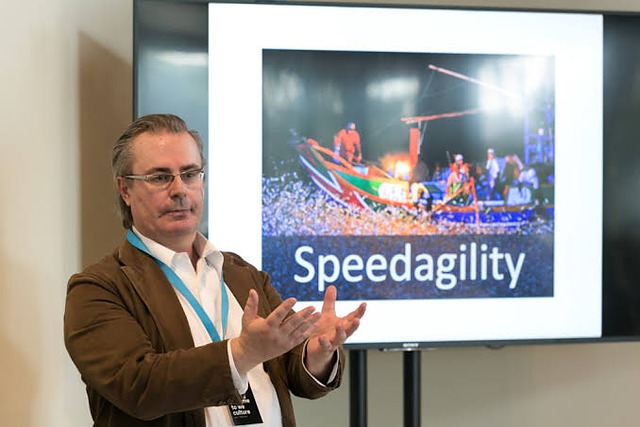
Evolution Mentor is the private coaching practice of Patrick Mazza, based in Toronto. The work is deliberately small a limited number of clients at any one time, each with real access, so the thinking has somewhere to go between sessions.
Patrick works with chief executives, founders, managing partners and senior operators across the GTA and, by video, further afield. Sessions are candid and unsentimental. You’ll be asked better questions than you’re currently asking yourself, and you’ll leave with something you can actually do on Monday.
What is your typical day, and how do you make it productive?
I build the day around a fact most people in my line of work ignore: coaching is cognitively expensive, and it doesn’t scale by trying harder.
Sessions run ninety minutes and I don’t schedule more than three in a day. The fourth is measurably worse than the third — I’m slower to hear what isn’t being said, and that is the entire job. Capping it isn’t discipline, it’s quality control.
Mornings are protected. Before a client arrives I re-read the last session’s commitments and what they said they’d do about them. That’s the difference between coaching and a good conversation: someone is holding the thread between meetings.
Afternoons are for sessions, with a half-hour gap between each. That gap isn’t a break. It’s where I write down what actually happened, before the next person’s situation overwrites it.
The productivity answer people expect is a routine. Mine is a refusal — a limited number of clients at any one time. Everything else follows from that constraint.
How do you bring ideas to life?
I test them on a live client problem before I build anything around them.
Most frameworks in this industry get invented at a desk and then go looking for somewhere to apply. I work the other way round. Something recurs across three or four unrelated engagements, I notice the pattern, and only then do I put language around it. The four-stage arc that Evolution Mentor engagements run on came out of exactly that — it’s a description of what was already happening, not a model I designed and imposed.
The test is simple. If a leader can use it in a real decision the same week, it’s real. If it needs a workshop to explain, it isn’t.
That test kills most of my ideas, which is the point. The ones that survive have already proved themselves on somebody’s actual problem before they ever get a name.
What’s one trend that excites you?
AI is quietly removing the last respectable excuse for indecision.
Senior leaders used to defer by asking for more analysis. It was a legitimate-sounding delay and it worked for decades — nobody gets criticised for wanting better data. That’s over. The analysis arrives in minutes now, and what’s left when the research is instant is the part that was always the actual job: deciding under uncertainty, telling somebody the truth, and absorbing the consequences of a call that turns out wrong.
I find that clarifying rather than threatening. The work I do gets more valuable exactly as the work around it gets automated. Judgement, nerve and the ability to have a hard conversation have no software substitute, and executives are starting to feel that shift before they can name it.
The leaders who struggle over the next decade won’t be the ones who failed to adopt the tools. They’ll be the ones who were using analysis as cover.
What is one habit that helps you be productive?
I write down what I expect to happen before it happens.
Before any significant decision — a client I’m unsure about, a change to how I run engagements — I write one line predicting the outcome. Then I go back and read it months later. It isn’t a journal. It’s a calibration record.
It’s uncomfortable, which is exactly why it works. Memory quietly edits itself so that you were right all along; everyone does this and nobody catches themselves doing it. Most senior people have no real idea how accurate their judgement is, because nothing in their environment ever tells them. Wins get remembered and misses get reframed as bad luck or somebody else’s execution.
A written prediction doesn’t allow that. Ten minutes a month, and after a year you know something about yourself that most executives never learn.
What advice would you give your younger self?
Being the most capable person in the room is a ceiling, not a moat.
I spent years proving I could do the work — faster, more thoroughly, to a higher standard than the people around me. It got rewarded, so I kept doing it. What I couldn’t see was that every hour spent demonstrating my own capability was an hour not spent building anyone else’s, and that the job had already quietly changed to making the work happen without me.
The tell was that I was busy and the organization was slow. I read that as a resourcing problem for far too long. It was a design problem, and I was the design.
So: notice earlier when your competence has become the bottleneck. The skills that get you promoted are almost never the ones that make you good at what you’ve been promoted into, and nobody is going to tell you that.
Tell us something you believe almost nobody agrees with you.
Most coaching engagements should end, and the industry is structured so that they don’t.
A relationship that renews indefinitely has usually stopped doing anything. It’s become a comfortable standing appointment — genuinely pleasant, valuable to the coach’s revenue, and no longer changing behaviour. Everyone involved is incentivised not to notice, and the conversation stays warm enough that nobody does.
I design engagements to finish. Six to twelve months, a defined end, and a real review of whether the thing we set out to change actually changed. It costs me money and it’s the right way to do the work.
If someone still needs me at month twenty-four the way they needed me at month two, I haven’t built anything durable. I’ve made myself load-bearing — which is precisely the dependency I’m supposed to be helping them remove from their own organization.
What is the one thing you repeatedly do and recommend everyone else do?
Identify the conversation you’re avoiding, and put a date on it.
Nearly all organizational drag traces back to one specific conversation nobody is having — with an underperformer, a co-founder, a board member, sometimes a spouse. It doesn’t decay while you wait. It compounds, and everyone around it starts adjusting their behaviour to route around the thing that can’t be said. That’s how a single avoided conversation becomes a culture.
I do this on myself monthly. Name the conversation, name the person, book it. Not “soon” — an actual date in the calendar.
What surprises people is that the relief has nothing to do with how the conversation goes. It comes from no longer carrying it. Most of the weight was never the confrontation; it was the anticipation of it, and you were paying that daily.
When you feel overwhelmed or unfocused, what do you do?
I separate what’s actually true from what I’m feeling about it, on paper.
Overwhelm is almost never the volume of work. It’s several unresolved things blurring into one large undifferentiated dread. Written down as a list, it’s usually four items — two of which aren’t actually mine, and one of which isn’t urgent. The list doesn’t solve anything. It just stops the pile behaving like a single enormous object.
Then I do the smallest concrete thing on it, badly if necessary. What’s missing in that state is momentum, not clarity, and waiting to feel clear before acting has it exactly backwards.
I also walk. Not as a productivity technique — I simply think better moving than sitting, and an hour outside does more for a stuck problem than another hour staring at it. Most of what I’ve worked out about difficult clients, I worked out on a walk.
What is one strategy that has helped you grow your business or advance in your career?
Turning down work that isn’t a fit — and saying specifically why.
That sounds like a luxury position taken from a comfortable place. It’s the opposite: it’s what built the practice. When someone wants validation rather than coaching, or a sponsor wants a compliance exercise rather than an actual change, I say no and explain the reasoning plainly.
A meaningful share of those conversations come back within the year, having found out I was right. Almost all of them refer somebody in the meantime — because the thing people remember is being told the truth by someone with an obvious financial incentive to say something else.
The mechanism isn’t mysterious. In a market with no licensing, no barrier to entry and no reliable quality signal, refusing revenue is one of the few credible signals available. Clients read it as confidence, and they’re reading it correctly.
What is one failure in your career, how did you overcome it, and what lessons did you take away from it?
I kept the wrong senior person in place for the better part of a year after I knew.
I knew inside the first month. Everything after that was me building increasingly sophisticated reasons to wait — the timing was bad, the market was turbulent, they deserved a fair run, a change would destabilise the team. Each reason was individually defensible. Together they were cowardice with a business case attached.
What it cost wasn’t the salary. It was the two good people underneath who left, because they’d concluded that performance wasn’t actually the standard. They were right to conclude that. I had told everyone what I tolerated, and they believed my behaviour over anything I said in a meeting.
The lesson took longer to accept than to learn. Delay isn’t neutral, and it isn’t kind. The person themselves lost a year they could have spent somewhere they’d have been good — which is the thing I’d told myself I was protecting them from.
Now I move on people decisions within weeks, and I say the hard thing early while it’s still small. It’s a large part of why I coach. I recognise that particular flavour of intelligent avoidance instantly, b
What is one business idea you’re willing to give away to our readers?
An independent post-mortem service for failed executive hires.
Companies run detailed reviews on failed products and failed acquisitions. Almost nobody reviews a senior hire who didn’t work out — despite the cost running well past a year of salary once you count severance, lost momentum, and the damage to the team underneath. The reason is obvious: the only people positioned to commission the review are the people who made the decision.
So it has to be external. A neutral third party interviews the hiring panel, the departed executive, and the team that reported to them, then reports on what actually went wrong — the brief, the interview process, the onboarding, or a fit problem that was visible and ignored.
Sell it as a subscription to companies making ten or more senior hires a year. Within eighteen months you’d hold proprietary data on why executive hiring fails that nobody else has. That’s the real business. The consulting revenue just pays for gathering it.
What is one piece of software that helps you be productive? How do you use it?
Notion — though the tool matters far less than the structure inside it.
I keep one record per client, and the top of that record is not notes. It’s commitments: the specific things that person said they would do, with the date they said it. Everything else sits below.
Before every session I read the commitments first. That single habit does more than any technique I know, because it changes what the session is. Without it, a coaching conversation drifts into a well-informed catch-up — interesting, warm, and gone by Thursday. With it, there’s continuity and mild accountability from the first sixty seconds, and the client knows before they arrive that they’ll be asked.
Almost any tool would serve. Recording what people committed to rather than what they talked about is the part that does the work.
What is the best $100 you recently spent?
Lunch with a former client, so I could ask what I got wrong.
The engagement had ended well and we’d stayed in touch, which made it the right conversation to have — enough distance for honesty, enough goodwill that he’d actually tell me. I asked which sessions had wasted his time, where I’d pushed on the wrong thing, and what he’d wanted to say at the time but didn’t.
He had answers. Specific ones. He’d found the first two months slower than they needed to be, and he’d been too polite to mention that I was over-diagnosing something he already understood perfectly well about himself.
Worth considerably more than a hundred dollars. Coaches get almost no honest feedback — clients are either grateful or they leave, and neither tells you much. Buying lunch is the cheapest quality-control mechanism available in this profession, and I do it two or three times a year now.
Do you have a favorite book or podcast from which you’ve received much value?
Immunity to Change, by Robert Kegan and Lisa Lahey.
Its central observation is one I see confirmed almost weekly: people don’t fail to change because they lack willpower or information. They fail because they hold a second, hidden commitment directly opposed to the change they say they want — and that hidden commitment is usually protecting them from something real. The executive who genuinely wants to delegate is also, quietly, committed to being indispensable. Both are true at once. Until the second one is on the table, no amount of planning touches the problem.
My reservation is that the book is heavier than it needs to be. The mapping process is academically rigorous and slow, and I’ve yet to meet a working chief executive who would sit through it as written. I use the underlying insight constantly and the formal exercise almost never.
Read it for the diagnosis rather than the method. The diagnosis is one of the more useful things anyone has written about why capable people stay stuck.
What’s a movie or series you recently enjoyed and why?
The Bear.
I went in expecting a show about restaurants and got the most accurate thing I’ve seen on screen about inheriting an organization you didn’t build. Somebody takes over a business full of people with long histories, deep loyalties and entrenched ways of working, and discovers that competence alone changes nothing — that you can be entirely right about what needs to happen and still be unable to make it happen, because you haven’t yet earned the standing to ask.
The kitchen is also an unusually honest setting for what pressure does to communication. Everyone in it is under-slept and over-committed, and you watch small unsaid things compound into large ones in real time.
I’ve had versions of that conversation with clients dozens of times. It’s rare to see it dramatised without either flattering the leader or turning them into the villain.
Key learnings:
- Your own competence eventually becomes the constraint. Being the most capable person in the room is a ceiling, not a moat. The tell is when you’re busy and the organization is slow — that’s a design problem, and you’re the design.
- Delay isn’t neutral, and it isn’t kind. Holding onto a wrong senior hire costs far more than salary. It tells everyone underneath what you actually tolerate, and they’ll believe your behaviour over anything you say in a meeting.
- The conversation you’re avoiding is compounding, not decaying. Nearly all organizational drag traces back to one thing nobody will say. Name it, name the person, put an actual date on it — the weight was never the confrontation, it was carrying the anticipation of it.
- Good coaching is built to end. An engagement that renews indefinitely has usually stopped changing anything. Designing for a finish costs the coach money and is the only way to know the work held.
- When analysis is instant, judgement is the whole job. AI has removed the last respectable excuse for indecision. What’s left is deciding under uncertainty, telling people the truth, and absorbing the consequences — none of which has a software substitute.