
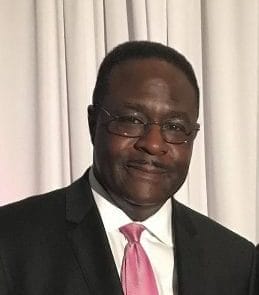
Robert Finch has broad experience in state government, healthcare, and human resources management. He has 15 years of executive experience in healthcare, including several key positions throughout his career.
Finch is also a man of the cloth. He joined Mt. Zion Baptist Church in Stephens, Georgia, at the age of nine and was ordained as a deacon in 1988. Reverend Finch served as a deacon at Mt. Zion until relocating to Jacksonville, Florida, in 1996, where he connected with Shiloh Metropolitan Baptist Church and also served in the deacon’s ministry. He has experienced many meaningful milestones in his life, but one of the most significant was his acceptance of his call to preach the Gospel in 2009. He is most grateful for the guidance of Rev. Abraham Mosley, senior pastor of Mt. Pleasant Missionary Baptist Church, who served as his mentor in ministry. Finch faithfully served as an associate pastor under Rev. Mosley until accepting the call to serve Billups Grove Baptist Church in Athens, Georgia, on October 12, 2019.
Robert Finch, Georgia, spent four years as Vice President, Human Resources & Organizational Development, with Coffee Regional Medical Center in Douglas. His responsibilities and achievements included managing a talented team of benefits, performance management, compensation, recruitment, and employee relations specialists; developing a policy to reduce Time to Fill to reflect industry standards; successfully managing 401k and 457b retirement plans conversions; managing 12 million self-insured benefits plans and achieving a $240,000 reduction in stop-loss premiums via cycle audit; as well as lowering the health plan’s prescription cost t by updating formulary and PBM selection. He was also the executive lead for Diversity & Inclusion Initiatives, completely redesigning the employee recognition program and PRN and PTO policies.
Finch also served as the Interim Executive Director at Mercy Health Center in Athens, Georgia, where he was responsible for strategic planning, facilities management, HR, donor management, and fiscal accountability.
As Vice President of Human Resources & Chief Diversity Officer at Piedmont Athens Regional Medical Center in Athens for four years, he managed compensation, compliance, benefits, recruitment, EAP, Employee Health, Employee Relations, Learning and Development, performance management, and Chaplain Services. Finch reduced voluntary turnover from 20.1
What is your typical day, and how do you make it productive?
I read two to three papers in the morning and then I go to the gym for a 40 minute workout.
How do you bring ideas to life?
I start by listening before I act. Whether it is a new initiative at the church, a workforce development program, or a healthcare policy change, I spend time in the community first, talking to the people who will be most affected. Once I understand the need from their perspective, I build a coalition of stakeholders who have both the will and the resources to move the idea forward. I have found that the best ideas do not come from the top down; they come from the ground up, and the leader’s job is to create the conditions for those ideas to take root and grow.
What’s one trend that excites you?
The expansion of telehealth and digital health platforms into rural and underserved communities excites me tremendously. Having spent years in healthcare human resources and administration across rural Georgia, I watched patients go without care simply because of geography or economics. Technology is beginning to close that gap in meaningful ways, and the intersection of that innovation with faith-based community health programs is an area I believe has enormous untapped potential.
What is one habit that helps you be productive?
Reading two to three newspapers every morning before the day begins. It keeps me informed, sharpens my thinking, and ensures that the decisions I make are grounded in what is actually happening in the world, not just my own corner of it. Combined with my morning workout, it creates a discipline that carries through everything else I do that day.
What advice would you give your younger self?
Do not wait until you feel fully ready to step into leadership. You will never feel fully ready, and waiting costs you and the people who need you. Start where you are, lead with what you have, and trust that the growth will come through the doing. I spent years preparing for roles that I was already capable of filling. That caution was not humility; it was hesitation. Move sooner.
Tell us something you believe almost nobody agrees with you on?
I believe that the Christian church is one of the most underutilized assets in American healthcare and social services. Churches already have the trust, the infrastructure, and the community presence that government agencies and healthcare systems spend millions trying to replicate. The partnership between the local church and the public health system is not just possible; it is necessary, and we are leaving enormous value on the table by treating them as separate sectors.
What is the one thing you repeatedly do and recommend everyone else do?
Invest in people who are not yet where they are going. I have mentored students, young professionals, and emerging leaders throughout my career, and the return on that investment, both for them and for the communities they go on to serve, is immeasurable. Everyone has someone they can bring along. Find that person and commit to their development the way someone once committed to yours.
When you feel overwhelmed or unfocused, what do you do?
I return to prayer and scripture. That is not a platitude; it is a practice. When I am overwhelmed, I need to be reminded of what I am actually working toward, and that clarity does not come from a to-do list. It comes from a quiet moment of reflection that reorients my priorities and restores my focus. After that, I go back to basics: What is the most important thing that needs to happen today? Just one thing. I do that first.
What is one strategy that has helped you grow your business or advance in your career?
Building genuine relationships across sectors before I needed them. Throughout my career in healthcare, education, nonprofit leadership, and ministry, I made a practice of showing up for other people’s work, not just my own. Serving on boards, volunteering for committees, sponsoring scholarships through the Athens Area Human Relations Council for 24 consecutive years; none of that was transactional. It was a genuine commitment to community. But those relationships also created a network of trust that opened doors I could not have opened alone, and that has made all the difference.
What is one failure in your career, how did you overcome it, and what lessons did you take away from it?
Early in my career I underestimated how critical it was to document and communicate progress in real time, not just at the end of a project. I delivered results that were genuinely significant but failed to tell the story along the way, which meant that the impact was not fully understood or credited. I overcame it by becoming a much more intentional communicator, building regular reporting and stakeholder updates into every initiative I led. The lesson is that results without narrative are invisible. Leadership requires you to translate outcomes into language that moves people, not just numbers that inform them.
What is one business idea you’re willing to give away to our readers?
A faith-based healthcare navigator program, staffed and operated out of local churches in rural and underserved communities, that connects congregants to preventive care, mental health services, and benefits enrollment. The church already has the trust. It already has the building, the volunteers, and the weekly foot traffic. What it lacks is a structured partnership with the healthcare system. Any health system or insurer looking to reduce emergency utilization and improve population health outcomes in underserved markets should be funding this model aggressively.
What is one piece of software that helps you be productive? How do you use it?
A well-organized calendar application is the backbone of my productivity. Whether for sermon planning, board meeting preparation, or coordinating community outreach, having everything in one place with reminders and time blocks keeps me from letting important things fall through the cracks. I treat my calendar as a reflection of my priorities. If something matters, it has a place on the schedule.
What is the best $100 you recently spent? What and why?
A set of devotional and leadership books that I have been working through with a small group of emerging leaders from the congregation. The investment was minimal, but the conversations it sparked have been among the most meaningful I have had all year. Books have always been one of the highest-return investments I make, personally and professionally.
Do you have a favorite book or podcast you’ve gotten a ton of value from and why?
The Bible remains the text I return to most consistently, both for spiritual grounding and for its remarkable depth on leadership, justice, and human nature. In terms of leadership literature, I have drawn heavily from works on servant leadership and organizational behavior throughout my career in healthcare human resources. I am also a devoted reader of newspapers and current events, which I find essential for any leader who wants to remain relevant and responsive to the world their community actually lives in.
What’s a movie or series you recently enjoyed and why?
I gravitate toward stories about leaders who serve something larger than themselves, historical dramas and biographical films that show both the weight and the reward of a life committed to purpose. Those stories remind me why the work matters and reinforce the kind of leader I am trying to be.
Key learnings
- Robert Finch’s approach to leadership is rooted in community trust built over decades, not campaigns. He consistently prioritizes relationships and genuine service over transactional networking, a practice that has shaped his career across healthcare, education, nonprofit leadership, and ministry.
- Finch believes faith-based institutions represent one of the most underutilized assets in American public health and social services, and advocates for structured partnerships between churches and healthcare systems to improve outcomes in underserved communities.
- A disciplined morning routine, reading multiple newspapers and a 40-minute workout, anchors his productivity and keeps his decision-making grounded in real-world context rather than organizational echo chambers.
- His most consistent career advice is to lead before you feel ready. Waiting for perfect preparation, he argues, is not humility but hesitation, and it comes at a cost both to the leader and to the people who need them.
- Finch’s 24-year commitment to providing scholarships through the Athens Area Human Relations Council reflects his broader conviction that investing in people, especially those who are not yet where they are going, is the highest-return leadership act available to anyone.