
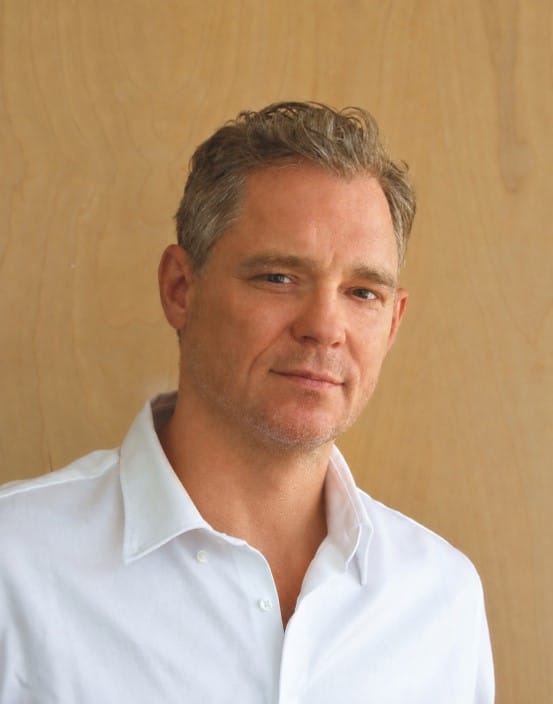
Michael Mikulec is a brand strategist, designer, and creative director. For over two decades, he has built identities for networks, teams, and institutions — ESPN, Fenway Park, The CW, NBC’s Olympics coverage — and, increasingly, for categories that don’t have a settled vocabulary yet.
In 2013, he named, positioned, and led the launch of Curaleaf, when regulated cannabis had almost no established brand vocabulary to borrow from. Instead of leaning on the familiar visual cues of cannabis culture, the identity was anchored in healthcare, credibility, and trust. The system became the foundation for what grew into the largest cannabis company in the United States by geographic reach, with operations across the U.S. and Europe.
The pull toward emerging systems started earlier. His 2011 Yale thesis, Ready Made to Order, looked at how algorithmic personalization could splinter shared experience and intensify political division. It is held in Yale’s Beinecke Rare Book Library.
His path ran through broadcast. At ESPN in Bristol, Connecticut, he worked in broadcast design on the 2003 and 2004 NBA Finals and was part of teams that earned two Sports Emmy Awards. At Troika Design Group in Los Angeles, he was the original designer of The CW’s network logo and worked on the launch of MTV’s HD platform and NBC’s identity for its 2008 Beijing Olympics coverage. In Fox Sports’ promo department, he earned a third Sports Emmy for a Daytona 500 campaign.
After Troika, Mikulec moved to Rome to work for Frame by Frame, spending two years directing projects across Europe and the Middle East. He returned to the U.S. for his MFA at Yale, where he won the pitch for Fenway Park’s 100th Anniversary identity. Following his time at Yale, he opened Frame by Frame’s New York office, running it as a partner and leading work for ESPN, CBS Sports, Fendi, Madison Square Garden, and the Miami Dolphins, plus the launch of AS Roma’s television network.
He later returned to SCAD, his alma mater, as Chair of Graphic Design. In that role, he reworked the curriculum around a question that had trailed him for years: what does graphic design need to become next? The program he built moved students through a clear progression — Designer as Producer, Designer as Director, Designer as Author — from making objects, to leading systems and teams, to developing a point of view that can hold its own.
What is your typical day, and how do you make it productive?
Before six, I’m already up. I’ll read for a bit, get my son ready for school, and take a walk just to rinse my mind out. After that the workday breaks in two; writing on one side, client work on the other. Somewhere along the line I try to sneak in a sauna. It’s become my reset button.
I make a point of wrapping client work before my son comes home. After that, it’s dad mode, full stop. Later, once the house settles, I’m back to reading, listening, doing research.
If I’m honest, productivity isn’t me cramming more into the hours. It’s me keeping different parts of the day protected, so each one gets the kind of attention it actually needs.
How do you bring ideas to life?
I let research steer first, and I treat every project a little like fieldwork.
Several years ago I had a project in Cairo, a part of the world I’d spent no time in. The only useful thing I could do was get off the internet, put down my assumptions, step outside the constraints of the brief, and wander the streets of Egypt at two in the morning. Drink tea with strangers. Buy trinkets. Have unplanned conversations. Nothing about that was efficient, and it was the whole project.
I also keep a pile of books going that have no obvious relationship to one another, because the connection is usually where the idea lives. Some obscure Gothic fresco or a line from John Adams will click against the problem I’m holding, and there’s the answer I couldn’t have designed on purpose. The trick is staying open long enough for that to happen. If you show up with the answer already loaded, you’ll spend the whole project collecting proof for the version you wanted.
What’s one trend that excites you?
What excites me most isn’t a trend; it’s teaching this stuff to younger designers.
Making semiotics fun. Breaking down postmodernism by watching Talking Heads videos. Letting students make GIFs and figure out that theory isn’t a punishment. My favorite exercise was asking them to set a word in a typeface that was its opposite. Someone wrote “Chuck E. Cheese” in a highly elegant typeface, and it came out looking like Charles Esquire Cheese — like the mouse grew up and got a law degree. That’s a real lesson about how typography carries meaning, and they’ll remember it forever because they were laughing when they learned it.
The broader shift I care about is the creative process opening up to more people. Yes, it means a flood of mediocre work, because anyone can make and distribute something now with little to no care. Good work can also find an audience it never would have reached before.
The version of this I’m proudest of wasn’t in a classroom. A designer I mentored at the Red Sox came in with essentially no formal design schooling and became their creative lead. He told me once that our work together changed how he thought about design and how he thought about life. I miss that kid.
What is one habit that helps you be productive?
Waking up before sunrise. There’s this narrow stretch, before the emails and texts and expectations start piling in, where my attention still feels like it’s mine. I guard that time.
And then at the opposite end of the day, I’ll cook something unnecessarily complicated. Not because I’m chasing a perfect diet, but because it soaks up the part of my brain that would otherwise keep grinding on work, and it has a clean finish line.
I like that it’s the one place I get to be creative without anyone paying for it or asking for changes. My only critic is my son, and he can deal. My wife has thoughts about the number of dishes I dirty.
What advice would you give your younger self?
Start writing sooner.
I treated writing as something I’d get to once the design career was settled. It turned out to be the thing that made the design work better — the argument underneath a brand gets written before it gets drawn. If you can’t say what a brand is claiming in a sentence, no amount of craft will save it.
I lost a lot of years thinking those were two separate practices.
Tell us something you believe almost nobody agrees with you on?
Northern Italian cuisine is Italy at its best.
I spent two years living in Rome, which sits in the middle — not really north, not really south — so I’ve managed to annoy everyone at once with this sentiment. Italians don’t have food opinions. They have food laws. I once bought linguine to make Bolognese, and my friends chastised me for weeks. They were right, incidentally.
What is the one thing you repeatedly do and recommend everyone else do?
Reread the things that light you up.
People love to keep pushing outward; one more book, one more article, one more source. I’ve gotten more by circling back to a handful of texts that actually hit me. You’re not the same person when you return, so the book isn’t the same either. Something you skimmed past five years ago can suddenly lay out an idea you’ve been stuck on for months.
When you feel overwhelmed or unfocused, what do you do?
I walk. I also try to meditate, but if we’re ranking reliability, walking wins. Getting away from the screen lets the problem keep running in the background, without me trying to force it into place.
What is one strategy that has helped you grow your business or advance in your career?
Let people see how much you care about the work.
I don’t sleep well before a new project starts. I go all the way in — for a few weeks the project is the only thing in my head, and I’m not much good for anything else. When I present, that shows — and it spreads to the team before it ever reaches the client. I think that’s the real reason clients trust the work. They’re not only buying the idea. They’re watching someone who actually cares about their problem, and that turns out to be contagious.
The part I’d underline is that the excitement doesn’t scale with the budget. A couple of years ago I designed a logo for my nephew’s Little League team pro bono, because I love my sister and her son is a great kid. Now when I visit, it’s on hats, shirts, and stickers on cars all over town, including people who don’t have kids in the league. It’s more or less become the town’s logo. My nephew draws it constantly, along with every other sports logo he can find, which is exactly what I did when I was his age.
There’s a longer loop in that. Growing up near Hartford, I drew the Whalers logo obsessively — arguably the most perfectly resolved mark in sports history. I learned how logos work by osmosis, copying it a thousand times without knowing that’s what I was doing. Years later, at Troika, I was the original designer on The CW’s first logo, and the whole thing was an homage to the Whalers logo I’d been drawing since I was eight.
What is one failure in your career, how did you overcome it, and what lessons did you take away from it?
Early on, I burned bridges.
I walked into the industry with more confidence than experience, and I confused strong opinions with good judgment. I could be brash. I’d dig my heels in when more experienced people told me things I didn’t want to hear, and I took their resistance as slights instead of what it often was: knowledge I hadn’t earned yet. I lost some relationships I’d give a lot to get back.
What shifted was getting far enough into my own career to recognize what those people had been doing. Once you’ve been the person in the room who understands why an idea won’t survive a client, an audience or a budget, you see that resistance differently. I got better at listening. I also made some apologies that should have happened sooner.
Being right and being effective are separate skills, and effectiveness, most of the time, is putting your ego aside and listening.
What is one business idea you’re willing to give away to our readers?
Take on smaller civic projects — festivals, historical societies, library systems, park conservancies. They have real equity and almost nobody working on it. Most are running on a logo a well-meaning volunteer put together years ago.
It pays less than corporate work and gives you more room than corporate work ever will. No brand committee. The people you’re working with are in it for the right reasons, and it shows if you’re in it for the same one — which is how you end up with partnerships instead of clients. It’s also the best case study you’ll ever build: you own the thing end to end, so you can show your actual process instead of the sanded-down version, and you walk into every interview and pitch after it with a story you can tell from beginning to end. That’s worth more than a portfolio image.
Build a few of those, and you have a set of keystone projects, real proof of concept, and work that leaves a legacy. Plus, it’s good for the soul.
What is one piece of software that helps you be productive? How do you use it?
Pen and paper, which, yes, is not software.
Nothing beats taking a thought straight from my head, through my hand, onto a page. I sketch, jot fragments, draw lines between ideas, scratch things out, bounce between words and images, and I don’t care if any of it looks done. Software can help later. Paper is where I find out what I actually think.
What is the best $100 you recently spent? What and why?/
A Harry Potter wand for my son at Universal Studios.
The amount of joy he pulled out of that small object was easily worth ten times the price. Watching his imagination fully take over gave me one of those perfect moments you can bank and return to later, when everything else feels messy.
Do you have a favorite book or podcast you’ve gotten a ton of value from and why?
Walter Benjamin’s The Arcades Project. It’s fragmented — observations, quotations, history, philosophy — so you can drop in almost anywhere and find something that connects to an idea you weren’t even looking for. It taught me a mental habit I rely on constantly: looking backward to understand what’s happening now, and letting unrelated pieces sit beside each other until a pattern appears.
My favorite podcast is The Ezra Klein Show. What I respect most is the listening. He’ll bring on people who seriously disagree with him and still give them room to explain what they believe instead of flattening them into a label. It’s made me notice how rare real listening is.
What’s a movie or series you recently enjoyed and why?
I went back to Krzysztof Kieślowski’s Dekalog.
Ten films set around one apartment complex, each loosely tied to one of the Ten Commandments, and none of them trying to hand you a correct answer. My family is from Poland, specifically Łódź, where Kieślowski trained, so it’s personal. Still, what keeps pulling me back is the restraint. It trusts you to sit with what doesn’t resolve
Key learnings
- Keep a sacred space before the day starts making demands. Make sure some part of it still belongs to you.
- Stay with a problem longer than feels comfortable. Decide too early and you start collecting evidence for the answer you already wanted.
- Push past the first competent answer. Distinctive work often appears after the project already looks finished.
- Learn the difference between being right and being effective. The second one usually requires more listening.
- Notice the conventions everyone in a category follows without saying so. Those are often the ones worth breaking.