
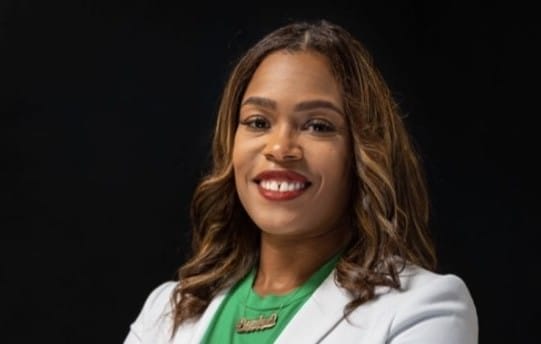
Dr. Pandwe Gibson is a distinguished scientist, a spirited visionary, and a tenacious ecopreneur with a fierce devotion to making the world a better place. To Pandwe, achieving success and mastering one’s skill set requires that leaders submit to the idea of “failing forward.” This is why she lives by the notion that if you’re driven by something, you won’t let anything stop you from the pursuit of that mission.
Pandwe Gibson’s diverse background has molded her into the experienced business owner and serial entrepreneur she is today. She is the president and founder of EcoTech Visions, a platform as a service for co-manufacturing. ETV is a blend of the physical and virtual. Their network of smart manufacturing facilities provides a number of essential services to ecopreneurs, including maker spaces, office spaces, event spaces, and high-quality business resources that support the design and development of sustainable products and packaging through artificial intelligence, the Internet of Things, and blockchain technology. They also offer supply chain logistics and a virtual marketplace and community where ecopreneurs can procure raw materials and make other retail purchases.
Pandwe Gibson also founded the EcoTech Visions Foundation, a multimillion-dollar foundation that provides citizens with sustainable affordable housing and uses the proceeds to provide free educational programming that facilitates economic development through green technology and digital economy opportunities. The foundation’s mission is to transition the workforce from blue and white-collar to green-collar.
Pandwe has proven her adeptness in transforming aspiring companies into profitable organizations, a talent she’s demonstrated for over a decade. Throughout her career, she has had tremendous success with designing effective organization models for rapid growth — increasing market share by an average of 20%. Her knowledge and experience span artificial intelligence, computer vision technology, energytech, operations, human resource management, business development, ESG investing, and real estate. For the past two decades, she has advised and collaborated with the world’s leading theorists and practitioners at the frontiers of greentech.
What is your typical day, and how do you make it productive?
Every day is a new adventure. The cool and terrifying thing about being an entrepreneur is no one tells you what to do — and that is a double-edged sword. I find it important to exercise a healthy combination of:
“Beware of the tyranny of the urgent” — meaning: helping those around you to understand that what they might think is urgent isn’t always so.
Doing things immediately as they come. If something comes to mind at 2 am, for example, just get up and jot it down — or just complete the task.
Sticking to the to-do list for daily, monthly, and large goal execution. This gives me an overwhelming sense of accomplishment and is my “north star” in tracking my progress. You either get to cross a task off the list or you don’t, so you always know whether you are productive or not. I always got good grades in school, so doing things the fastest and the best became the game I played with myself. I think being an entrepreneur is trading grades for dollars. Cash flow is the individual grade, while contracts/customers are the overall GPA. This makes it very easy to rate success and remove emotions and subjectivity from the equation.
Exercising and exploring creative outlets. I spend 8-10 hours a week moving my body and 8-10 hours expressing myself through art. Though the method might change seasonally, it is important to condition my whole body. I also take a vacation at least twice a year and workcations whenever possible.
How do you bring ideas to life?
Allow me to introduce myself. My name is Pandwe, pronounced “pond-way or pon-dway” — blending the “dw” like in dwelling. My mother fell in love with the name while traveling in Tanzania during her college-abroad experience, and it means “beauty derives from intelligence and not the other way around.”
My grandmother Mamie Gibson and my great-aunt Evelyn Gaston are illuminated in my consciousness when I observe the surrounding lights. Both worked on the Manhattan Project, helping to discover and harness atomic energy. Female scientists demonstrating that innovators solve the world’s problems are at my roots, and I can only imagine the daily pressures that my grandmother and great-aunt faced as Black women scientists in the 1930s and 40s. That consciousness has inspired me to accomplish some notable achievements following my tenure at Scripps College, including: graduating from MIT, Harvard, and Claremont Graduate University with an MBA, two MAs, and a Ph.D., founding a charter management organization that scaled to sixteen schools and $3B in revenue in post-Katrina New Orleans, and scaling several other businesses in alignment with the stewardship of our global ecosystem. Yet, I still have a larger legacy to step into.
I bring ideas to life through research, which I define as a combination of studied best practices that are tried, failed at, and iterated until maximum efficiency is achieved. Praxis and global exposure are essential to fulfilling my purpose. My purpose, as an indigenous human, is to model our civic responsibility as stewards of the earth. My ancestors, as well as cultural, entrepreneurial, and academic experiences, have all crystallized a path toward that purpose, imbued me with creativity, and have given me the ability to pivot when faced with challenges. It does not matter if you are an entrepreneur or intrapreneur, if you work at Footlocker in sales, as I did in high school, or run the company, you must pursue excellence in every endeavor.
What’s one trend that excites you?
Millennials and the subsequent generation value the earth and believe in stewardship. There is a wealth of research pointing to climate change being a top priority for my generation. As this trend increases, I believe we will see more market-based solutions emerging.
What is one habit that helps you be productive?
I’ll never give up playing. Some believe that when you become an adult you are supposed to be serious all the time, but I believe that every day gets to be fun. When I was a child, I did gymnastics and was on the swim team, so even as an adult, I found ways to continue this practice through my well-being activities. These include aerial silks classes, Pilates, Weng Chun Kung Fu, synchronized swimming, and barre. I also love going to the beach, sailing, parasailing, snorkeling, trapeze, attending water parks or amusement parks, and ranch hand work. I am a licensed scuba diver and advanced international yoga instructor.
The New Orleanian in me also makes sure I am in full costume for every activity I do — I assure you that you can’t take yourself too seriously wearing a mermaid fin and glitter, crawling on the floor, or flying through the air.
What advice would you give your younger self?
A number of different things:
It’s all coming, so be patient. Anyone who really knows me knows I am on a lifelong quest for speed. To me, success is efficiency, and efficiency is excellence at the objective in the fastest time. This framework has served me well to complete all degrees ahead of my peers and thrive in business and cooking, but the downside is sometimes forgetting to celebrate substantial progress and frustration when things take longer than scheduled.
It is important to be competent and dangerous. Morality and virtue lie in being able to protect yourself and others while having the discipline to sheath your sword to pursue diplomacy. People can make the mistake of thinking I ascribe to a Martin Luther King Jr or Gandhi mindset. While they are both great men pursuing a moral high ground, Weng Chun Kung Fu (the only martial art founded by a woman and based on the movements of animals in nature) teaches us that to be competent and dangerous is healthy and necessary to thrive in a world as a woman.
Your tribe is not a race, it is a purpose, and it will keep evolving/maturing over time. I had to learn to shed Western identity frameworks because individualist identity thinking can lead you to monolithic thinking. I was born into a majority Black community and, at various points in life, often surrounded by people my age or women because of how society typically stratifies. I did not accept those boxes as facts or life. And there I can also count on one hand how many times I have been to a party or club. I have never been a drinker or enticed by peer pressure to ingest or do anything. You would think getting into MIT would be a cause for celebration, but even at that juncture, I had limited support around me. As a public speaker, I often introduce myself as an earthling, and I recall several times when people who are stuck to their social location get very upset with me for not committing to one geographic home. I was speaking to a German woman in Italy once who told me that it made sense I was willing to shed my location because Black women are the bottom of everything, and she wanted to be White and German because it made her better and she had no interest in giving that up. Rather than educate her, which I rarely do for free anyway, I pondered her ignorance and learned to have grace for people. She later came around due to her desire to know more about my culture — my New Orleans roots intrigued her. Her interest also enlightened me to understand the power of culture and the privilege it is to be a mature one.
Purpose or a calling can be hard to bear at times. However, it was on a trip to Australia that I began to truly understand what it means to be an indigenous earthling and the responsibility that goes with it. I also learned that most humans are not there yet, so I surround myself with people who share stewardship as a purpose — not a phenotype, age group, nationality or race, but rather thought.
The purpose of life is maturation, not survival of the fittest. Cooperation is a fundamental process in nature. Separate parts are an illusion. The 6,000 languages in the world have trapped us into missing the truth — we are ALL one with the EARTH. We cannot survive without her atmosphere. Maturation is the activity of oneness.
Nothing is as it seems. Alias and enemies are interest-based, not people. I served as an ambassador to the White House and the Department of Energy for three administrations: Obama’s second term, Trump, and then Biden. I saw first-hand people who were unwilling to stick to the purpose due to their political affiliation. It was heartbreaking to watch people sabotage or push their own agenda over the goal, which was to forward the mission of the DOE, which is energy security and independence across America.
Tell us something you believe almost nobody agrees with you.
Much of society looks to the government to solve our most pressing problems, but I believe that sustainable solutions only derive from innovators. Whales were being fished to extinction in the early 1900s. It was not laws, activism, fines, prayer, or education that helped them avoid extinction. In fact, the wealthy class of the northeast was built by whalers during that time. The educators pushed books like Moby Dick that made monsters out of intelligent life to justify the mass murder, and people just wanted to light their homes, so they looked the other way. The government regulated the economy which is their only job. It was the advent of the incandescent light bulb by Edison and the filament perfected by Louis Latimore, an African American man, that shifted buyers from lanterns to electricity. Innovation saved the whale, and we believe this lesson is the key to a healthy planet for years to come.
EcoTech Visions is committed to building innovators who will solve the world’s problems through entrepreneurship and innovation. We educate, advocate, and provide resources to support environmentally focused startup goals. We focus on SpaceTech, GreenTech, BlueTech and Big Data companies.
A close second and seemingly simple thing is that I hate weekends. No one else is working, and it makes productivity arduous. I often feel excited for Monday morning “go time,” but getting through the weekend has been the best teacher of patience for me.
What is the one thing you repeatedly do and recommend everyone else do?
Travel. I believe all Americans should have to travel abroad. If we did, national pride would immediately skyrocket, and so would innovation. Globally, people are dying to get into this country, but when you only know American privilege, you cannot see the boxes and limitations you are imposing on your own life.
Traveling for exploration and exposure helps humans stay curious, and curiosity drives ingenuity and quality of life. In high school, I lived and studied in France. In college, I spent a year in Ghana, where I learned to take bucket baths and cook on an outside open fire. These experiences were useful in the United States after the Gulf hurricanes and changed my perspective on what humans really need to survive and thrive on this earth. Also, Americans spend entirely too much time thinking about individual identity, and traveling abroad shifts that identity gaze just enough to remind us that the labels are all made up anyway. Case in point, I am writing this answer from the Galapagos, following a scuba diving excursion with Hammerhead sharks, manta rays, and a host of other beautiful marine life. Under the sea, nothing matters but your breath and the health of the entire ecosystem. I find these experiences to be freeing and supportive of increased creativity because new environments force you to spend less time thinking about the superficial and more time thinking about how to be civically responsible — thus, exploration leads to innovation.
When you feel overwhelmed or unfocused, what do you do?
Being unfocused or overwhelmed are not experiences that I normally have. I actively choose to do nothing sometimes, which could be seen as unfocused, but it is a choice. My mother taught me at a very young age that the inner reality creates the outer form, so feel before you think. I live by the aphorism that maturing awareness, not hiding away or trying to shine, is the proof that God exists.
I also believe that being a homeowner has shielded me from feeling overwhelmed. That’s why I am an advocate for homeownership. Owning a home creates a sense of security. Having been homeless in my youth, I have the perspective that whatever is happening cannot be that bad or affect my well-being and security if I have home security.
Before I became an entrepreneur, I paid off all my debt — even the $150k I had in student loans (which I learned later in business school was a poor financial move). However, at the time, it was critical to me to have security. Basic security, home, car, and a year’s cash flow are what allow me to take big swings in business toward my purpose. I live by the airplane security analogy, “put your oxygen mask on first before assisting others,” and the biblical analogy that you feed others from your overflow. These understandings highlight that once YOU are good, you can go above and beyond to assist others at the highest level.
What is one strategy that has helped you grow your business or advance in your career?
Research, research, research. The definition is best practices studied, implemented, failed at, and iterated on until success — at maximum efficiency — is achieved, prior to forming any conclusion. I believe that theory must always inform practice, and being able to pivot is how you stay alive in business. One of the benefits of being a small to midsize business is agility. When COVID-19 was beginning, I was in London, England, working and presenting at a conference. I was awakened one day by an announcement from President Trump warning Americans abroad to return to the U.S. by the following day, or they would have to spend a month or more in Europe. I was not scheduled to leave for another few weeks but hopped on a flight that very day. The following day the news was telling people the lockdown would only last a few weeks, maybe a month at most. I went to the grocery store in Miami, and the line to get in was around the corner. It was clear to me that it was time to pivot. I called movers and packed up my offices, put things in storage, and decided to move to Omaha, Nebraska and then Hawaii. Why? A few reasons:
Up until 2019, 60% of my business revenue was based on rental income and events. This was no longer viable, given my understanding that the pandemic would last for at least 12-18 months.
It was obvious to me, having experienced hurricane panic many times, that being in a populated city was a bad idea, considering the potential for increased crime and resource availability.
In Omaha, I was planning to attend Berkshire Hathaway’s annual meeting, which was scheduled for a few months later. I knew travel would become difficult, and I figured I could make local connections prior to the conference to ensure I got the full value. Unfortunately, the meeting was canceled like everything else, but having land and an eco-home made the first transition easier. I wanted space to focus on my art which was great until George Floyd happened. Omaha also gave me a chance to connect with business partners as EcoTech Visions was already working on an app to take our programming digital. My two months in Omaha were perfect timing to secure the transition and identify new partners.
I scheduled to leave the Midwest for Hawaii prior to the election, and George Floyd made that timetable speed up a bit. As a Black woman acutely aware of our nation’s history, I figured a farm would be the best place to wait out the rest of the pandemic. I rented three acres between a volcano and the ocean — about 45 minutes from town. I had also signed up for an art course at the university that my father’s cousin was teaching. I wanted to be near family where I could work on my tennis and art, eat fresh food I picked, live in nature, and ensure that the only way I would contract COVID would be from the wild boar, cats, or geckos who frequently visited. The year I spent on the Big Island was a great time for business transition and work-life balance. The time difference allowed me to work from 4 am-noon, and work out or be creative the rest of the day, but this was only possible because I understood how to decode the data we all received from the authorities. Knowing what to read and what to believe are important elements of research and critical thinking, which I believe have saved my business many times. Once you know, pivot. Today, my company revenue model is a hybrid of fee-for-service and profit share, depending on our evaluation of the client’s stage of business development, the portfolio of services provided, the duration of client engagement, and EcoTech Visions’ sector view on the client’s business.
What is one failure in your career, how did you overcome it, and what lessons did you take away from it?
My biggest professional failure was with my first business venture, ReNew Schools, and trusting a partner because I didn’t know anything about what it means to legally form a business entity. On August 29, 2005, Hurricane Katrina struck New Orleans, where my mother, brother, and grandmother were residing, along with countless other family and friends. I watched the television in horror with the rest of the world, feeling paralyzed while people I knew and who looked like me were left to drown or worse. My stepfather worked for the fire department hazmat unit and had to stay in New Orleans to deal with the aftermath. He would send email updates weekly for the next four years about the clean-up efforts and the horrid stories of pulling bodies out of buildings. I called my mother and told her that I wanted to drop out of school, come home, and charter a bus to drive people out of the affected areas, but she was emphatic when reasoning that I would do better by finishing my Ph.D. So, I accelerated my coursework and qualifying exams and applied to Harvard in 2006 for the 2007 school year. The goal was to complete my Ph.D. and gain the relationships and acumen necessary to remake the school system in New Orleans at the highest level.
While at Harvard, I met my future co-founder, who, at the time, was with the Recovery School District in New Orleans. I wrote my Harvard thesis as a model for what would become ReNew Schools. It was a similar model to the principal internship I had worked on while in Boston at Timilty Middle School as a co-principal, featuring some of the best practice tweets and a model for rapid scaling. When I shared my research with him, we decided to work together to build ReNew Schools in New Orleans and, within six months, had secured funding commitments from Walton, Gates, and several other big-name funders. While I was unmatched at understanding educational pedagogy, it was my first formal business.
In 2010, I returned to my family home determined to serve and help rebuild my community and pass forward to everyday people who had been devastated by Katrina and the levee break. Seeing the burden placed on social services and other government bodies, I looked for a better way. This led me to innovate. I co-founded the ReNEW Charter Management Organization, where we opened six schools in the first year, eleven in the second year, and sixteen in the third year. I became the founding principal of the flagship Batiste Cultural Arts Academy, which quickly became one of the most successful schools in New Orleans.
Batiste Cultural Art Academy introduced a new pedagogy that transitioned students from a failing environment into an energetic and progressive learning facility ranking in the top 10 statewide. I combined my academic and business background to transform part of the New Orleans, Louisiana, education framework for the good of students and our NOLA community. Along with a supportive, equally committed team, we used modern and proven business principles to change how successful schools scaled, getting students back in their seats. New Orleans was rebuilding, and the messages from Mother Nature were fierce and clear: respect the planet, her resources, and her limitations. Science, technology, data, and innovation pushed our students to succeed. Data-driven instruction, civic education, and a science and arts focus were our winning strategies. By our second year, we had a 100-piece middle school band marching in Mardi Gras parades and had achieved state ranking in English and Math with students who had previously scored 2-4 years behind grade level. This became part of our curriculum, and our intention was to ingrain environmental responsibility into the minds of every student, each of whom is our future.
Unbeknownst to me, while I was speaking at both the Parish and State Education board meetings and had my name on all the legal liability documents for the organization, I had no real ownership. I was not on the bank accounts, and as the organization grew to employ hundreds, I learned I held much of the liability and none of the power to make real decisions. This was made abundantly clear to me when my co-founder and other team members outvoted me and pushed forward an effort to increase special education testing, which would invariably increase funding. I was the sole voice against the move. I understood first-hand the harm it would do to label children with disabilities, but my co-founder and others convinced parents that it was to their benefit. The real benefit was to the school’s bottom line. I was there to educate children towards citizenship and stewardship, not to make money. As the bottom line continued to take priority over what was best for children, I also became aware that the criminal liabilities that arose from these choices would be mine to bear, though the financial upside was benefiting all my co-founders. This lesson has taught me about what ownership really looks like in America and how the innovator is treated in business. I started EcoTech Visions to ensure that scientists and innovators are protected in partnership with businesspeople. What paperwork your name is on matters, and in order for the best ideas to be sustainable, balanced partnerships are necessary.
What is one business idea you’re willing to give away to our readers?
Packaging your product sustainably is the key to a new market and a better future, and EcoTech Visions can help you with that. Don’t put your lotion in plastic or juice in a toxic bottle. There are alternatives.
What is one piece of software that helps you be productive? How do you use it?
Asana and SalesForce will make any business run more efficiently.
What is the best $100 you recently spent?
On my cleaning lady every other week. She is worth her weight in gold because I can focus on work when I am in a clean and organized space.
Do you have a favorite book or podcast from which you’ve received much value?
I am an avid reader, so picking one is very difficult. Stephen Hawking’s A Brief History of Time is a classic favorite, as well as DrawDown: The Most Comprehensive Plan Ever Proposed to Reverse Global Warming. But a more contemporary favorite is The Disordered Cosmos: A Journey into Dark Matter, Spacetime, & Dreams Deferred by Chanda Prescod-Weinstein. It merges all the things I love: physics, Star Trek, creative approaches to rethinking societal boxes, and the scientific method to discuss how Black Skin and melanin could solve our energy problems. Though just a theory, the way she shares it through her story, like Hawking, is both aspirational and digestible.
What’s a movie or series you recently enjoyed and why?
I enjoy Star Trek Lower Deck. It really exemplifies the role that the team plays in the success of every mission. It is also funny, fun, and satirical as it reframes all other Star Treks from the eyes of their children. The main character Beckett Mariner, played by Tawny Newsome, is also always going against the grain, and I’d like to think we have a lot in common as adventurous, loyal, dangerous, purposeful, and principled humans.
Key learnings:
- No one will tell you what to do as an entrepreneur. You have to forge your own path forward and discover the work-life balance that works for you. I believe you must prepare with humility but perform with confidence.
- Stay curious! “Hit the ground listening — not running” as a strategy for life success. In business, conduct customer focus groups. In relationships, talk less, research, and ask questions.
The inner reality creates the outer form, so feel before you think. Maturing awareness, not hiding away or trying to shine, is the proof that God exists. (Goal: Entrepreneurial mind, athletic body, and artist soul.) - Product sustainably is the key to a new market and a better future for both people and the planet.
Bringing ideas to life requires research, an identified purpose and a commitment to excellence in execution. Never be afraid to fail. Failure is feedback, so fail forward! - Following these tenets will give you the ability to pivot when faced with challenges.